

This article may contain affiliate links. If you buy through them, we may earn a commission at no extra cost to you. Learn more in our affiliate disclosure.
Flying with a small dog starts with a terminology problem. A “kennel” on an airline booking page is a rigid container for the cargo hold. A “carrier” is the soft-sided bag that goes under the seat in front of you. Buy the wrong one and your dog gets turned away at the counter, so this article reviews both — hard kennels built for cargo travel and soft carriers built for the cabin — and tells you plainly which lane each pick belongs in.
One honesty rule runs through everything below: “airline approved” is not a certification. No kennel manufacturer can certify your dog for your flight. Airlines publish their own crate dimensions, hardware rules, and minimum-age and vaccination requirements, and the gate agent’s checklist is the only approval that matters. Buy against your airline’s published rules, not the marketing on the box.
| # | Product | Why it made the list | Check Price |
|---|---|---|---|
| 1 | Petmate Sky Kennel 21″ | IATA-style cargo kennel, ships with fly-ready essentials | Check Price |
| 2 | Petmate Pet Porter 24″ | Workhorse cargo kennel with four-sided ventilation | Check Price |
| 3 | SportPet Designs Collapsible Small Kennel | Folds flat for storage; car and vet visits, not cargo | Check Price |
| 4 | Sleepypod Air, Jet Black | Under-seat specialist, and the only CPS crash-tested pick here | Check Price |
| 5 | Sherpa Original Deluxe, Medium | Spring-frame classic with denied-boarding backing | Check Price |
| 6 | Amazon Basics 2-Door Top-Load Carrier | Budget hard carrier for car and vet trips | Check Price |
1. Petmate Sky Kennel 21″ (up to 15 lbs)
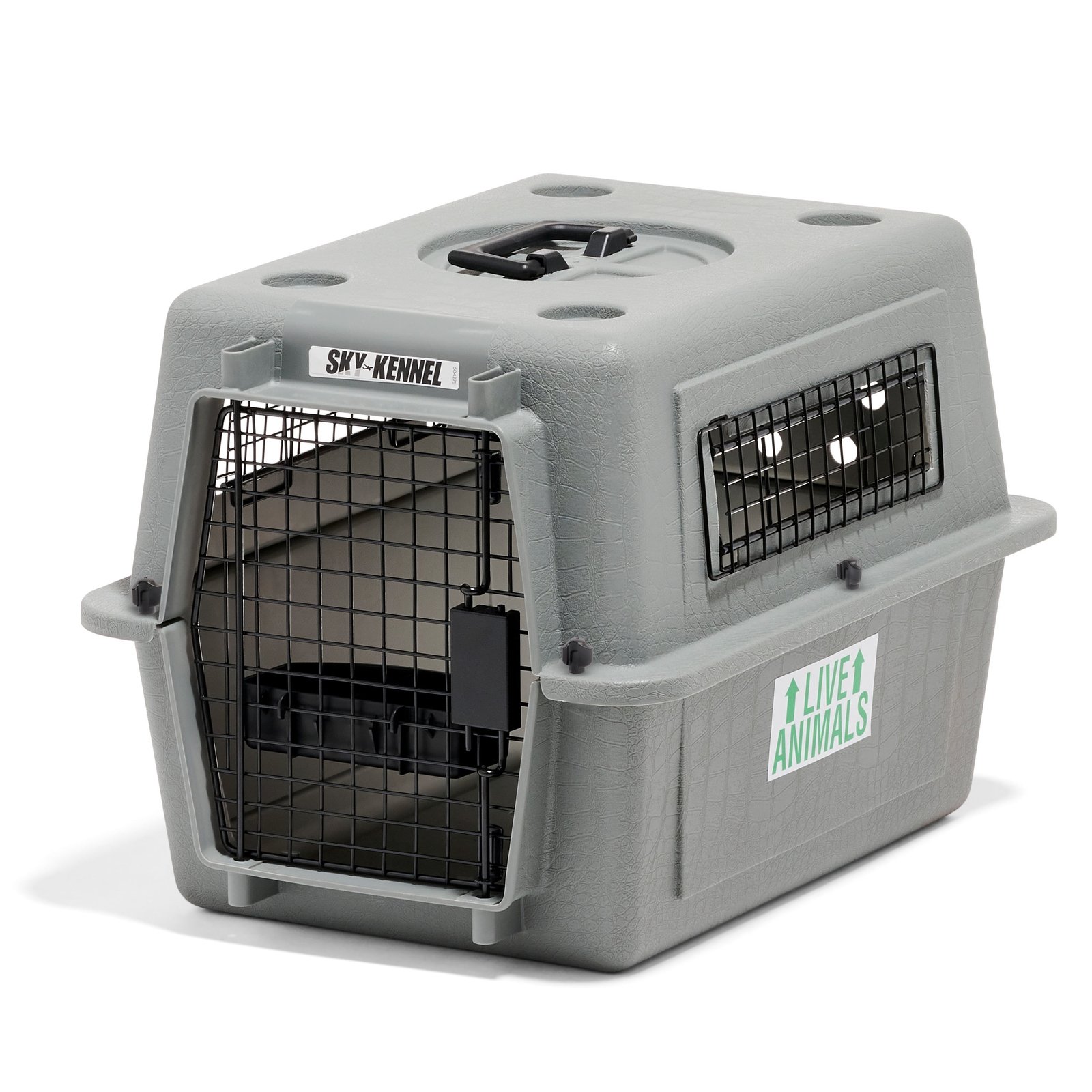
The Sky Kennel is the default answer for cargo travel because it ships ready: two “Live Animal” stickers, a clip-on water bowl, and a shell built to IATA-style requirements with 360-degree ventilation and tie-down strap holes. The 21-inch size fits dogs up to 15 pounds — Chihuahuas, Yorkies, small Shih Tzus. Petmate builds these in the USA and the design hasn’t changed much in a decade, which for a safety container is a feature, not a complaint.
The real recurring owner complaint is the hardware: the included wing nuts are plastic, and many airlines — Alaska included — require metal. Owners routinely buy metal wing nuts at a hardware store for a few dollars and swap them. It’s a cheap fix, but budget for it before flight day. The twist-lock door latch needs two hands, and escape artists can work a twist latch given enough flight time, so this isn’t the kennel for a determined Houdini.
Key specs: 21″ L x 16″ W x 15″ H · Polypropylene shell · 360-degree ventilation · Wire door with twist-lock latch · Made in USA · For pets up to 15 lbs
Pros:
- Built to IATA-style requirements — the reference design most cargo agents know
- Ships with fly-ready extras: Live Animal stickers and a clip-on water bowl
- 360-degree ventilation keeps air moving in a stacked cargo hold
- Tie-down strap holes for anchoring the kennel in place
Cons:
- Plastic wing nuts — plan to swap for metal; some airlines require it
- Two-hand twist latch is awkward and not escape-proof against determined dogs
- 15-lb ceiling is small; measure your dog, don’t guess
- Chewers can work the plastic door frame over long holds — plastic is chew-resistant, not chew-proof
Verdict: The cargo-travel standard for tiny dogs. Swap the hardware, confirm your airline’s rules, and it’s the least likely kennel to get a second look at the counter.
2. Petmate Pet Porter 24″ (up to 20 lbs)
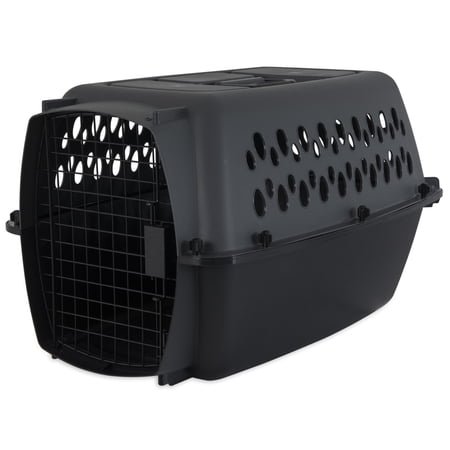
The Pet Porter is Petmate’s other cargo workhorse — the same rigid-plastic philosophy as the Sky Kennel, with its own round-hole ventilation pattern and a wire door behind an easy-open latch. The 24-inch size steps up to 20 pounds, covering French bulldog puppies, Cavalier King Charles spaniels, and the bigger end of “small.” Petmate says it meets most airline cargo specifications; note the word most, because cargo acceptance still varies by airline and by station, and some stations interpret ventilation and hardware rules strictly.
The shell halves bolt together, and some owners use the metal screw hardware for extra security — a habit worth copying for cargo flights. The fold-down carry handle makes the terminal walk easier, and the “stay-dry moat” around the floor pulls liquid away from the dog on long holds. We found no verified complaint pattern for this listing at research time.
Key specs: 24.1″ L x 16.7″ W x 14.5″ H · Rigid plastic shell · Wire door · Four-sided ventilation · Fold-down handle · For pets up to 20 lbs
Pros:
- 20-lb capacity covers the larger small breeds the Sky Kennel 21 can’t
- Four-sided ventilation — no dead corners in the hold
- Bolted shell halves add real structural security for cargo
- Stay-dry floor design handles accidents on long holds
Cons:
- “Meets most airline cargo specifications” — verify your airline’s exact rules anyway
- Wire door is ventilated but less privacy for anxious dogs than solid doors
- Weighs more than the soft carriers below — cargo weight counts toward checked fees
Verdict: The bigger-small-dog cargo pick. If your dog is over 15 pounds, this is where the cargo list starts.
3. SportPet Designs Collapsible Small Kennel 24″ (up to 25 lbs)
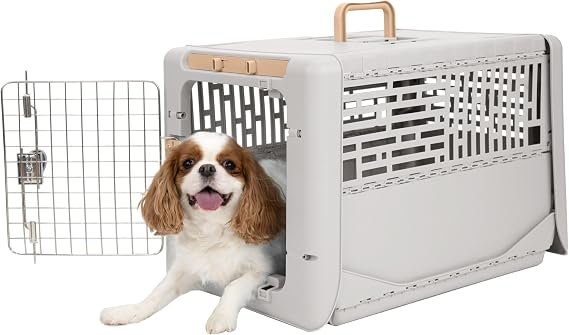
The SportPet collapsible kennel answers a different question: what if the kennel itself needs to disappear when you’re not traveling? The tan plastic panels fold flat, the twist-lock metal gate opens from the front, and the slat sides give good ventilation and visibility. At 24.5 inches long with a 25-pound rating, it covers most small dogs, and it lives happily in a trunk, an office, or a hotel room.
Here’s the honesty: this is not a flight kennel. Collapsible kennels generally fail IATA cargo rigidity requirements, and at 16 inches tall it won’t fit under most airline seats either — most under-seat spaces cap around 10–11 inches. It’s included in this review because “kennel” searches bring it up, and it deserves an honest placement: car, vet, and hotel duty, where it genuinely earns its keep. The brand also has a thinner track record than Petmate, so we state that rather than gloss over it.
Key specs: 24.5″ L x 16.5″ W x 16″ H · Collapsible hard plastic · Twist-lock metal gate · Slat ventilation · Folds flat · For pets up to 25 lbs
Pros:
- Folds flat — the easiest kennel here to store between trips
- 25-lb capacity is generous for a “small” kennel
- Metal gate latch is more reassuring than plastic twist locks
- Good visibility through the slats keeps anxious dogs calmer
Cons:
- Not cargo-acceptable — collapsible kennels fail IATA rigidity requirements
- 16 inches tall is too tall for under-seat in-cabin travel
- Thinner brand track record; no verified complaint pattern we could confirm
Verdict: The best kennel here for the 95% of travel that isn’t flying. Just don’t book a cargo slot for it.
4. Sleepypod Air in-Cabin Pet Carrier, Jet Black (up to 17.5 lbs)
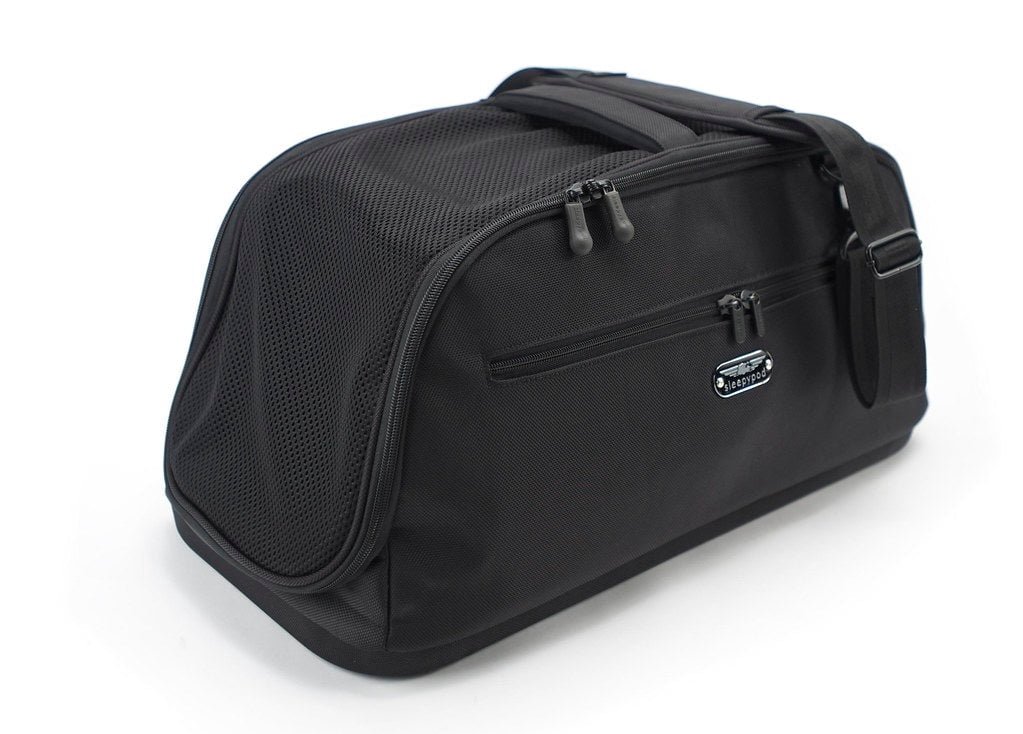
The Sleepypod Air is engineered for the exact moment other carriers fail: boarding. It compresses from 22 inches down to 16 inches long and from 10.5 to 8 inches tall so it slides under tight airline seats, then expands once you’re cruising so your dog gets the bigger space for the rest of the flight. The luggage-grade nylon shell, Ultra Plush bedding, and padded shoulder strap are all cut above the commodity soft-carrier standard, and there’s a pass-through pocket for sliding it onto a rolling suitcase handle.
This is the only product in this lineup with independent crash-test certification: the Center for Pet Safety certified the Sleepypod Air in January 2025 (4-star). That matters for the car ride to the airport, not the flight — and it’s a meaningful distinction, because none of the hard kennels here are crash-tested for cars. The price is firmly premium, and 17.5 pounds is the ceiling, so large small-dogs age out of it.
Key specs: 22″ x 10.5″ x 10″ (compresses to 16″ x 10.5″ x 8″) · Luggage-grade nylon · Ultra Plush bedding · CPS certified (Jan 2025, 4-star) · For pets up to 17.5 lbs
Pros:
- Compresses for tight under-seats, expands for the flight — solves the boarding bottleneck
- The only CPS crash-tested product in this lineup — real car-travel safety data
- Luggage-handle pass-through for airport navigation
- Machine-washable bedding for the inevitable accident
Cons:
- Premium price — the most expensive pick here by a wide margin
- 17.5-lb ceiling; dogs near the limit should size up in concept, not squeeze in
- Soft walls won’t contain a determined chewer — zipper escapes are a real risk with the wrong dog
Verdict: The in-cabin gold standard for small dogs. If your dog flies with you, this is the one to measure against.
5. Sherpa Original Deluxe Travel Pet Carrier, Medium (up to 16 lbs)
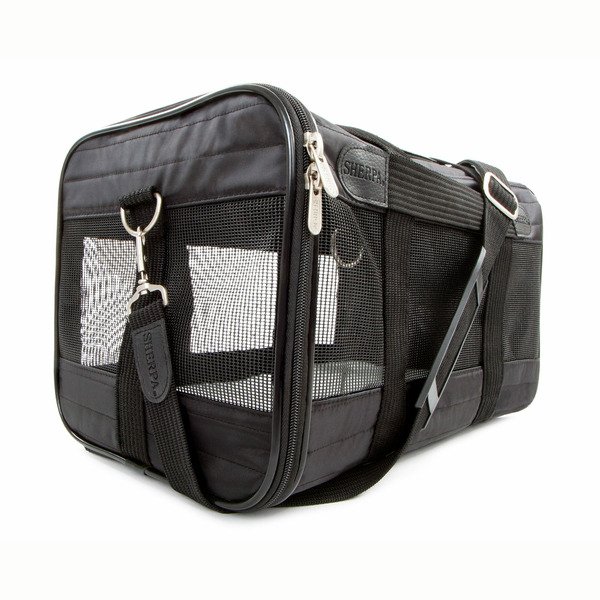
Sherpa’s Original Deluxe is the soft-carrier classic: a patented spring wire frame lets the rear of the carrier push down to conform to under-seat space, the mesh panels ventilate, the zippers lock, and a seat-belt security strap doubles as a luggage strap. At 17 by 11 by 10.5 inches and up to 16 pounds, the Medium fits most under-seats and most small dogs, and Sherpa backs the “airline approved” language with its Guaranteed On-Board program — which comes with denied-boarding conditions, so read the fine print rather than treating it as a boarding pass.
Mesh is this carrier’s strength and its weakness: great airflow and visibility, but a determined chewer will eat through it. Soft carriers and chew-prone dogs do not mix — if your dog destroys toys, pick hard plastic. We found no verified complaint pattern for this listing at research time.
Key specs: 17″ L x 11″ W x 10.5″ H · Spring wire frame · Mesh panels with locking zippers · Removable machine-washable liner · For pets up to 16 lbs
Pros:
- Spring frame conforms to under-seat dimensions on real aircraft
- Locking zippers close the most common soft-carrier escape route
- Guaranteed On-Board program adds real backing to the boarding claim
- Long-established design — gate agents have seen thousands of these
Cons:
- Mesh panels are chew-through for determined dogs — not for chewers
- 16-lb ceiling is tight for stocky small breeds
- The Guaranteed On-Board program has conditions; it isn’t automatic approval
Verdict: The sensible in-cabin soft carrier — proven, affordable relative to Sleepypod, and honest about what it is.
6. Amazon Basics 2-Door Top-Load Hard-Sided Carrier 22.8″ (up to 20 lbs)
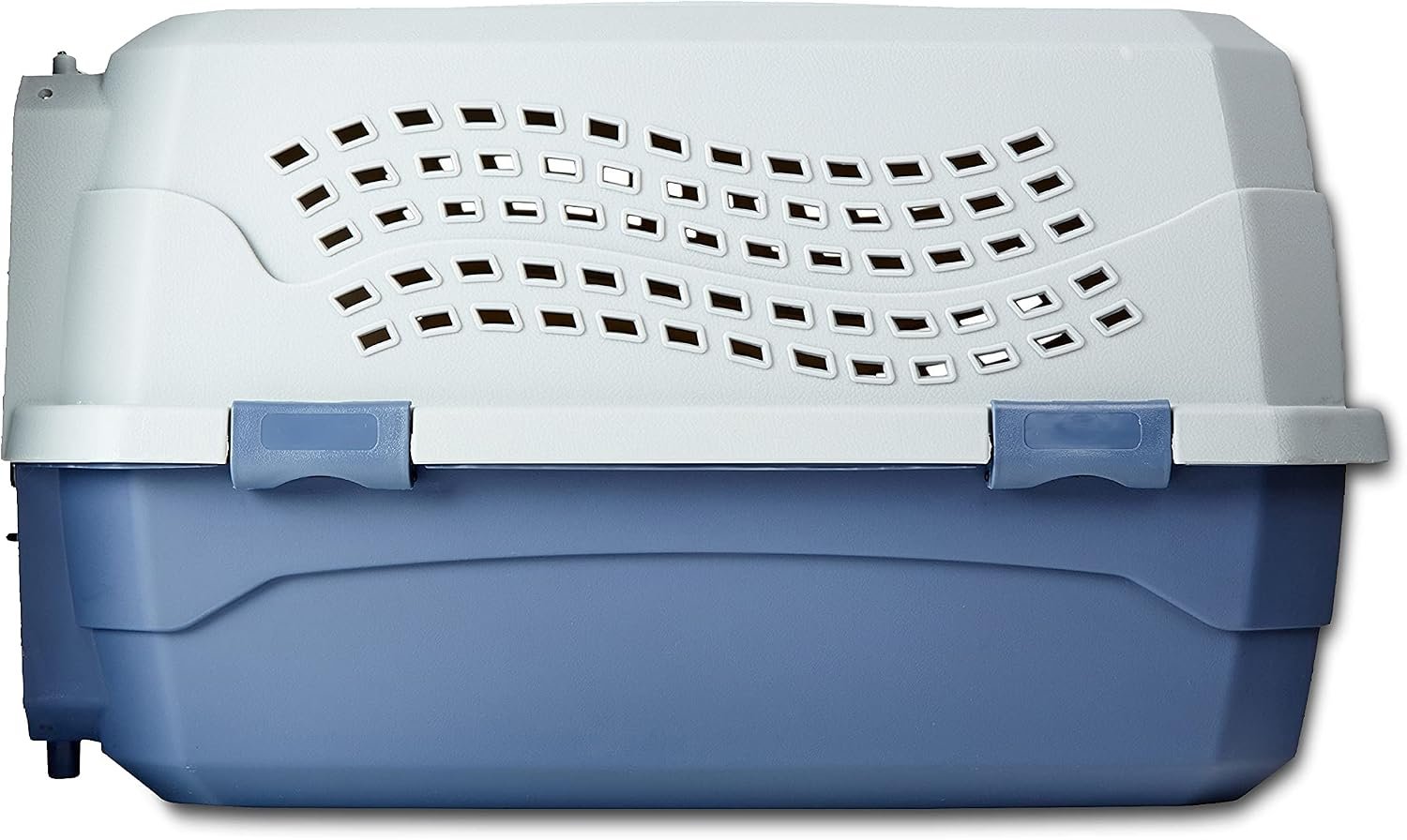
The Amazon Basics two-door is the budget hard carrier: 22.8 inches of gray-and-blue plastic with a steel-wire front door and a top-loading hatch that vets love — dropping a cat or small dog in from the top beats wrestling one through a front door. It includes metal screws to join the shell halves, which is more hardware than most budget carriers bother with, and the price is the lowest here.
It is not a flight carrier. At 13 inches tall and nearly 23 inches long it exceeds most under-seat limits, and real owners report the plastic isn’t sturdy enough for airline travel — one airline-savvy owner noted kennels for air travel need metal-capped screw hardware, zip-tie-able corners, and a single door, none of which this has. There’s also a genuine owner complaint pattern on this listing: the top door’s locking bar can shift when you lift the carrier by the top handle, letting the top door pop open — always check both doors after lifting. Its honest lane is car trips, vet visits, and around-town containment, where it’s a genuine bargain.
Key specs: 22.8″ L x 15″ W x 13″ H · Hard plastic two-door · Steel-wire front door · Metal screw hardware included · For pets up to 20 lbs
Pros:
- Top-load hatch makes vet visits dramatically easier
- Includes metal screws for the shell halves — rare at this price
- Steel-wire front door beats the flimsy plastic doors on cheaper carriers
- The cheapest hard carrier in this lineup
Cons:
- Verified owner pattern: top door can pop open when lifted by the handle — check after every lift
- Too tall and long for in-cabin under-seat travel; not cargo-rigid enough for the hold
- Wire front door strains under heavier dogs near the 20-lb limit
Verdict: The best value for everything that isn’t a flight. Keep it for the car and the vet; buy a different pick for the plane.
Checked cargo or in-cabin: pick your lane first
This is the decision that eliminates half the list. If your dog flies as checked cargo, you need a rigid hard kennel with bolted or metal hardware, ventilation on at least three sides (four is the norm), and a door that locks — that’s the Sky Kennel and the Pet Porter above. If your dog flies in the cabin, you need a soft carrier that fits your airline’s under-seat dimensions, full stop — that’s the Sleepypod and the Sherpa. Everything else here is for the car, the vet, and the hotel. Buying a hard kennel for an in-cabin trip, or a collapsible kennel for cargo, is how dogs get denied at the counter.
Measure the under-seat space, not the marketing
Under-seat dimensions vary by aircraft, not just by airline — a regional jet and a wide-body on the same airline have different seat boxes, and bulkhead rows are usually tighter. Find your aircraft’s under-seat dimensions, then buy a carrier that fits inside them with an inch to spare on each side. The Sleepypod’s compression and the Sherpa’s spring frame exist precisely because real seat boxes are smaller than brochures suggest. Soft carriers get a little forgiveness because they can squish; hard kennels get none.
Hardware, ventilation, and chew reality
For cargo kennels, the hardware is the safety system: replace plastic wing nuts with metal, use the included metal screws, and bring zip ties — many airlines require the door to be zip-tied shut at check-in. For ventilation, hard kennels need it on all sides because a stacked cargo hold has no airflow to spare; soft carriers need mesh that doesn’t block breathing when the carrier squishes under a seat. And the chew rule is absolute: plastic is chew-resistant, not chew-proof, and mesh is chewable. A dog that destroys toys needs hard plastic and a supervisor, never a soft carrier left unzipped in a hotel room.
What does “airline approved” actually mean on a kennel?
It means the manufacturer believes its kennel meets the general requirements airlines publish — rigid construction, ventilation, locking door. It is not a certification, and no manufacturer can guarantee your airline will accept a kennel on a specific flight. The airline’s published crate rules and the counter agent’s checklist are the only approvals that exist.
Should I use a hard kennel or a soft carrier for in-cabin travel?
Soft, almost always. Airlines require in-cabin pets to stay in a carrier that fits under the seat in front of you, and soft carriers can compress into tight seat boxes where rigid kennels cannot. Hard kennels are for checked cargo, where rigidity is the safety system.
Can I use these kennels in the car as crash protection?
No — none of the hard kennels in this lineup are crash-tested for cars, and saying so would be a lie. The Sleepypod Air is the single exception here: it holds a Center for Pet Safety certification (tested January 2025, 4-star). For the rest, secure the kennel in the car so it can’t become a projectile, but don’t confuse a cargo kennel with a crash-tested safety device.
Will my carrier fit under my airline’s seat?
Measure, don’t assume. Look up your airline’s maximum in-cabin carrier dimensions and — better — your specific aircraft’s under-seat box. A carrier that fits a 737 under-seat may not fit a regional jet’s. Leave an inch of slack; a soft carrier that bulges past the dimensions can still be denied.
Do I really need metal bolts on a cargo kennel?
Check your airline. Some require metal hardware explicitly, and the recurring owner complaint on the Sky Kennel is its plastic wing nuts. A few dollars of metal hardware from a hardware store is the cheapest travel insurance in this article — buy it when you buy the kennel, not at the airport.
How old does my puppy have to be to fly?
Most US airlines require puppies to be at least 8 weeks old for domestic flights, with proof of vaccination, and older for international travel. Breed and snub-nose restrictions apply separately — brachycephalic breeds face heavy cargo restrictions or outright bans on many airlines. Confirm age, vaccine, and breed rules with your airline before buying anything.
