

This article may contain affiliate links. If you buy through them, we may earn a commission at no extra cost to you. Learn more in our affiliate disclosure.
A kitten’s first travel is usually the first time anything about the trip goes wrong — a carrier that’s three sizes too big, a door the kitten shoulders open at the vet’s front desk, or a “kennel” bought for the plane that belongs in the cargo hold. Kittens are small, fast, and excellent at finding the one weakness in a container, so the kennel has to be the right size, the right type, and bought for the right trip. This article reviews six: hard kennels built for cargo and car travel, and soft carriers built for the cabin — each one labeled with the lane it belongs in.
The honesty rules are the same as every travel article we publish: “airline approved” is not a certification. No manufacturer can certify your kitten for your flight — the airline’s published crate rules and the counter agent’s checklist are the only approvals that exist. And nothing here is a substitute for a car restraint: no hard kennel in this lineup is crash-tested for cars, a point the one certified exception below makes by contrast.
| # | Product | Why it made the list | Check Price |
|---|---|---|---|
| 1 | Petmate Sky Kennel 21″ | IATA-style cargo kennel in the kitten-friendly 21-inch size | Check Price |
| 2 | Petmate Pet Porter 19″ | The kitten sweet spot: 19 inches, 10-lb ceiling, four-sided ventilation | Check Price |
| 3 | Petmate Top Load Cat Kennel 19″ | Vet-recommended top loading for kittens; designed as a cat kennel | Check Price |
| 4 | Sherpa Original Deluxe, Small | In-cabin classic in the small size, backed by Guaranteed On-Board | Check Price |
| 5 | Sleepypod Air, Jet Black | Compresses for tight under-seats; the only CPS crash-tested pick here | Check Price |
| 6 | Amazon Basics 2-Door Top-Load Carrier | Budget two-door with vet-friendly top hatch; car and vet duty | Check Price |
1. Petmate Sky Kennel 21″ (up to 15 lbs)
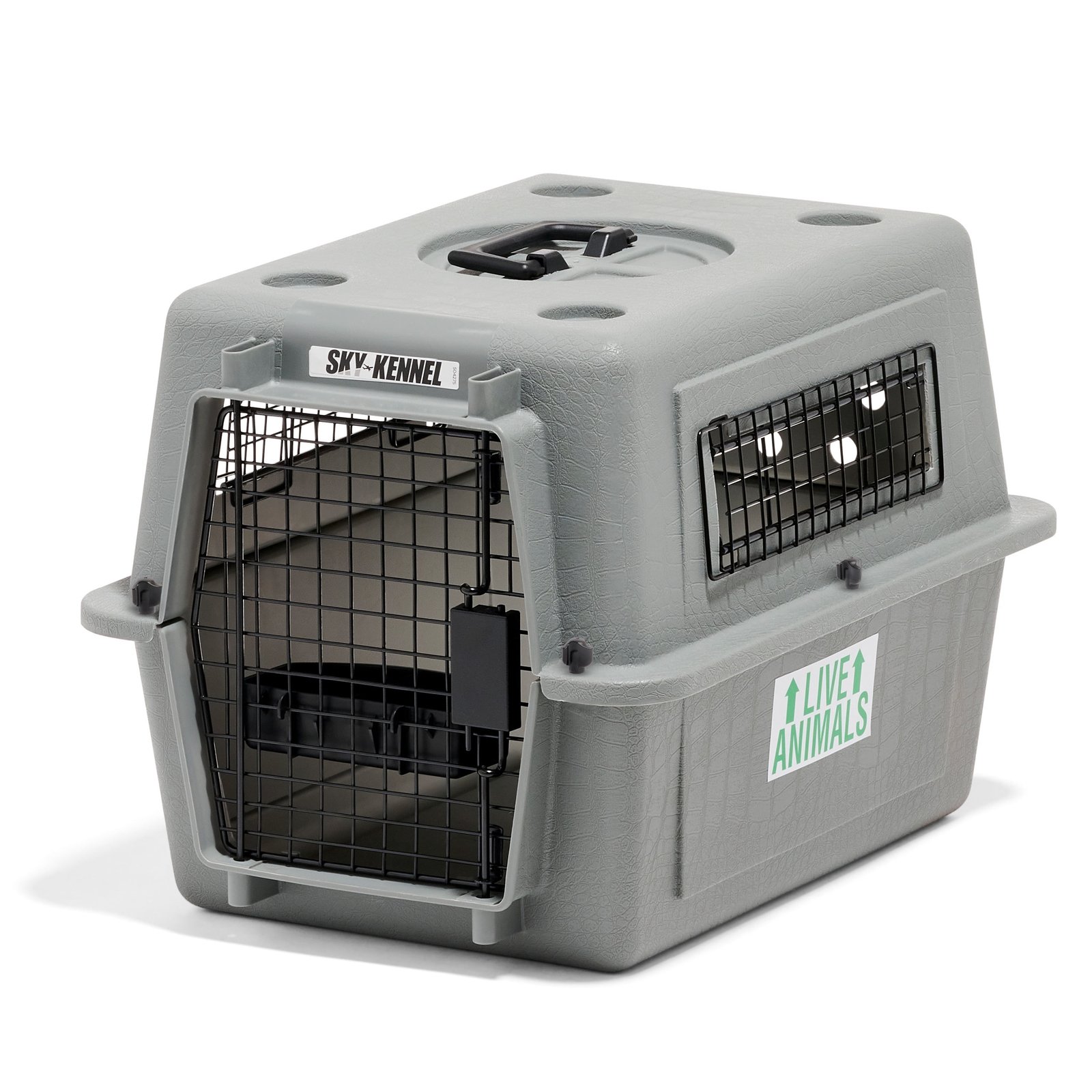
The Sky Kennel is the cargo-travel standard, and the 21-inch size is the kitten-eligible one: room for a kitten plus a folded blanket, without the cavernous emptiness of the larger sizes. It ships fly-ready — two “Live Animal” stickers, a clip-on water bowl — with a shell built to IATA-style requirements, 360-degree ventilation, and tie-down strap holes. Petmate builds these in the USA and the design has barely changed in a decade, which for a safety container is a feature.
The recurring owner complaint is the hardware: the included wing nuts are plastic, and some airlines (Alaska among them) require metal. Owners routinely swap in metal wing nuts from a hardware store for a few dollars — budget for that before flight day. The twist-lock door needs two hands, and this is not the kennel for a determined Houdini.
Key specs: 21″ L x 16″ W x 15″ H · Polypropylene shell · 360-degree ventilation · Wire door with twist-lock latch · Made in USA · For pets up to 15 lbs
Pros:
- Built to IATA-style requirements — the reference design cargo agents know
- Ships with fly-ready extras: Live Animal stickers and a clip-on water bowl
- 360-degree ventilation for a stacked cargo hold
- The 21-inch size suits kittens without wasting space
Cons:
- Plastic wing nuts — plan to swap for metal; some airlines require it
- Two-hand twist latch is awkward and not escape-proof against determined animals
- Cargo only — far too big and rigid for under-seat in-cabin travel
- Plastic is chew-resistant, not chew-proof, over long holds
Verdict: The cargo-travel standard in the right size for a kitten. Swap the hardware and confirm your airline’s rules before flight day.
2. Petmate Pet Porter 19″ (up to 10 lbs)
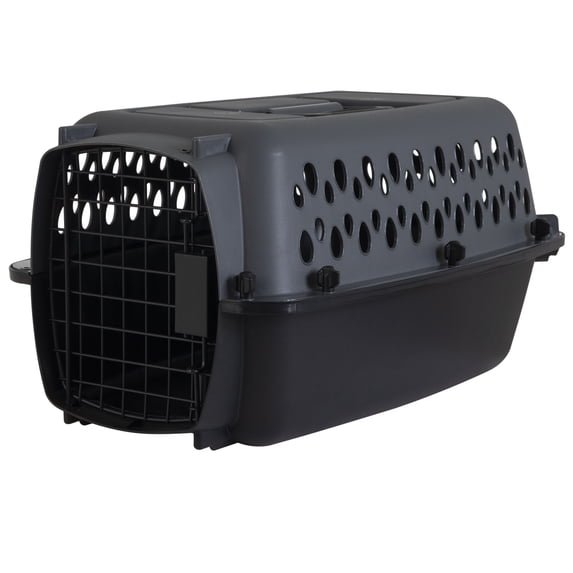
Nineteen inches is arguably the perfect kitten kennel size: a kitten can stand, turn, and stretch, and there’s no wasted volume. The Pet Porter 19 is Petmate’s other cargo workhorse — the same rigid-plastic philosophy as the Sky Kennel, with its own round-hole ventilation pattern on four sides and a wire door behind an easy-open latch. Petmate says it meets most airline cargo specifications; read the word most carefully, because acceptance still varies by airline and station. The stay-dry moat around the floor pulls liquid away from the kitten on long holds.
Key specs: 19″ L x 12.6″ W x 10″ H · Rigid plastic shell · Wire door · Four-sided ventilation · Fold-down carry handle · Made in USA · For pets up to 10 lbs
Pros:
- 19-inch size is the kitten sweet spot — snug without being cramped
- Four-sided ventilation — no dead corners in the hold
- Stay-dry floor design handles accidents on long holds
- Light enough to carry one-handed through the terminal
Cons:
- “Meets most airline cargo specifications” — verify your airline’s exact rules anyway
- We found no verified complaint pattern for this listing at research time
- 10-lb ceiling means larger kittens age out of it quickly
Verdict: The best-sized hard kennel here for an actual kitten. If your kitten flies cargo, start with this one.
3. Petmate Top Load Cat Kennel 19″ (up to 10 lbs)
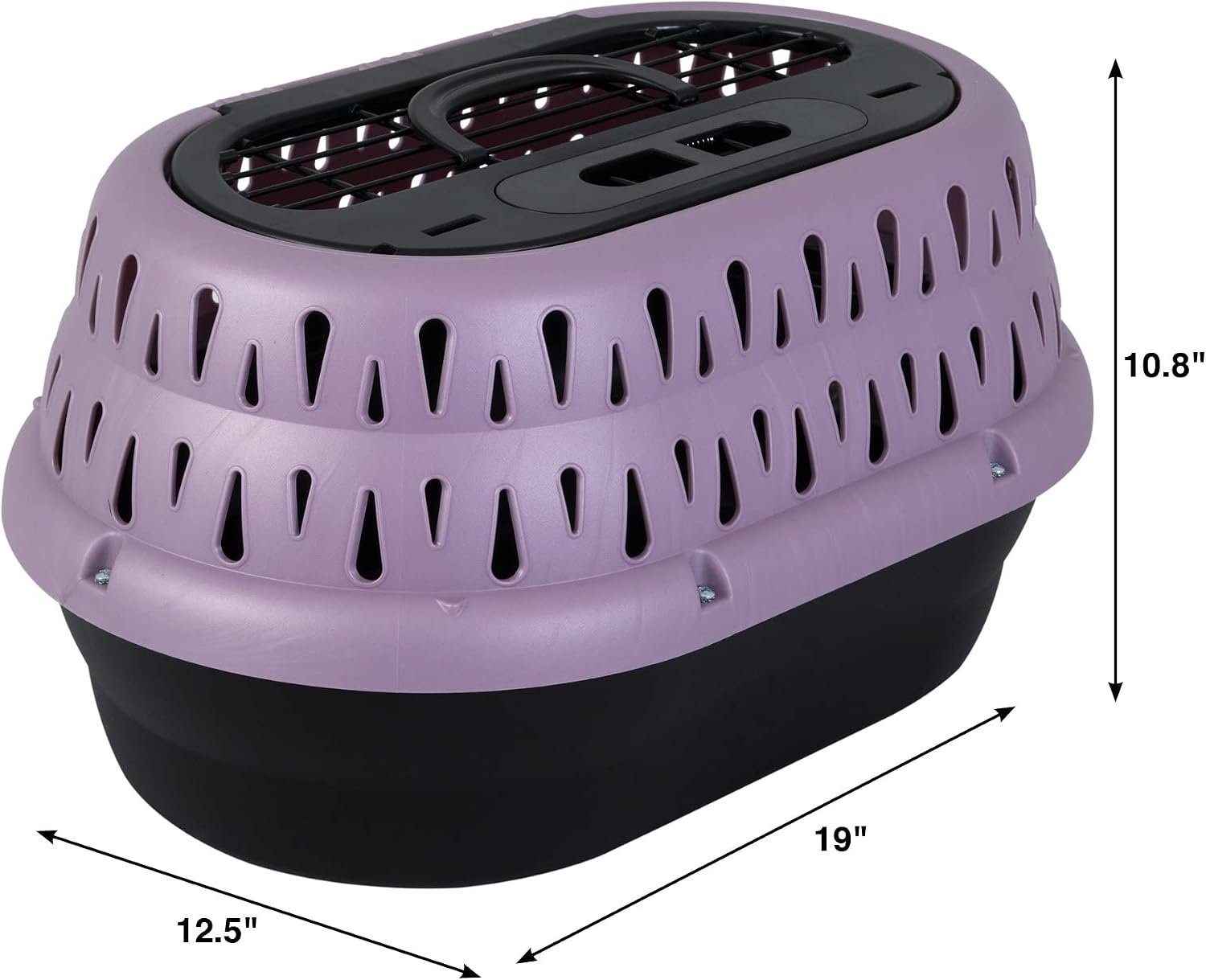
This is the one designed for cats specifically. The top-load design is veterinarian recommended: you lower the kitten in through the top door instead of wrestling it through a front gate, which is how vet visits stop being fights. The 19-inch shell suits cats and kittens up to 10 lbs, with ventilation all around, a stay-dry moat, and a fold-down carry handle. It also meets most airline cargo specs on paper — but the single top-door format and lighter construction mean most owners use it for car and vet duty, which is honestly its best lane.
Key specs: 19″ L x 12.5″ W x 10.8″ H · Top-loading door with easy-squeeze latch · 360-degree ventilation · Stay-dry moat · Made in USA · For pets up to 10 lbs
Pros:
- Top loading is genuinely the least stressful way to load a kitten
- Designed as a cat kennel, not a dog kennel shrunk down
- 360-degree ventilation and a stay-dry floor
- Light and easy to carry with one hand
Cons:
- Single top door only — no front door for a second loading option
- We found no verified complaint pattern for this listing at research time — newer model, thinner owner history
- Not the first choice for checked-cargo flights; car and vet are its lanes
Verdict: The kitten-first kennel for the 95% of travel that isn’t flying. For vet runs and car trips, the top hatch earns its price alone.
4. Sherpa Original Deluxe, Small (up to 8 lbs)
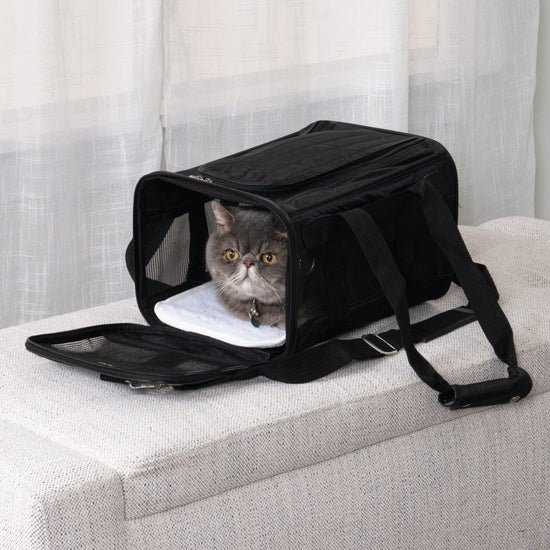
The Sherpa Original Deluxe is the in-cabin classic, and the Small size is the kitten one: 15 by 10 by 8.5 inches, a patented spring-wire frame that presses down a couple of inches to slide under seats, locking zippers, mesh ventilation panels, and a washable faux-lambskin liner. Sherpa backs the “airline approved” language with its Guaranteed On-Board program, which covers the Small and Medium sizes — with denied-boarding conditions, so read the fine print rather than treating it as a boarding pass.
The honest limit is the weight: 8 lbs is a kitten weight, not a cat weight. Most adult cats will size out of the Small. Buy it for the kitten you have now, knowing you may hand it down later — or buy the Medium if you want one carrier for the adult cat too.
Key specs: 15″ L x 10″ W x 8.5″ H · Up to 8 lbs · Patented spring wire frame · Locking zippers · Mesh panels · Washable faux lambskin liner · Guaranteed On-Board program (Small covered)
Pros:
- Spring frame compresses under seats without collapsing — the real article
- Locking zippers close the most common soft-carrier escape route
- Guaranteed On-Board program backs the boarding claim with conditions
- Kitten-sized footprint that actually fits tight under-seats
Cons:
- 8-lb ceiling — most adult cats will outgrow it; measure honestly
- Mesh panels are chew-through for determined kittens — claws and teeth will find them
- No expansion; what you buy is the space you get
Verdict: The safest in-cabin bet for a kitten right now. Just go in knowing the 8-lb limit is a real ceiling, not a suggestion.
5. Sleepypod Air, Jet Black (up to 17.5 lbs)
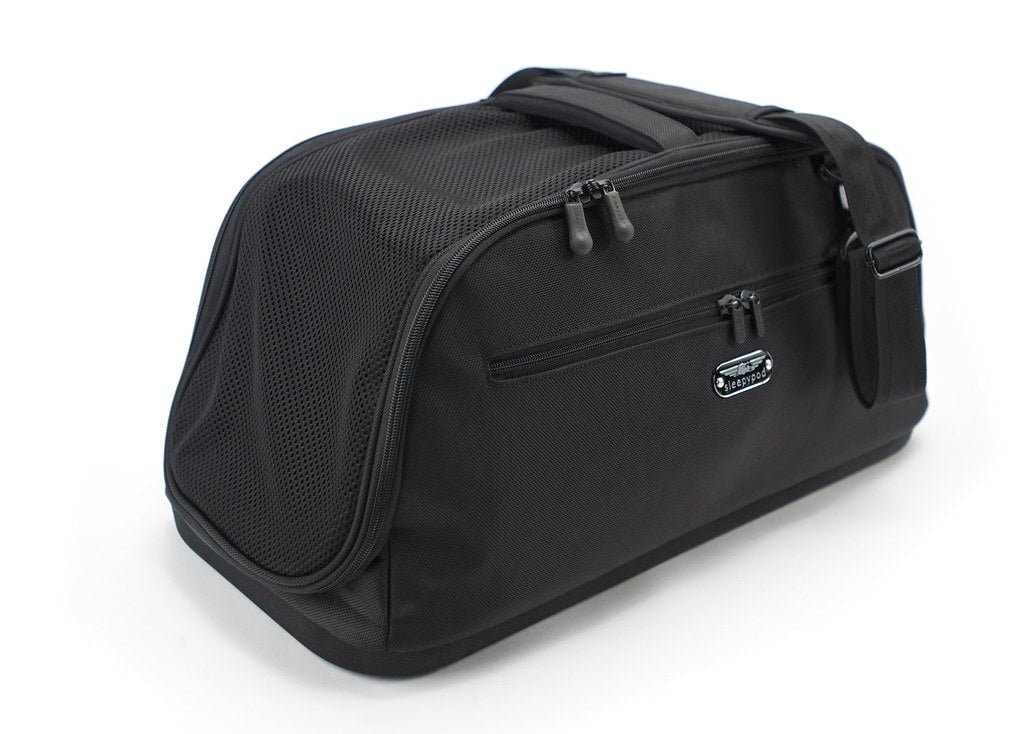
The Sleepypod Air is engineered for the exact moment other carriers fail: boarding. It compresses from 22 inches down to 16 inches long and from 10.5 to 8 inches tall so it slides under tight airline seats, then expands once you’re cruising so the kitten gets the bigger space for the rest of the flight. Luggage-grade nylon, Ultra Plush bedding, a padded shoulder strap, and a pass-through pocket for rolling suitcase handles — all cut above the commodity soft-carrier standard.
This is the only product in this lineup with independent crash-test certification: the Center for Pet Safety certified the Sleepypod Air in January 2025 (4-star). That matters for the car ride to the airport, not the flight — and it’s a meaningful distinction, because none of the hard kennels here are crash-tested for cars. The price is firmly premium, and for a kitten, you’re buying years of future-proofing: the 17.5-lb ceiling covers the adult cat too.
Key specs: 22″ x 10.5″ x 10″ (compresses to 16″ x 10.5″ x 8″) · Luggage-grade nylon · Ultra Plush bedding · CPS certified (Jan 2025, 4-star) · For pets up to 17.5 lbs
Pros:
- Compresses for tight under-seats, expands for the flight — solves boarding
- The only CPS crash-tested product in this lineup — real car-travel safety data
- 17.5-lb ceiling means the kitten won’t outgrow it
- Luggage-handle pass-through for airport navigation
Cons:
- Premium price — the most expensive pick here by a wide margin
- Soft walls won’t contain a determined chewer — zipper escapes are a real risk
- Oversized for a tiny kitten right now; you’re buying for the future
Verdict: The in-cabin gold standard, and the only pick with car crash-test data. Expensive, but it’s the last carrier you’ll need to buy for the flight.
6. Amazon Basics 2-Door Top-Load Hard-Sided Carrier 22.8″ (up to 20 lbs)
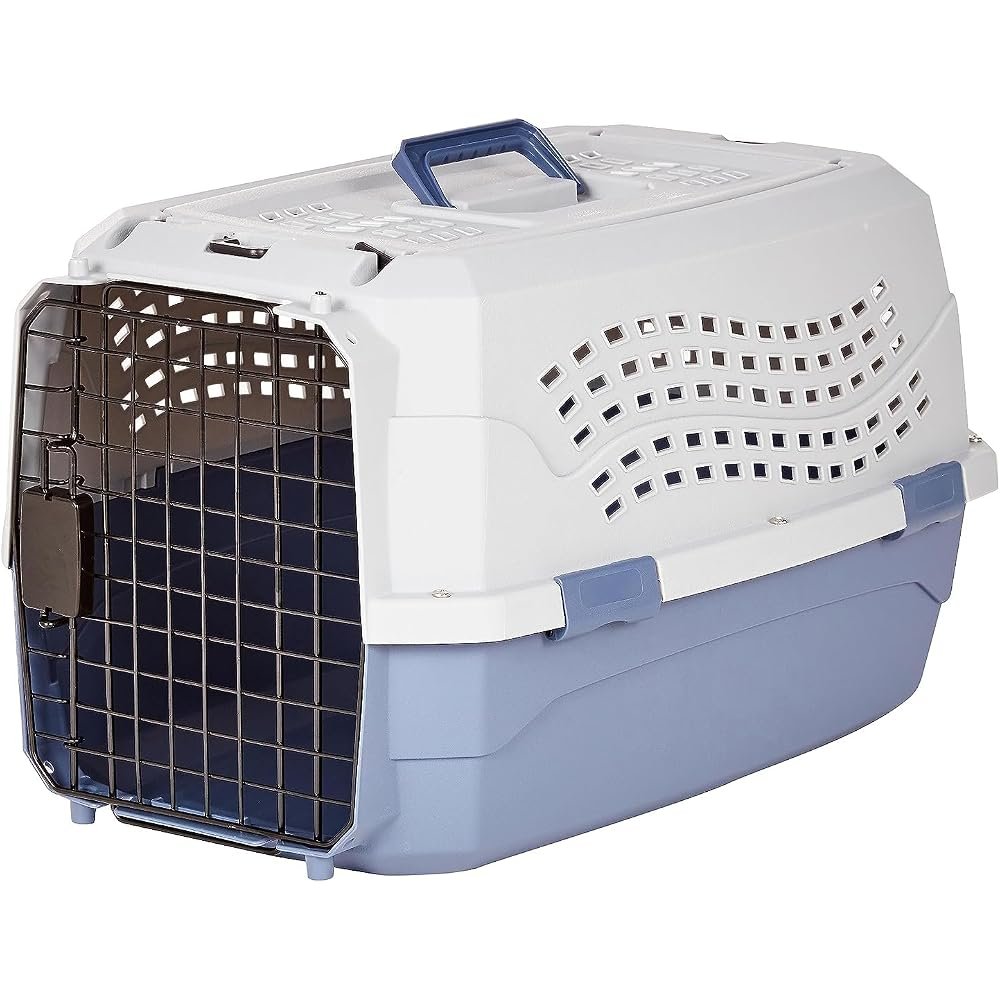
The budget two-door: 22.8 inches of gray-and-blue plastic with a steel-wire front door and a top-loading hatch that vets love — dropping a squirming kitten in from the top beats wrestling one through a front door. It includes metal screws to join the shell halves, which is more hardware than most budget carriers bother with, and the price is the lowest here.
It is not a flight carrier. At 13 inches tall and nearly 23 inches long it exceeds most under-seat limits, and real owners report the plastic isn’t sturdy enough for airline travel. There’s also a genuine owner complaint pattern on this listing: the top door’s locking bar can shift when you lift the carrier by the top handle, letting the top door pop open — always check both doors after lifting. Its honest lane is car trips, vet visits, and around-town containment, where it’s a genuine bargain.
Key specs: 22.8″ L x 15″ W x 13″ H · Hard plastic two-door · Steel-wire front door · Metal screw hardware included · For pets up to 20 lbs
Pros:
- Top-load hatch makes vet visits dramatically easier
- Includes metal screws for the shell halves — rare at this price
- Steel-wire front door beats the flimsy plastic doors on cheaper carriers
- The cheapest hard carrier in this lineup
Cons:
- Verified owner pattern: top door can pop open when lifted by the handle — check after every lift
- Too tall and long for in-cabin under-seat travel; not cargo-rigid enough for the hold
- Wire front door strains under heavier animals near the 20-lb limit
Verdict: The best value for everything that isn’t a flight. Keep it for the car and the vet; buy a different pick for the plane.
Cargo, cabin, or car: pick your lane first
This is the decision that eliminates half the list. If your kitten flies as checked cargo, you need a rigid hard kennel with bolted or metal hardware and ventilation on at least three sides (four is the norm) — that’s the Sky Kennel and the Pet Porter 19 above. If your kitten flies in the cabin, you need a soft carrier that fits your airline’s under-seat dimensions, full stop — that’s the Sherpa Small and the Sleepypod. Everything else here is for the car, the vet, and the hotel. Buying a hard kennel for an in-cabin trip, or a collapsible kennel for cargo, is how kittens get denied at the counter.
Size for the kitten you have, then for the cat they’ll become
Kittens grow fast, and carrier sizing punishes both directions. Too big, and a 3-pound kitten slides around a hard kennel in turbulence; too small, and the adult cat you get in a year can’t turn around. The practical answer: buy for the trip you’re actually taking. If the kitten flies next month, the 19-inch Pet Porter and the Sherpa Small are the right sizes now. If the kitten only rides to the vet, the top-load Petmate or the Amazon Basics two-door is all you need — and when the cat’s grown, the Sleepypod is still waiting. Don’t buy a 24-inch kennel “to grow into” for a kitten that’s flying tomorrow.
Hardware, ventilation, and the chew/claw reality
For cargo kennels, the hardware is the safety system: replace plastic wing nuts with metal, use the included metal screws, and bring zip ties — many airlines require the door to be zip-tied shut at check-in. Ventilation needs to be on all sides of a hard kennel because a stacked cargo hold has no airflow to spare; soft carriers need mesh that doesn’t block breathing when the carrier squishes under a seat. And the claw rule is absolute: kitten claws are needle-sharp, plastic is chew-resistant but not chew-proof, and mesh is chewable. A kitten that shreds scratching posts will eventually find the weak panel — inspect mesh and zippers after every trip.
What does “airline approved” actually mean on a kennel?
It means the manufacturer believes its kennel meets the general requirements airlines publish — rigid construction, ventilation, locking door. It is not a certification, and no manufacturer can guarantee your airline will accept a kennel on a specific flight. The airline’s published crate rules and the counter agent’s checklist are the only approvals that exist.
Should my kitten fly cargo or in the cabin?
In the cabin, whenever the airline allows it — most US airlines accept kittens as in-cabin pets, and the soft carriers above (Sherpa Small, Sleepypod Air) are built for it. Cargo is the fallback for kittens that exceed in-cabin size limits or fly routes that don’t allow cabin pets. Never put a kitten in cargo without checking the airline’s minimum-age and vaccination rules first — most require at least 8 weeks and proof of vaccination.
Can I use these kennels in the car as crash protection?
No — none of the hard kennels in this lineup are crash-tested for cars, and saying so would be a lie. The Sleepypod Air is the single exception here: it holds a Center for Pet Safety certification (tested January 2025, 4-star). For the rest, secure the kennel in the car so it can’t become a projectile, but don’t confuse a cargo kennel with a crash-tested safety device.
How do I keep a kitten calm in a kennel?
Make the kennel furniture before travel day: leave it open in the living room with treats and a worn shirt inside for a week. On travel day, load the kitten feet-first or through the top hatch, add a familiar-smelling blanket, and keep the kennel covered with a light cloth during the flight — most kittens settle faster when they can’t see the chaos. Don’t introduce the kennel for the first time at the airport.
Will a kitten fit in the Sherpa Small as it grows?
Only for a while. The Small is rated to 8 lbs and measures 15 by 10 by 8.5 inches — perfect for a kitten, tight for most adult cats. If your kitten is already 6 lbs and growing, size up to the Medium now rather than buying twice. The Sleepypod’s 17.5-lb ceiling is the buy-once option for owners who want the carrier to last.
How old does a kitten have to be to fly?
Most US airlines require kittens to be at least 8 weeks old for domestic flights, with proof of vaccination, and older for international travel. Some airlines and destinations have additional health-certificate requirements. Confirm age, vaccine, and paperwork rules with your airline before buying anything — the kennel matters less than the paperwork.
