

Disclosure: As an Amazon Associate, we earn from qualifying purchases made through links on this page. It costs you nothing and keeps our reviews honest and independent.
Read this first, because the whole dog-car-harness market depends on you not reading it: a seatbelt harness is a RESTRAINT, not crash protection, unless an independent lab says otherwise. Almost every harness listing on Amazon uses words like “crash tested” or “crash safe.” Those words have no legal meaning when a brand applies them to itself. A company can slam-test its own product in its own facility, watch it not break, and print “crash tested” on the box. Unless the claim is tied to a named laboratory and a named standard — or better, an independent certification — it is marketing.
As far as we can establish from manufacturer statements and independent reviewers, exactly one harness brand in this category holds genuine third-party certification: Sleepypod’s Clickit Sport, certified with a 5-star safety rating by the Center for Pet Safety (CPS), an independent nonprofit. Every other claim on this page is the brand’s own testing story, and we label each one as such. We also correct one widespread myth below: the Ruffwear Load Up is NOT CPS certified, no matter how many review sites say otherwise. Ruffwear’s own testing page says so plainly.
That does not make uncertified harnesses useless. A $25 harness that keeps your dog off your lap and out of the front seat does real, valuable work — it prevents the driver-distraction crashes that kill dogs and people every day. Just buy it for restraint, not for crash protection it was never independently proven to provide. Six options below, ordered from the one genuinely certified harness down through solid brand-tested picks to budget restraint kits. We did not crash-test anything ourselves; nobody outside a lab with a sled rig can.
| # | Product | Why It Made the List | Check Price |
|---|---|---|---|
| 1 | Sleepypod Clickit Sport Plus | The only CPS-certified harness (brand claim, independently corroborated) | Check Price |
| 2 | Kurgo Enhanced Strength Tru-Fit Dog Car Harness | Mainstream bestseller; “crash tested” is the brand’s own claim | Check Price |
| 3 | EzyDog Drive Dog Car Harness | Brand claims FMVSS-213 testing; dead-simple seat belt loop design | Check Price |
| 4 | Ruffwear Load Up Dog Car Harness | MGA-tested restraint, honestly NOT CPS certified; strength-rated hardware | No verified Amazon listing |
| 5 | Blueberry Pet Pastel Colored Reflective Dog Harness with Seatbelt Clip | Budget walking vest with a car restraint clip | Check Price |
| 6 | SlowTon Dog Seat Belt Harness for Car | Budget car-first kit: harness + bungee tether in one box | Check Price |
1. Sleepypod Clickit Sport Plus
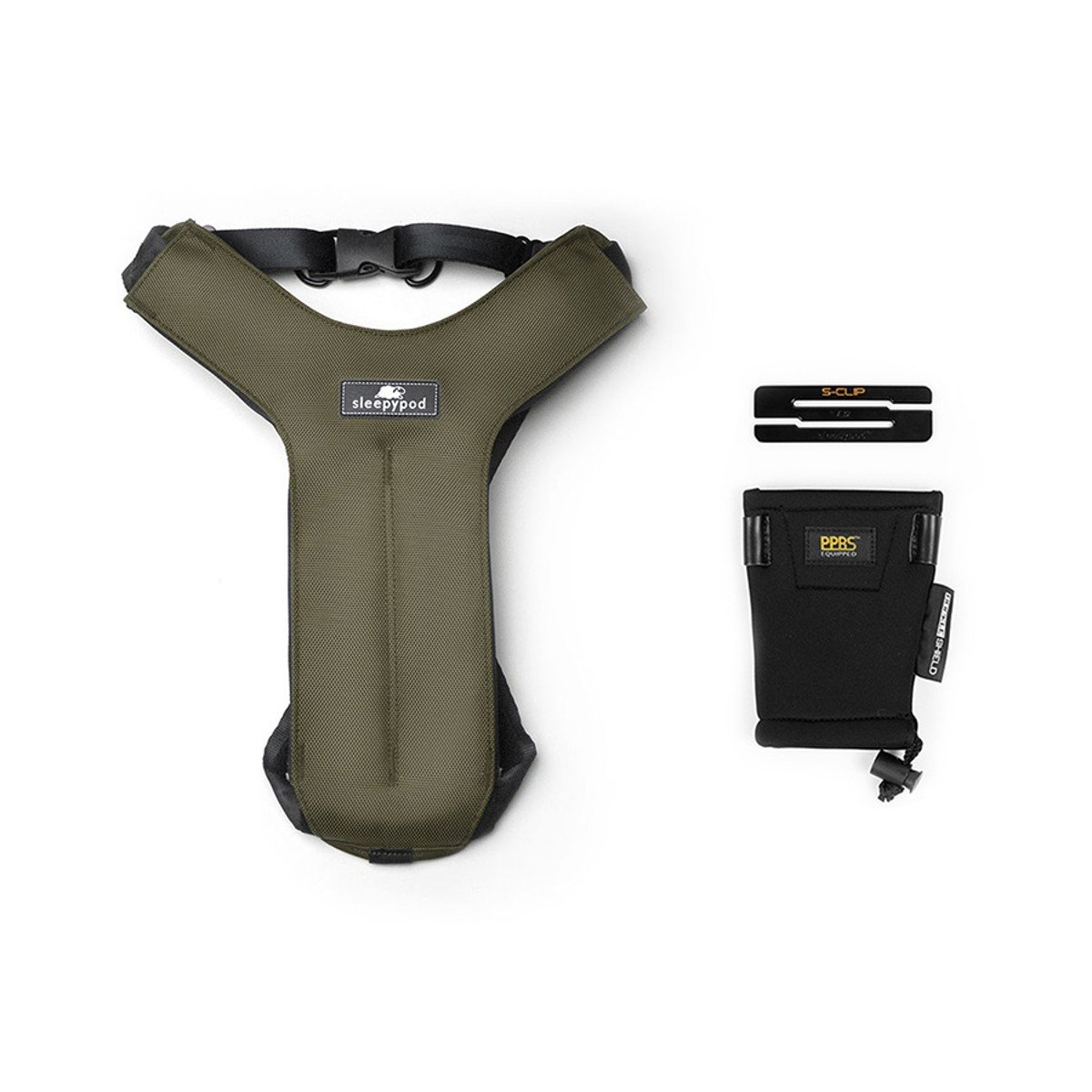
This is the only harness on the list with genuine third-party safety certification, and that is the whole argument. Sleepypod states the Clickit Sport was crash-tested to U.S., Canadian, and E.U. child-safety-restraint standards and then independently tested and certified with a 5-star safety rating by the Center for Pet Safety — and unlike most brand claims, this one checks out: an independent reviewer (the Whole Dog Journal) confirms that only Sleepypod’s harnesses carry CPS approval. The engineering behind it is the patented Infinity Loop system: three webbing loops the car’s own seat belt threads through, spreading crash forces across a broad padded neoprene vest instead of concentrating them at a single clip point. No separate tether to buy, lose, or connect wrong.
The practical honesty, though: this is a premium product in every sense, including fussiness. The sizing runs by exact chest measurement (16.5 inches up to 40 inches across four sizes), and the harness only works if you measure the dog and set all the adjusters before the first drive. It also doubles as a walking harness via leash D-rings at the neck, with reflective strips front and back. If crash protection is the actual buying reason rather than just restraint, this is the only pick on this page that an independent lab has verified — and that is worth knowing plainly.
Specifications
- Size reviewed: Medium (22.5–28 inch chest), Olive Green
- Certification: Center for Pet Safety 5-star certified, per brand claim; independently corroborated
- Design: Patented Infinity Loop three-point webbing; car seat belt threads through the loops
- Material: Neoprene vest with automotive-grade strength-tested webbing
- Sizes: S, M, L, XL (16.5–40 inch chest, measured behind the front legs)
- Extras: Doubles as walking harness; reflective strips; hand wash only
Pros and Cons
Pros: The only independently certified crash harness in the category. Seat belt threads directly through — no separate tether. Doubles as a walking harness, so it gets used daily, not just on trips.
Cons: Premium pricing tier. Fitting is exacting; measure carefully and adjust everything before the first drive. The vest runs warm — heavy-coated dogs will feel it in summer.
Verdict
The only choice if you want verified crash protection rather than restraint alone. Check the price on Amazon.
2. Kurgo Enhanced Strength Tru-Fit Dog Car Harness

The Tru-Fit is the mainstream default in this category for a reason: five adjustment points, steel nesting buckles, a padded chest plate, and Kurgo’s lifetime warranty when bought from an authorized seller. The Amazon listing carries the phrase “Crash Test Certified Fit,” and we want to be precise about what that is: Kurgo’s brand claim, not an independent certification. We found no Center for Pet Safety certification for this harness. Treat it as a well-built, widely owned restraint with documented brand testing behind it — which is a reasonable thing to buy, as long as you are buying it for what it actually is.
The design reality is mainstream, too. This is a webbing harness, not a padded vest, so it relies on you getting the five adjusters dialed in; a loosely fitted webbing harness is both a chafing machine and an escape hatch, and that is the category pattern to watch here, not a brand-specific flaw. Steel buckles are the meaningful upgrade over the plastic hardware on budget picks — hardware is where cheap harnesses fail first. This ASIN lists the harness alone, so confirm exactly what attachment method comes in the box before you order and make sure you know how it connects to your car’s seat belt on day one.
Specifications
- Size reviewed: Medium, Black
- Certification claim: “Crash Test Certified Fit” per listing — brand claim; no CPS certification found
- Adjustment: Five-point adjustment
- Hardware: Steel nesting buckles; padded chest plate
- Weight: 12.8 ounces
- Warranty: Lifetime, when purchased from an authorized seller
- Care: Hand wash only
Pros and Cons
Pros: Five adjustment points for a genuinely custom fit. Steel buckles instead of plastic. Lifetime warranty. The most-reviewed mainstream pick in the category.
Cons: “Crash Test Certified Fit” is the brand’s claim, not independent certification. Webbing design demands careful fitting — loose fit means chafing and escape. Confirm the included attachment method before ordering.
Verdict
The sensible mainstream pick: well-built restraint hardware with an honest label once you strip the marketing. Check the price on Amazon.
3. EzyDog Drive Dog Car Harness
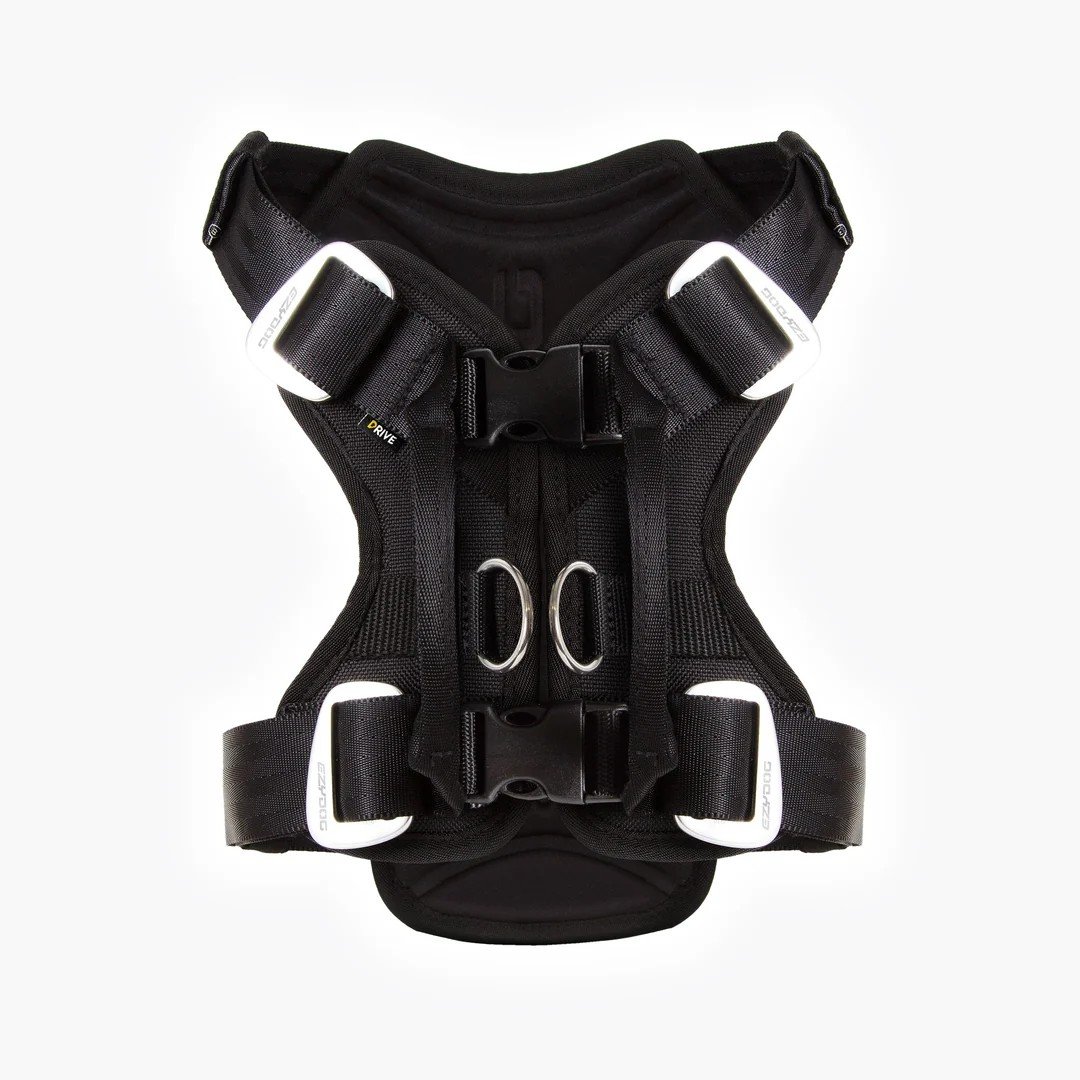
The EzyDog Drive is the simplest attachment concept in the category: the car’s own seat belt feeds through both webbing handles on top of the harness and clicks into the car’s buckle. Nothing extra to buy, nothing extra to lose, and the connection logic is obvious the first time you see it. The listing title claims “Crash Tested and Certified (US-FMVSS 213)” — again, brand language, and we should be honest about the standard: FMVSS 213 is the U.S. standard for human child restraints. Testing a dog harness to its conditions is a meaningful brand effort; calling it “certified” stretches the word, since no federal standard certifies pet products, and there is no CPS certification here.
Two practical notes from the listing details. The Medium weighs a full 16 ounces — this is a substantial harness, not a featherweight vest, and thick-coated or heat-sensitive dogs will notice. And unlike most picks here, the Drive’s own comparison chart shows no reflective trim, so night visibility is not built in. What you are buying is a straightforward, heavy-duty restraint with dual buckles and a grab handle, from a brand whose car line has been around for years. For owners who want the car’s seat belt to be the restraint rather than a separate strap system, this is the cleanest version of that idea.
Specifications
- Size reviewed: Medium, Black
- Certification claim: “Crash Tested and Certified (US-FMVSS 213)” per listing — brand claim; FMVSS 213 is a human child-restraint standard; no CPS certification found
- Attachment: Vehicle seat belt feeds through both webbing handles, buckles into the car’s seat belt buckle
- Closure: Dual SR buckle system; grab handle included
- Weight: 16 ounces (1 pound)
- Sizes: S, M, L
- Visibility: No reflective trim
- Breed guidance: Medium to large breeds
Pros and Cons
Pros: Simplest attachment concept — the car’s own seat belt is the restraint. Heavy-duty build with dual buckles and a grab handle. No separate tether to manage.
Cons: “Certified (US-FMVSS 213)” is brand language; no independent pet-product certification exists here. Heavy at 16 ounces. No reflective trim for night visibility.
Verdict
Best for owners who want the seat belt itself to be the restraint, with no extra hardware in the system. Check the price on Amazon.
4. Ruffwear Load Up Dog Car Harness
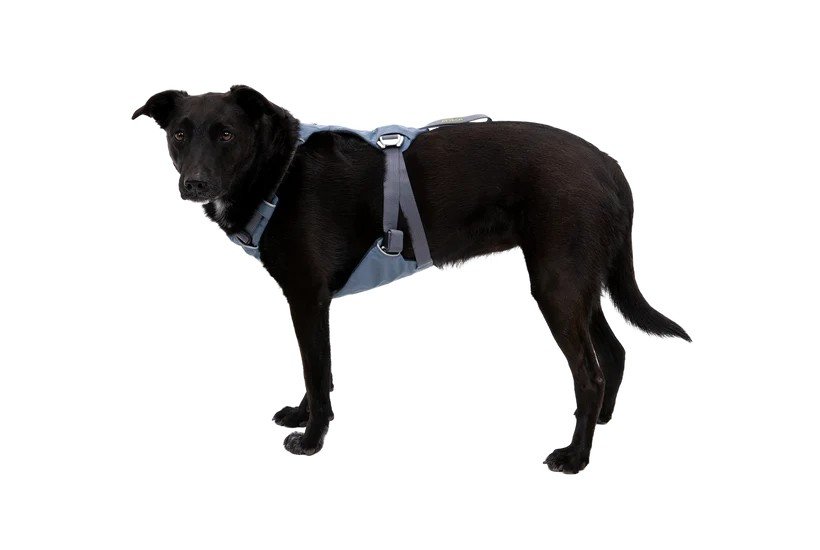
This section exists partly to correct the record. A surprising number of review sites describe the Ruffwear Load Up as “certified by the Center for Pet Safety.” It is not, and Ruffwear says so on its own testing page. Here is what the brand actually documents: the Load Up was dynamically crash-tested by MGA Research under the conditions of FMVSS 213 with 25-, 45-, and 75-pound dog mannequins, and the mannequins stayed upright on the seat. Ruffwear further states that the harness was not tested against CPS’s protocol and that, based on its results, it would not meet CPS’s current certification — specifically the limits on how far forward the dog travels in a test. That is unusually candid for a pet brand, and it is why the Load Up deserves a spot on this list despite the missing listing verification: this is the brand that told on itself.
The harness itself is a vehicle-only restraint — Ruffwear’s own chart lists “Vehicle Only,” not a walking harness — with a padded chest plate, four adjustment points, strength-rated metal hardware, and a universal attachment the car’s seat belt threads through. The honest framing: this is a well-documented, independently lab-tested restraint that falls short of CPS certification by the brand’s own admission. If your standard is “the manufacturer tested it in a real lab and published what happened,” the Load Up is one of the better-documented entries in the category. Note that we could not verify an Amazon listing for this product in search, so there is no price button below; buy it from Ruffwear or an authorized retailer and confirm sizing there.
Specifications
- Testing: Dynamically tested by MGA Research under FMVSS 213 conditions (25/45/75-lb mannequins); NOT CPS certified, per Ruffwear’s own page
- Use: Vehicle travel only — not a walking harness
- Design: Padded chest plate; car’s seat belt threads through the universal attachment
- Adjustment: Four adjustment points
- Hardware: Strength-rated metal hardware
- Sizes: Five sizes, roughly 13–42 inch chests
Pros and Cons
Pros: Independently lab-tested with published results. The brand publicly states its CPS status instead of hiding it. Strength-rated metal hardware; padded chest plate.
Cons: Not CPS certified — do not buy it believing otherwise. Vehicle-only; you still need a separate walking harness. No verified Amazon listing found, so no price button here.
Verdict
The best-documented uncertified restraint in the category — but treat it as restraint, and buy from the brand or an authorized retailer.
5. Blueberry Pet Pastel Colored Reflective Dog Harness with Seatbelt Clip
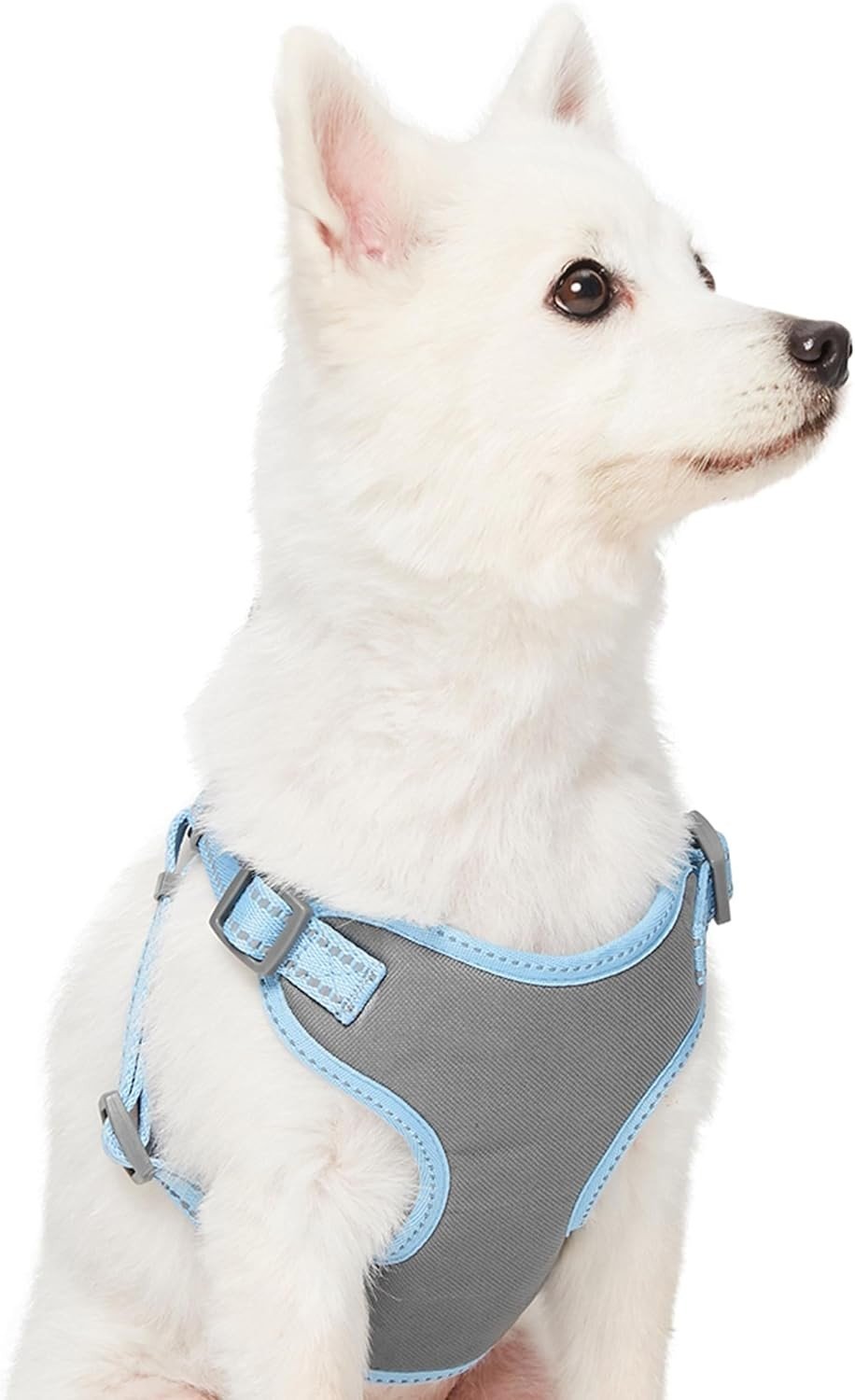
File this one under restraint, honestly priced as such. The Blueberry Pet is a walking vest first — adjustable no-pull design with reflective strips — and it carries a seatbelt clip that connects the dog to the car. It makes zero crash claims, and that is precisely its virtue: nothing here pretends to be a safety device. At 7 ounces it is the lightest option on this list, which matters for small dogs and for any dog that needs to wear the harness for hours, in the car and out of it.
The trade-off is hardware honesty. A clip is not a restraint system. The seatbelt clip keeps a small dog from roaming the car during normal driving and sudden stops, but it is not doing what the Sleepypod’s Infinity Loop or even the Kurgo’s webbing-and-steel system does. Buy this if you want one harness for walks and short car rides, with the dog contained rather than secured; do not buy it believing a clip equals crash protection. For a small dog that rides quietly in the back seat, that is a legitimate and common use case.
Specifications
- Size reviewed: Small, Baby Blue
- Crash claims: None — restraint only
- Design: No-pull walking vest with seatbelt clip for car connection
- Material: Polyester; reflective strips
- Weight: 7 ounces
- Care: Wipe clean
Pros and Cons
Pros: No false crash claims — honest product positioning. Lightest pick at 7 ounces. One harness for walks and car rides. Reflective strips included.
Cons: A clip is not a restraint system; containment only. Not a substitute for a crash-engineered harness. Walking-vest design, not car-first.
Verdict
The honest budget pick for small dogs that ride quietly: containment, not crash protection. Check the price on Amazon.
6. SlowTon Dog Seat Belt Harness for Car
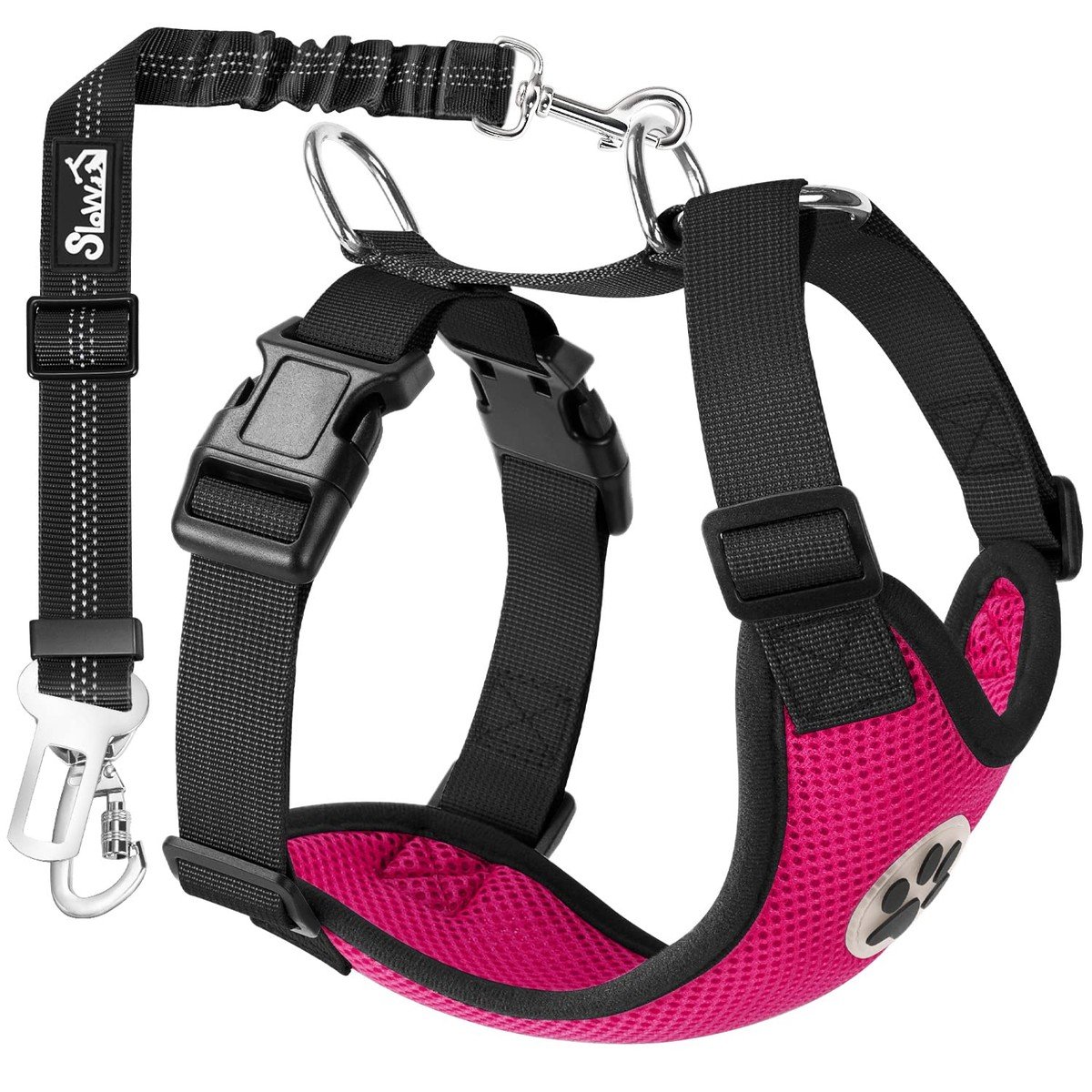
The SlowTon is the category’s budget car-first kit: an adjustable mesh harness with a separate seat belt tether that uses an elastic bungee section to soften the jerk of sudden stops. The tether clips to the harness’s back strap and anchors to either the car’s seat belt buckle or the latch bar via a carabiner — two attachment options, which solves the real-world problem of seat belt receivers that don’t accept third-party plugs. The listing makes no crash-test claims at all, and the article treats it accordingly: this is a restraint kit, priced like one.
The category patterns apply most visibly here. A tether long enough to let the dog lie down is also long enough to let the dog into the front seat — measure the tether against your car’s back-seat depth before assuming it keeps the dog in the back. Mesh vests chafe at the elbows if fitted loosely, so use the listing’s own two-finger rule and re-check the four straps after the first week of wear, because webbing stretches and buckles creep. The listing suggests small to medium breeds; respect that, since the tether and hardware are not sized for a large dog’s momentum. One year of warranty is included, which is more than most budget picks offer.
Specifications
- Size reviewed: Medium, Fuchsia
- Crash claims: None — restraint only
- Kit: 2-in-1: adjustable harness (4 straps, double clip) + seat belt tether with elastic bungee
- Tether attachment: Carabiner to the latch bar or the car seat belt buckle
- Material: Nylon mesh
- Weight: 8.8 ounces
- Fit guidance: Measure neck and chest; two-finger rule; size up between sizes
- Warranty: 1 year
- Breed guidance: Small to medium breeds, per listing
Pros and Cons
Pros: Complete car-restraint kit in one box. Bungee section softens sudden stops. Two anchor options (buckle or latch bar). One-year warranty is generous at this price.
Cons: No crash-test claims of any kind — restraint only. Tether length can still let a determined dog reach the front seat. Mesh can chafe if fitted loosely; webbing needs re-tightening.
Verdict
The cheapest way to do car restraint properly for a small or medium dog — with honest expectations. Check the price on Amazon.
Buying Guide: Reading Dog Seatbelt Harnesses Without Getting Fooled
Restraint is not crash protection
Every harness on this page restrains a dog. Only one carries independent certification that it protects in a crash. The distinction matters because the words overlap in marketing: “crash tested,” “crash safe,” “travel safety harness.” Ask two questions of every claim. Who ran the test — the brand or an independent lab? And tested against what — a named standard, or the brand’s own idea of a test? If the listing can’t answer both, you are buying restraint. Restraint is worth buying. Just don’t pay crash-protection money for it.
Learn the certification vocabulary
There is exactly one independent pet-safety certifier that matters in this category: the Center for Pet Safety, a nonprofit that publishes its test protocol and certifies products against it. Sleepypod’s Clickit harnesses hold CPS certification — verified by an independent reviewer, not just the brand. “FMVSS 213” is the U.S. standard for human child restraints; brands that test to its conditions (EzyDog, Ruffwear’s lab) are doing something real, but FMVSS 213 does not certify pet products, and “tested to” is not “certified by.” And anything a brand says about its own crash testing is a brand claim until an independent lab repeats it.
Fit decides everything
A harness that fits loosely fails at both jobs. Loose webbing chafes the elbows and armpits on long drives. Loose shoulder straps let a dog back out of the harness — in the car, that means a loose dog in a moving vehicle. The universal rule from the listings themselves: two fingers between strap and dog, no more, and re-check after the first week because webbing stretches and buckles creep. Measure the chest behind the front legs, and if the dog falls between sizes, size up; a harness you can tighten down is useful, one you can’t expand is a return.
Tether length is a safety feature, not a convenience
The most common complaint pattern in this category is the tether that’s too long: the dog can reach the front seat, the driver’s lap, or out an open window. Before buying, measure your car’s back-seat depth and compare it to the tether length. The dog should be able to sit, lie down, and turn around — and nothing more. If the tether lets the dog reach you while you drive, it is a distraction device, not a safety device.
How it connects to your car matters more than the harness brand
There are three connection styles on this list, and each has a failure mode. Seat-belt-through designs (Sleepypod, EzyDog, Ruffwear) use the car’s own belt — strong, but the dog can step on the buckle release. Buckle-plug tethers (SlowTon) plug into the seat belt receiver — convenient, but receiver sizes vary and some don’t accept third-party plugs, which is why latch-bar anchors exist. Harness clips (Blueberry Pet) are the simplest and the weakest. Whatever you buy, test the connection in the driveway before the first highway drive.
Never attach the restraint to the collar
In a sudden stop, a collar attachment concentrates the full force of a moving dog on its neck. Every harness here connects at the chest or back for a reason: force spreads across the torso. If your current setup clips a seat belt to the collar, change it before the next drive. This is the single most important rule in this guide.
Frequently Asked Questions
Are dog seatbelt harnesses crash tested?
Some are — but “crash tested” usually means the brand tested its own product. The only harnesses with independent third-party certification are Sleepypod’s Clickit models, certified with a 5-star safety rating by the Center for Pet Safety, an independent nonprofit. Everything else on the market is restraint until an independent lab says otherwise.
Is the Ruffwear Load Up CPS certified?
No, and this is the most misreported fact in the category. Ruffwear’s own testing page states the Load Up was dynamically tested by MGA Research under FMVSS 213 conditions but was not tested against the Center for Pet Safety’s protocol, and that it would not meet CPS’s current certification limits. It is a lab-tested restraint, not a certified crash harness.
Can I just use my dog’s regular walking harness in the car?
For restraint, yes, with a proper seat belt connection — a walking harness plus a seat belt loop or tether keeps a calm dog contained during normal driving. For crash protection, no: walking harnesses have plastic buckles and untested load paths, and were never engineered for impact forces. The Blueberry Pet entry on this list is essentially this approach in one box.
How tight should a dog seatbelt harness be?
Two fingers between strap and dog, no more. Looser and the dog backs out or the straps chafe; tighter and you restrict breathing. Re-check the fit after the first week of wear — webbing stretches and buckles loosen — and every time you dress the dog after that.
Where should my dog ride in the car?
The back seat, secured to a seat belt. Never the front seat with an active airbag — a deploying airbag can kill a dog. Never loose in the car, where the dog can reach the pedals or become a projectile. Never in an open truck bed.
How long should the tether be?
Long enough for the dog to sit, lie down, and turn around — and no longer. Measure your back-seat depth against the tether length before buying. A tether that lets the dog reach the front seat or the driver is a distraction device, not a safety device, and defeats the purpose of the harness.
