

Here’s the SUV owner’s version of the problem: your dog rides in the cargo area behind the rear seats, and every stoplight is an invitation to vault the seatback and land in your lap — or worse, on a kid in the second row. An SUV’s cargo space is bigger, taller, and more tempting to a dog than a sedan’s back seat, which means generic back-seat barriers often come up short. Literally: they’re too short and too narrow for the job.
The honest note most roundups skip: SUV barriers are a different product than car barriers. You’re usually mounting behind the rear headrests to wall off the cargo area, not behind the front seats — the space is wider (often 55–60″), taller, and the barrier takes more abuse from a dog with a running start. This guide covers six barriers built for that job — adjustable-width metal and wire-mesh gates sized for cargo areas — with the complaints owners actually report: side gaps, fiddly assembly, straps that need retightening, and heights that athletic dogs can still clear.
Pet Travel Items is reader-supported. When you buy through links on this page, we may earn a commission at no extra cost to you. Our picks are driven by documented owner feedback, never by commission rates.
Best Dog Barriers for SUVs at a Glance
| # | Product | Key Spec | Best For | |
|---|---|---|---|---|
| 1 | Magshion Adjustable Dog Barrier | 34–60″ W · 30–50″ H | Best for large cargo areas | Check Price |
| 2 | rabbitgoo Dog Car Barrier for SUVs | 35.8–59.8″ W · steel wire mesh | Best value | Check Price |
| 3 | MBR&MBS Dog Barrier for SUVs | Extends to 61.3″ · side panels | Best adjustable gate | Check Price |
| 4 | Bushwhacker Cargo Area Dog Barrier | 46″ x 21″ · metal tube frame | Best for CUVs / mid-size SUVs | Check Price |
| 5 | Zookeeper Vehicle Pet Barrier | Metal tube · 42–61″ wide | Best that moves with seats | Check Price |
| 6 | CASIMR Dog Car Barrier | 38–61.9″ W · triple-folding | Best folding design | Check Price |
Prices shift constantly — check before you buy. SUV interiors vary: measure your cargo width and height before ordering.
1. Magshion Adjustable Dog Barrier — Best for Large Cargo Areas
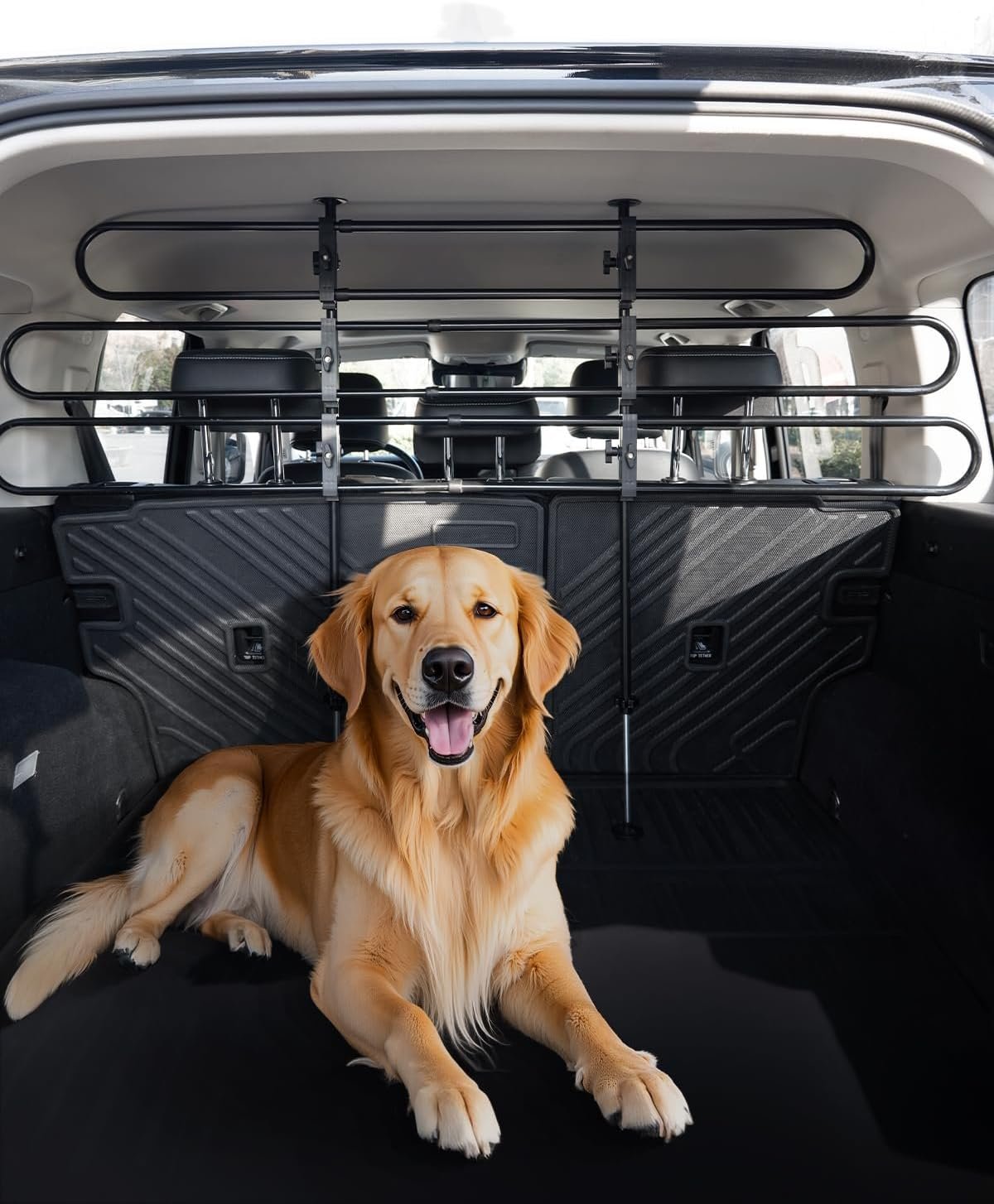
The Magshion is built for the biggest cargo spaces: it adjusts from 34″ to 60″ wide and 30″ to 50″ tall, which covers full-size SUVs that narrower barriers can’t span. The strong metal tubing construction handles large, pushy dogs, installation needs no tools, and it ranked #27 in Dog Car Barriers on Amazon — respectable in a crowded category. If your SUV’s cargo area is cavernous, start here; most competitors top out narrower.
The honest complaints: it’s heavy at 11.6 lbs, so it’s a semi-permanent install rather than something you pop in and out. Assembly with the extension sections is a two-person job the first time. And metal tube barriers rattle on rough roads — a strip of foam tape on contact points is the owner-approved fix. As with all tube barriers, small dogs can exploit side gaps.
Specs: adjustable 34–60″ wide, 30–50″ tall · strong metal tubing · 11.6 lbs · tool-free install · #27 in Dog Car Barriers.
Pros: spans the widest cargo areas; tall enough to deter most jumpers; sturdy metal build; no tools needed.
Cons: heavy — not a quick in-and-out barrier; two-person first assembly; can rattle on rough roads; side gaps for small dogs.
Verdict: The big-SUV answer — if others are too narrow, this one fits. Check the price on Amazon.
2. rabbitgoo Dog Car Barrier for SUVs — Best Value
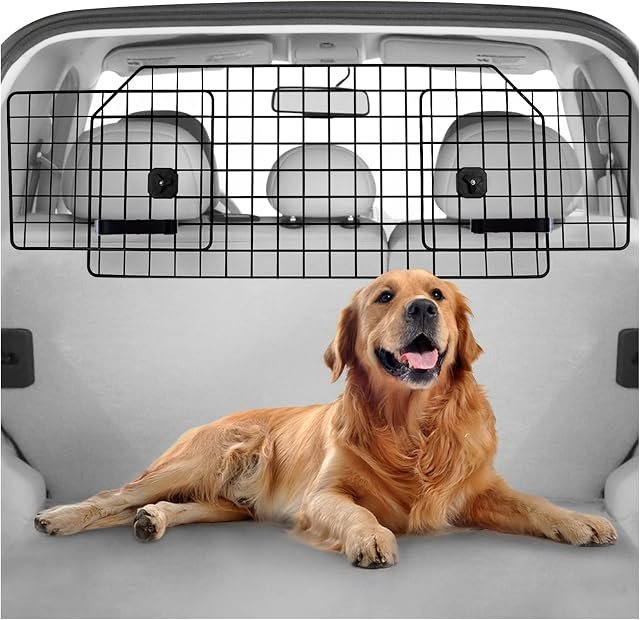
rabbitgoo’s barrier is the value sweet spot: a heavy-duty steel wire-mesh gate that adjusts from 35.8″ to 59.8″ wide, with a main folding panel plus two side panels, mounting to the rear headrests with thick nylon straps and metal grips. The triple-folding design collapses to a compact 17″ x 12″ x 2.3″ for storage — genuinely trunk-friendly. The see-through mesh keeps your rear visibility intact, and the smooth steel surface won’t scratch your interior.
The honest complaints: strap-mounted barriers live or die by strap tension, and owners report needing to retighten periodically — especially with dogs that lean on it. The side panels attach with nuts, screws, and plates rather than tool-free fittings, so assembly takes longer than the listing suggests. And a very determined large dog can flex wire mesh over time; it’s sturdy, not indestructible.
Specs: steel wire mesh · adjusts 35.8–59.8″ wide · main panel + 2 side panels · triple-folds to 17″ x 12″ x 2.3″ · rear-headrest strap mounts.
Pros: excellent width range for the price; folds compact; see-through mesh preserves visibility; smooth, scratch-free steel.
Cons: straps need periodic retightening; side-panel assembly is fiddly; determined dogs can flex the mesh.
Verdict: The value pick — most of the Magshion’s coverage for less money and less weight. Check the price on Amazon.
3. MBR&MBS Dog Barrier for SUVs — Best Adjustable Gate
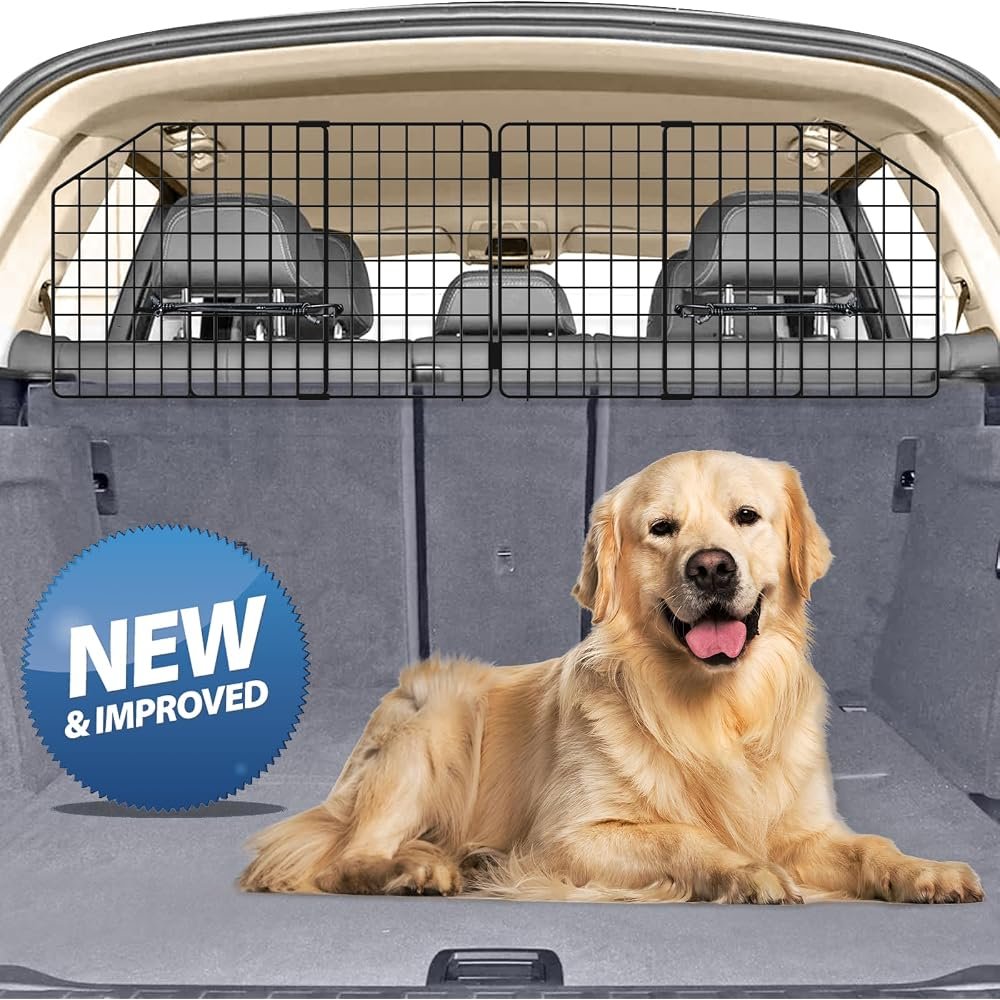
The MBR&MBS takes the wire-mesh cargo gate formula and refines the weak point: instead of the knob-style connectors that owners report breaking on cheaper barriers, the side panels attach to the main panel with nuts, screws, and fixed plates, plus hook-and-loop fasteners for extra stability. It extends to a full 61.3″ (36″ main panel plus two 16.8″ side panels), mounts to rear headrests with thick nylon straps and metal grips, and the see-through design eliminates driver blind spots.
The honest complaints: the upgraded hardware is also the complaint — more parts means a longer, more fiddly assembly, and the brand itself recommends two people for installation. Once it’s up it’s solid; getting it up is the project. Like all strap-mounted gates, expect to check tension after the first few drives.
Specs: premium steel wire mesh · extends to 61.3″ wide · nut/screw/plate panel connectors · rear-headrest strap mounts · see-through design.
Pros: strongest panel connectors in the category; widest extension here; stable once installed; no blind spots.
Cons: most involved assembly — two people recommended; strap tension needs checking; overkill for small SUVs.
Verdict: The set-it-and-forget-it gate — invest the assembly time once, then stop thinking about it. Check the price on Amazon.
4. Bushwhacker Cargo Area Dog Barrier — Best for CUVs and Mid-Size SUVs
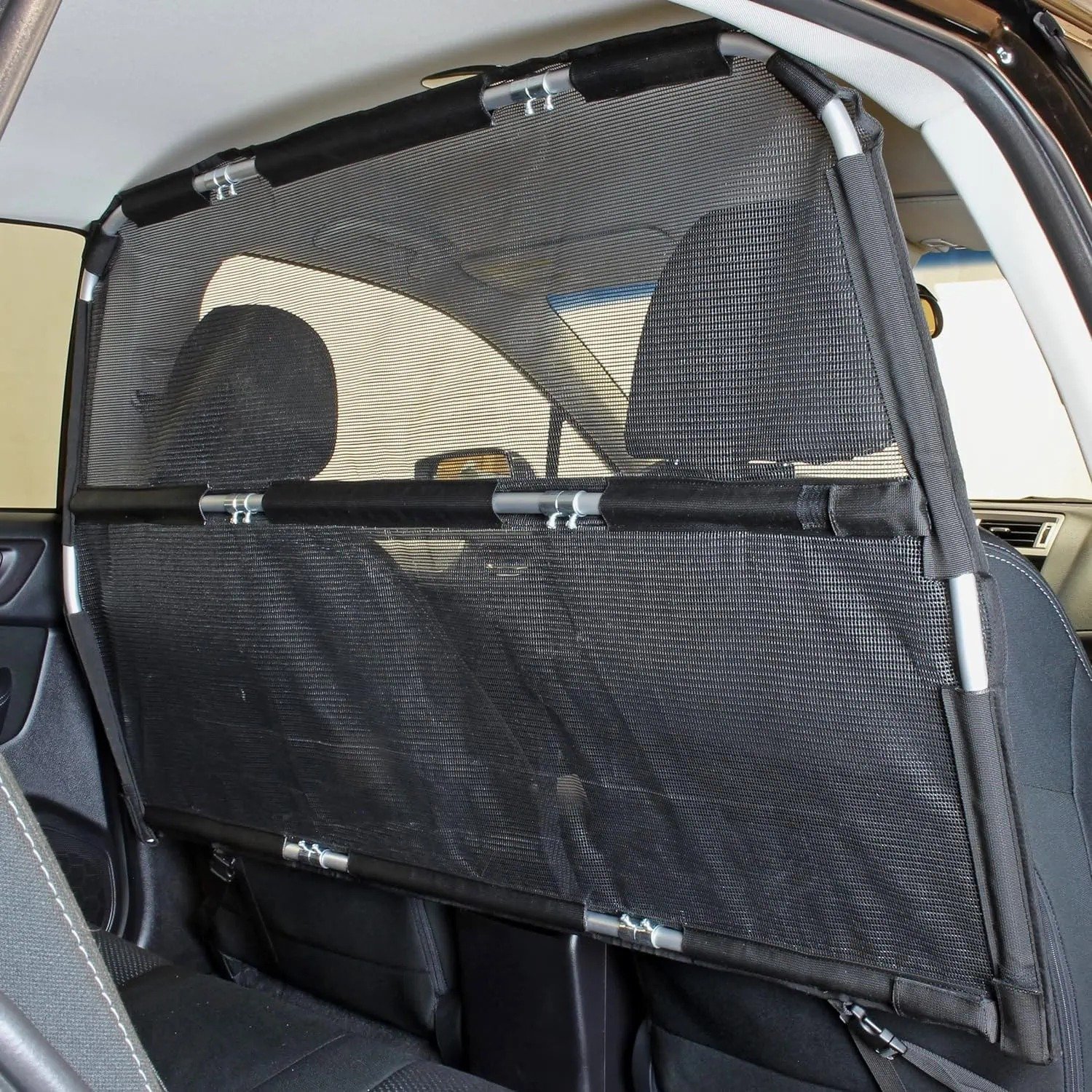
Not every SUV is a Suburban. The Bushwhacker is sized for crossovers, hatchbacks, and mid-size SUVs: a fixed 46″ wide by 21″ high panel of scratch-and-tear-resistant pet screen in a half-inch lightweight metal tube frame, mounting to the backseat headrests and securing to child-seat anchors, tie-downs, or the seat frame with no tools. It’s lighter and simpler than the adjustable giants — and for a RAV4 or CR-V cargo area, 46″ is exactly right.
The honest complaints: the fixed size is the whole gamble — measure your interior behind the rear headrests before buying, because there’s no adjusting it. At 21″ tall it’s a climbing barrier, not a jumping barrier; athletic dogs can clear it. And the pet-screen mesh, while tough, is still mesh — dedicated chewers will eventually win. This is a right-size pick, not a universal one.
Specs: 46″ x 21″ fixed size · pet-screen mesh · ½″ metal tube frame · headrest + anchor/tie-down mounts · no tools.
Pros: perfect proportions for CUVs and mid-size SUVs; lightweight; simple install; no-tools mounting.
Cons: fixed size — must measure first; 21″ height is jumpable; mesh won’t survive dedicated chewers.
Verdict: The Goldilocks pick for smaller SUVs — if it fits your measurements, it’s the simplest option. Check the price on Amazon.
5. Zookeeper Vehicle Pet Barrier — Best That Moves with Your Seats
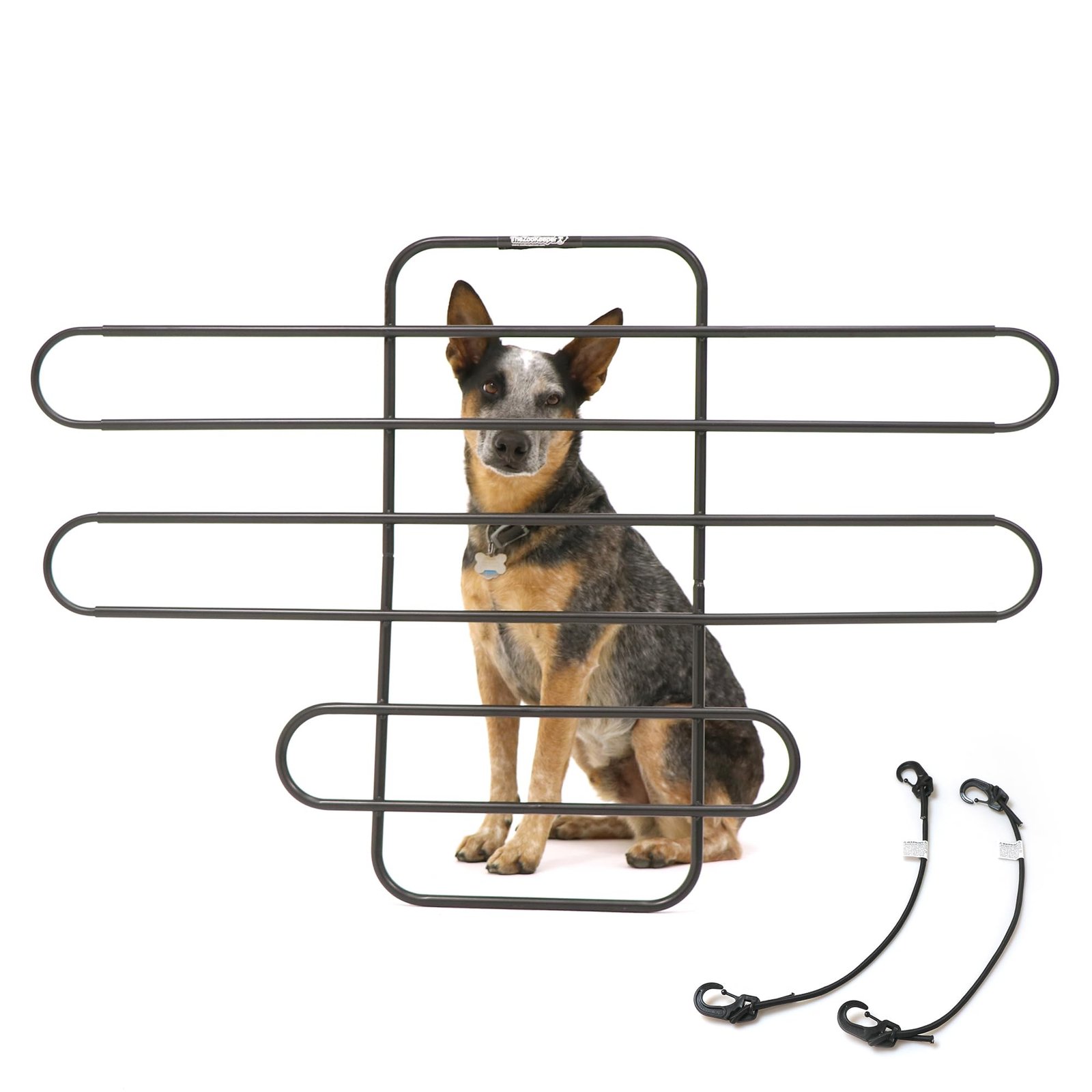
The Zookeeper earns its place in an SUV guide with a trick none of the cargo gates have: it tilts, slides, and reclines with your seatbacks. Fold the rear seats, recline them, adjust them — the barrier moves along instead of needing removal and reinstallation. The 28.75″-tall metal tube frame adjusts from 42″ to 61″ wide, mounts with flexible headrest cords (no tools, no holes), and the open tube design gives the best visibility here.
The honest complaints: 28.75″ is shorter than the dedicated cargo gates, so it’s best mounted behind the front seats or for dogs that aren’t committed jumpers. Side gaps exist in some vehicles. And it’s the premium-priced option — you’re paying for the seat-moving mechanism and USA finishing. The cords need occasional re-tensioning like all strap systems.
Specs: metal tube frame · 28.75″ high · 42–61″ wide · tilts/slides/reclines with seats · headrest-cord install.
Pros: unique seat-following design; excellent visibility; chew-proof tubes; no-tools install and removal.
Cons: shorter than cargo gates; side gaps possible; premium price; cords need re-tensioning.
Verdict: The flexible choice for owners who constantly reconfigure their seats. Check the price on Amazon.
6. CASIMR Dog Car Barrier — Best Folding Design
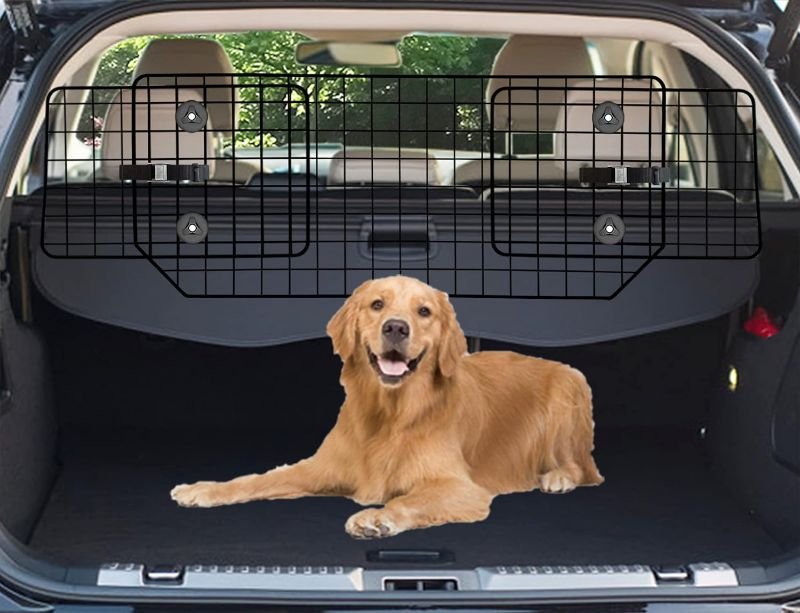
The CASIMR is the frequent traveler’s cargo barrier: a heavy-duty steel wire-mesh gate adjusting from 38″ to 61.9″ wide with a triple-folding design that collapses for easy storage — the one you can actually take in and out without dreading it. It ranked #9 in Dog Car Barriers on Amazon, which suggests the folding formula resonates. Standard rear-headrest mounting, see-through mesh, no-tools setup.
The honest complaints: CASIMR is a newer, less-established brand than the names above, so the long-term durability track record is thinner — buy from a listing with solid return terms. The folding joints are the natural weak point versus one-piece gates; check them periodically for loosening. And like its wire-mesh cousins, strap tension is ongoing maintenance.
Specs: steel wire mesh · adjusts 38–61.9″ wide · triple-folding design · rear-headrest mounts · #9 in Dog Car Barriers.
Pros: easiest to remove and store; wide adjustment range; strong category ranking; no-tools setup.
Cons: newer brand, thinner track record; folding joints need periodic checks; strap maintenance as usual.
Verdict: The traveler-friendly gate — in and out without the wrestling match. Check the price on Amazon.
How to Choose a Dog Barrier for Your SUV
Decide: behind the rear seats or behind the front seats. Cargo-area barriers mount to the rear headrests and wall off the trunk — best when the dog rides in back and passengers use the second row. Back-seat barriers mount behind the front seats — best when the dog rides in the second row. They’re different widths and heights; buying the wrong type is the #1 fit mistake.
Width adjustability is non-negotiable. SUV cargo areas run roughly 40–60″ wide depending on the vehicle. A fixed-width barrier is a gamble; an adjustable one (34–60″ or similar) absorbs the guesswork. Measure your interior at the headrest line, then buy a barrier whose range comfortably covers it.
Height beats width for jumpers. A wide barrier that a dog can vault is decoration. For athletic dogs, prioritize 28″+ of height (Magshion’s 30–50″, Zookeeper’s 28.75″); for calm dogs, shorter mesh gates are fine and preserve more rear visibility.
Check your headrest situation. Nearly every SUV barrier mounts to rear headrest posts. If your third row is folded flat or your headrests are the fixed type, confirm the mounting method works — some barriers also anchor to child-seat brackets or tie-downs (Bushwhacker), which is a useful backup.
Plan for removal. If the barrier lives in the car permanently, weight doesn’t matter — buy the sturdiest. If it comes out for groceries, school runs, or car camping, folding designs (CASIMR, rabbitgoo) and lighter tube barriers (Zookeeper) save real frustration.
Expect maintenance, not magic. Strap-mounted barriers need retightening. Metal tubes can rattle (foam tape fixes it). Mesh can be chewed. No barrier is install-and-forget — a two-minute tension check every few weeks is the difference between a barrier that works and one that slowly becomes a suggestion.
Bottom line: the Magshion is the best pick for full-size SUVs with big cargo areas and big dogs — nothing else here spans 60″ wide and 50″ tall. The rabbitgoo is the value alternative that covers most mid-size SUVs well. Go Bushwhacker for crossovers, Zookeeper if you reconfigure your seats constantly, and CASIMR if the barrier needs to come in and out easily.
Frequently Asked Questions
What size dog barrier do I need for my SUV?
Measure the width of your cargo area at the rear headrest line and the height from the cargo floor to the headliner. Most SUV cargo areas are 40–60″ wide; choose a barrier whose adjustable range covers your measurement with room to spare. When in doubt, go wider — an over-extended barrier is unstable.
Should the barrier go behind the front seats or behind the rear seats?
Behind the rear seats (walling off the cargo area) when the dog rides in the cargo area and passengers use the second row — the most common SUV setup. Behind the front seats when the dog rides in the second row. The products above are primarily cargo-area barriers; check the mounting description matches your plan.
Will a cargo barrier fit if my third row is folded down?
Usually yes — most barriers mount to the second-row headrest posts, which stay put when the third row folds. Measure with the seats in the configuration you’ll actually drive with, since folded seats change the available width and the mounting points.
Can a big dog push through a wire-mesh barrier?
Sturdy steel wire mesh (rabbitgoo, MBR&MBS, CASIMR) holds up to leaning and pawing, but it’s not immovable — a large, determined dog can flex it over time, and strap tension is the usual failure point, not the mesh. For dogs that hit barriers at speed, a rigid metal-tube barrier (Magshion, Zookeeper) is the safer bet.
Do SUV dog barriers block the rearview mirror?
See-through mesh and spaced tube designs preserve rear visibility well — that’s why they’re the standard here rather than solid panels. Mount the barrier as low as effective (rather than at maximum height) to keep the mirror view clear, and test-fit before a long trip.
Are cargo barriers crash-safe for my dog?
No — like all barriers, they prevent distraction and contain the dog during normal driving; they don’t restrain the dog in a crash. For crash protection in an SUV cargo area, use a secured crash-tested crate sized to the space, which is the gold standard for cargo-area travel.
