

Here’s the travel scenario a harness exists for: you’re at a highway rest stop in the rain, your 85-lb Shepherd sees a squirrel, and the only thing between you and a chase across four lanes of traffic is the gear on your dog. A cheap harness with plastic buckles and one adjustment point doesn’t cut it for a strong dog — the forces involved are just bigger, and the failure modes are scarier.
The honest note most roundups skip: no harness fixes pulling on its own, and “large dog harness” mostly means three things — stronger hardware, a wider size range that actually reaches big chests, and adjustment points in the right places so it can’t be wriggled out of. This guide compares six harnesses that genuinely fit large, strong dogs, with the complaints owners actually report: sizing gaps, bulky fits, confusing straps, and hardware that isn’t as tough as it looks.
Pet Travel Items is reader-supported. When you buy through links on this page, we may earn a commission at no extra cost to you. Our picks are driven by documented owner feedback, never by commission rates.
Best Dog Harnesses for Large Dogs at a Glance
| # | Product | Key spec | Best For | |
|---|---|---|---|---|
| 1 | Ruffwear Front Range (L/XL) | Foam-padded · front + back clips | Best overall | Check Price |
| 2 | 2 Hounds Design Freedom No-Pull (1″, L) | Martingale control loop · stainless hardware | Best for pullers | Check Price |
| 3 | rabbitgoo No-Pull (L) | Padded vest · front + back D-rings | Best budget padded | Check Price |
| 4 | Kurgo Tru-Fit Smart (L) | 5 adjustment points · seatbelt loop included | Best car + walk combo | Check Price |
| 5 | Blue-9 Balance (M/L) | 6 adjustment points · buckle neck | Best for hard-to-fit shapes | Check Price |
| 6 | Auroth Tactical (L) | 900D nylon · MOLLE · up to 135 lbs | Best heavy-duty pick | Check Price |
Prices shift constantly — check before you buy. Sizes are manufacturer figures.
1. Ruffwear Front Range (L/XL) — Best Overall
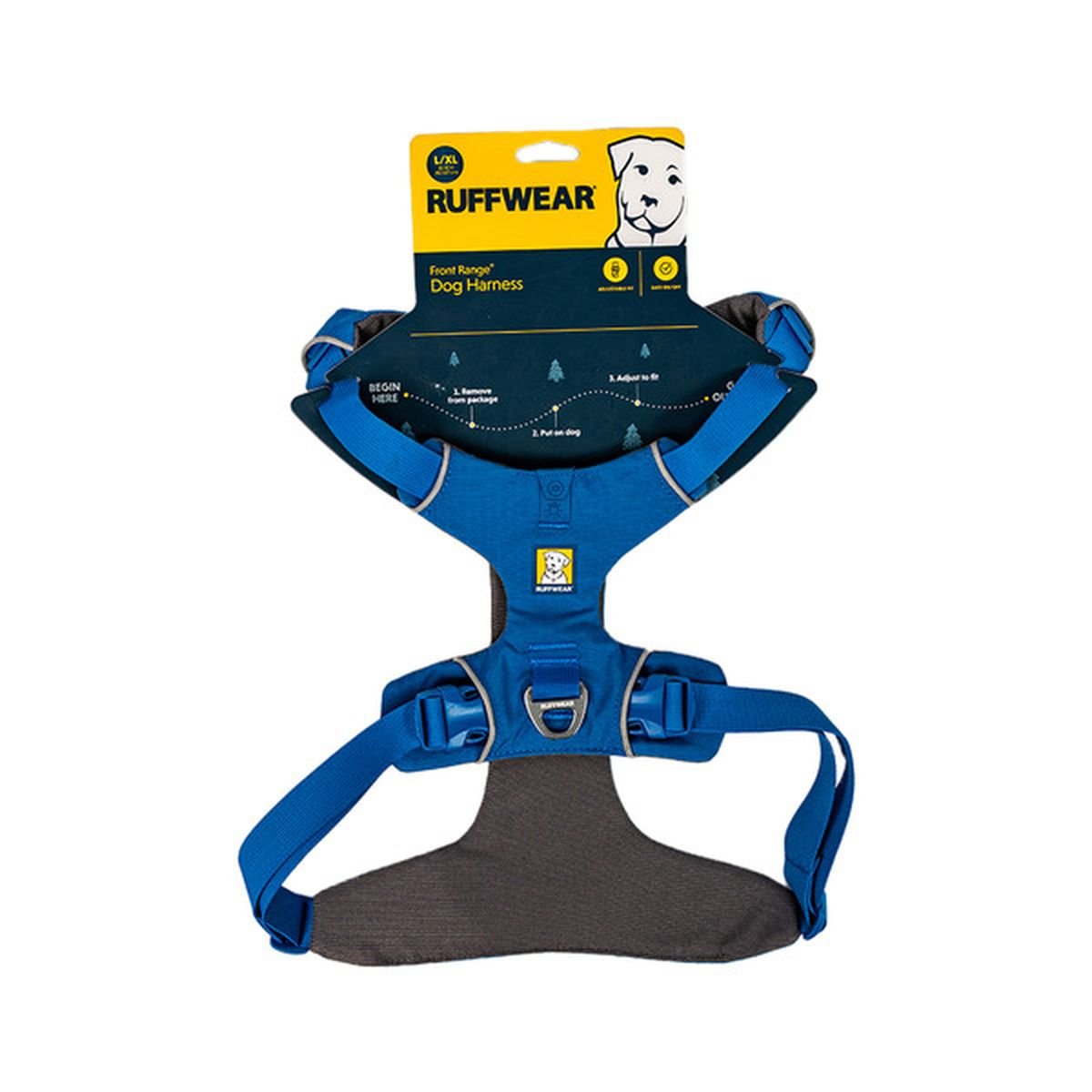
The Front Range is the default recommendation at trailheads and dog parks for a reason: it scales properly to big dogs. The L/XL size fits chests up to about 42 inches, the chest and belly panels are foam-padded so a lunging dog doesn’t get a strap edge digging in, and you get two leash points — an aluminum V-ring on the back for everyday walks and a reinforced webbing loop on the chest for no-pull training. Four adjustment points, reflective trim, and an ID pocket round it out. A veterinary review (puppygrowthcalculator.com, Dr. Jennifer Coates, DVM) rated it 4.7/5, the highest of the no-pull harnesses it tested.
The honest part: the front no-pull attachment is a fabric webbing loop, not a metal ring — that’s the vet reviewer’s one listed con, and it matters if your dog is a heavy, sustained puller. It’s also priced like premium gear (third-party roundups put it around $50–70), and the padded vest design runs warmer than a bare-strap harness on hot days.
Specs: L/XL fits chest girths up to ~42″ · foam-padded chest/belly panels · aluminum back V-ring + front webbing loop · 4 adjustment points · reflective trim · ID pocket.
Pros: true big-dog sizing; padded where it counts; two leash options; highest vet-review score in its class.
Cons: front clip is fabric, not metal; premium price; padded vest runs warm in summer.
Verdict: The safest all-round pick for a large dog — comfortable, secure, and proven. Check the price on Amazon.
2. 2 Hounds Design Freedom No-Pull (1″, L) — Best for Pullers
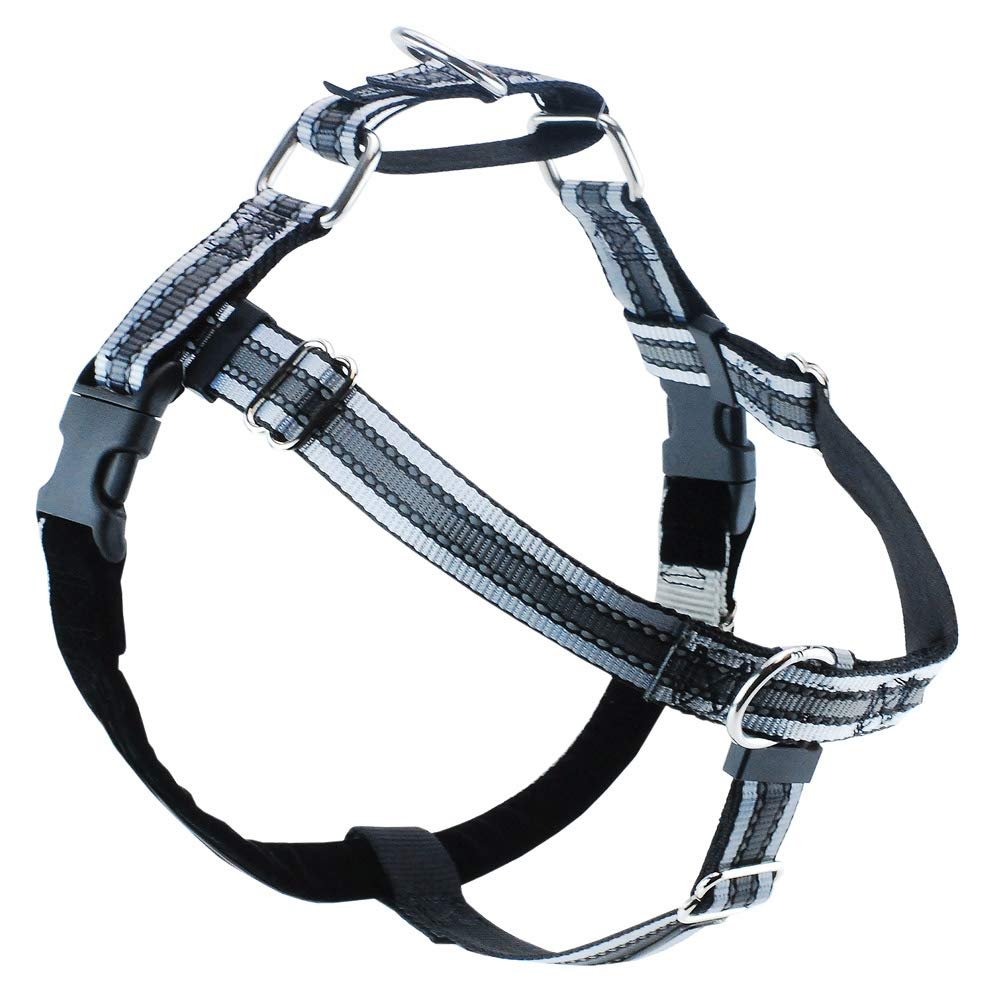
If your large dog’s main problem is pulling, the Freedom is the harness trainers name most. The patented martingale control loop on the back tightens gently around the chest when the dog pulls, and there’s a structural ring on the front so you can run a double-ended leash to both points — steering like reins. The chest strap is lined with Swiss Velvet to prevent the armpit chafing that plagues strap harnesses, the hardware is stainless steel, and it’s made in the USA with a chew-replacement warranty. It fits dogs from 14 lbs all the way past 250 lbs, and the same vet review rated it 4.5/5 as its best overall no-pull pick.
The honest part: there is no padding — it’s webbing on your dog, full stop — which is the reviewer’s listed con. And the double-ended leash that unlocks the full steering effect is sold separately, so budget for that if you want the complete system. Some owners also find the martingale loop confusing to fit the first time.
Specs: 1″ width (large-dog version) · patented rear martingale loop + front ring · stainless steel hardware · Swiss Velvet chest-strap lining · 4 adjustment points · fits 14–250+ lbs · made in USA.
Pros: the most effective pull-reduction design here; velvet lining prevents chafing; genuinely strong hardware; chew warranty.
Cons: no padding at all; double-ended leash sold separately; fitting takes a learning curve.
Verdict: The puller’s harness — buy the double leash with it and learn the fit once. Check the price on Amazon.
3. rabbitgoo No-Pull (L) — Best Budget Padded
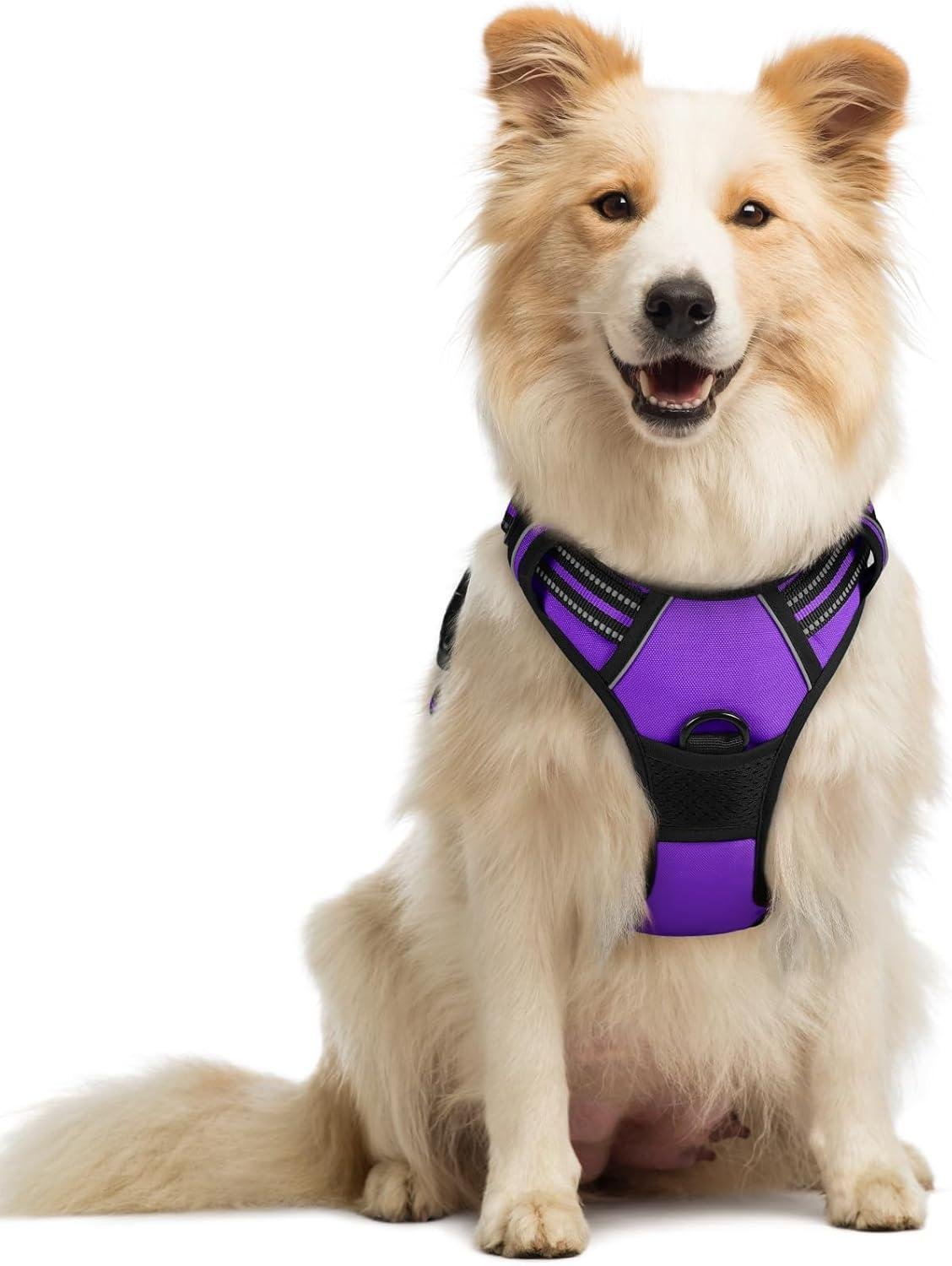
rabbitgoo is the budget pick that shows up in every roundup because it gets the fundamentals right at roughly half the premium price (third-party roundups list it around $25–35). The L size suits medium-to-large breeds — Huskies, Labs, Shepherds — with four adjusting straps, metal D-rings front and back, a padded top handle for grabbing your dog at the rest stop, breathable air mesh, and reflective strips. A vet review gave it 4.5/5 as its best padded pick.
The honest part: that same review’s cons were that it can be bulky on some dogs and isn’t sized for all breeds — the vest-style panels that make it comfortable also make it a lot of fabric. One gear-testing outlet (treelinereview.com) also found the back runs short on longer-bodied dogs, letting straps ride toward the armpits. Measure carefully against the size chart, and expect to re-tighten straps periodically — budget harnesses stretch.
Specs: L for medium–large breeds (range spans ~13–38″ chests across sizes) · padded vest panels · front + back metal D-rings · top control handle · reflective strips · 4 adjustment points.
Pros: padded comfort at a budget price; metal hardware both ends; control handle; huge color range.
Cons: bulky on some body types; back can run short on long dogs; straps need re-tightening.
Verdict: The value pick — most of the comfort of premium harnesses for half the money. Check the price on Amazon.
4. Kurgo Tru-Fit Smart (L) — Best Car + Walk Combo
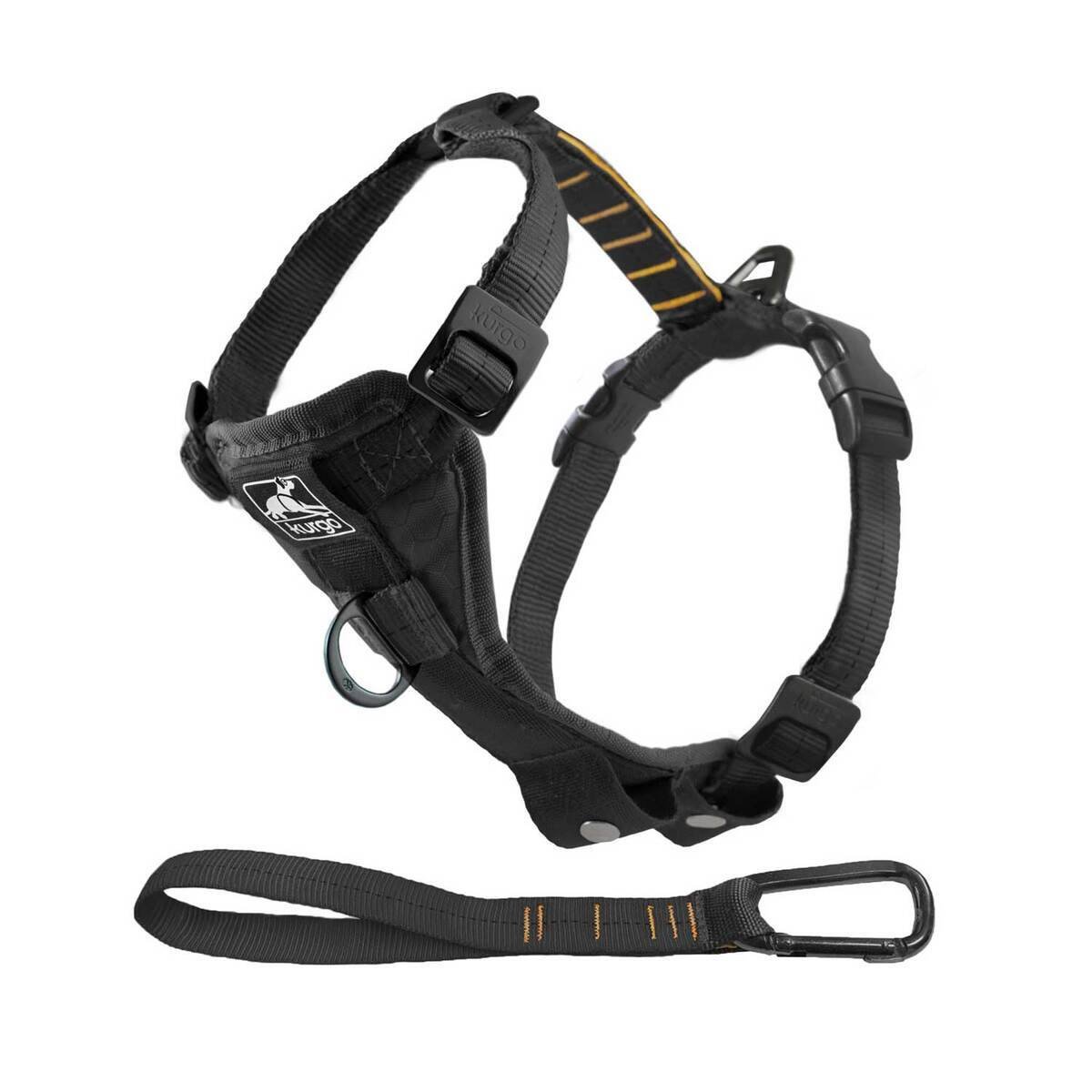
For travel specifically, the Kurgo earns its place: it’s a walking harness that doubles as a car restraint, with a 10-inch seatbelt loop included in the box and crash-test certification behind it. The padded chest plate spreads force across the sternum instead of the throat, there are five adjustment points, front and back leash attachments, quick-release buckles, reflective trim, and a lifetime warranty — the best warranty in this guide.
The honest part: owners report it’s heavier and bulkier than pure walking harnesses (one review roundup lists exactly that as its con), and a detailed 4-star owner review on Kurgo’s own site notes the belly strap can be a tough fit — dogs at the top of a size range may max it out, since the strap’s adjustment is limited by its sewn construction. The same reviewer notes the seatbelt carabiner occupies the back leash point, so switching from car to walk takes an extra step. Size up if your dog is between sizes.
Specs: L for large breeds · 5 adjustment points · padded chest plate · front + back attachments · 10″ seatbelt loop included · crash-tested · lifetime warranty.
Pros: genuine car-safety use case; padded chest plate; lifetime warranty; reflective trim.
Cons: heavier/bulkier than walking-only harnesses; belly-strap sizing can max out; carabiner shares the back clip.
Verdict: The road-trip harness — one piece of gear for the walk and the drive. Check the price on Amazon.
5. Blue-9 Balance (M/L) — Best for Hard-to-Fit Shapes
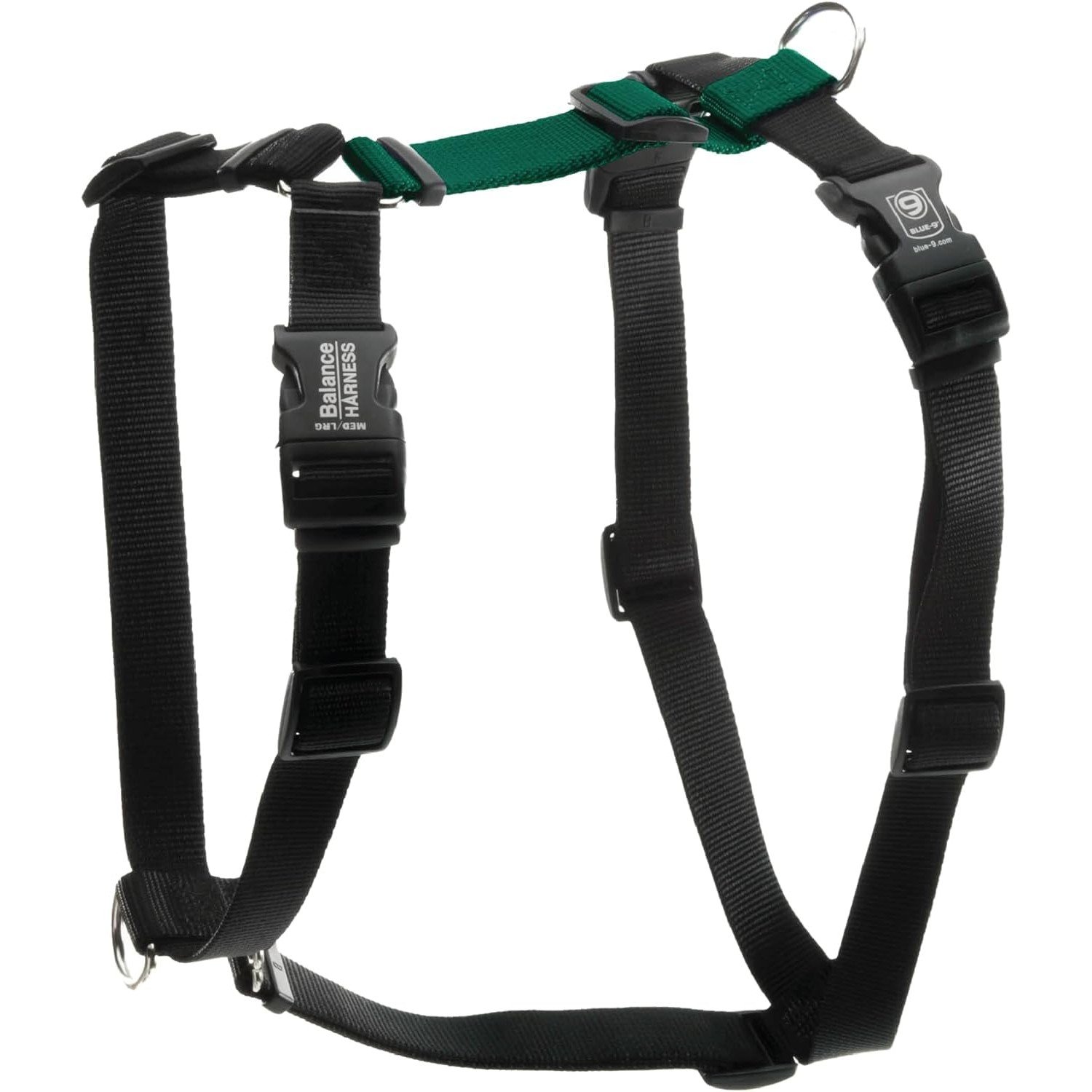
Deep-chested Greyhound types, barrel-chested bullies, lanky adolescents — dogs whose proportions defeat normal harnesses are the reason the Blue-9 exists. Six adjustment points let you fit the neck, chest, and girth independently, and the buckle-neck design means nothing goes over the head (great for head-shy rescues) while doubling as a safety release if the dog gets snagged on a trail. The Y-shaped front keeps shoulders free for a natural gait, and it’s made in the USA. The M/L fits ribcages 24–35.5 inches — squarely large-dog territory.
The honest part: six adjustment points is also the complaint. Chewy reviewers call it a puzzle to put on — straps tangle, and getting front vs. back right takes practice. Multiple owners report it runs large and can slide or cinch behind the armpit on narrower dogs, and the soft nylon that makes it comfortable also let one determined chewer through it in minutes. It’s also premium-priced (roundups list around $55–75). Watch the fitting videos before you buy.
Specs: M/L fits 24–35.5″ ribcage · 6 adjustment points · buckle neck (no overhead) · Y-front for free shoulder movement · front + back D-rings · made in USA.
Pros: fits body shapes nothing else fits; no overhead donning; unrestricted gait; minimal coverage stays cool.
Cons: genuinely fiddly to fit and put on; runs large for some dogs; soft nylon vs. chewers; premium price.
Verdict: The problem-solver — worth the learning curve if standard harnesses never fit your dog. Check the price on Amazon.
6. Auroth Tactical (L) — Best Heavy-Duty Pick
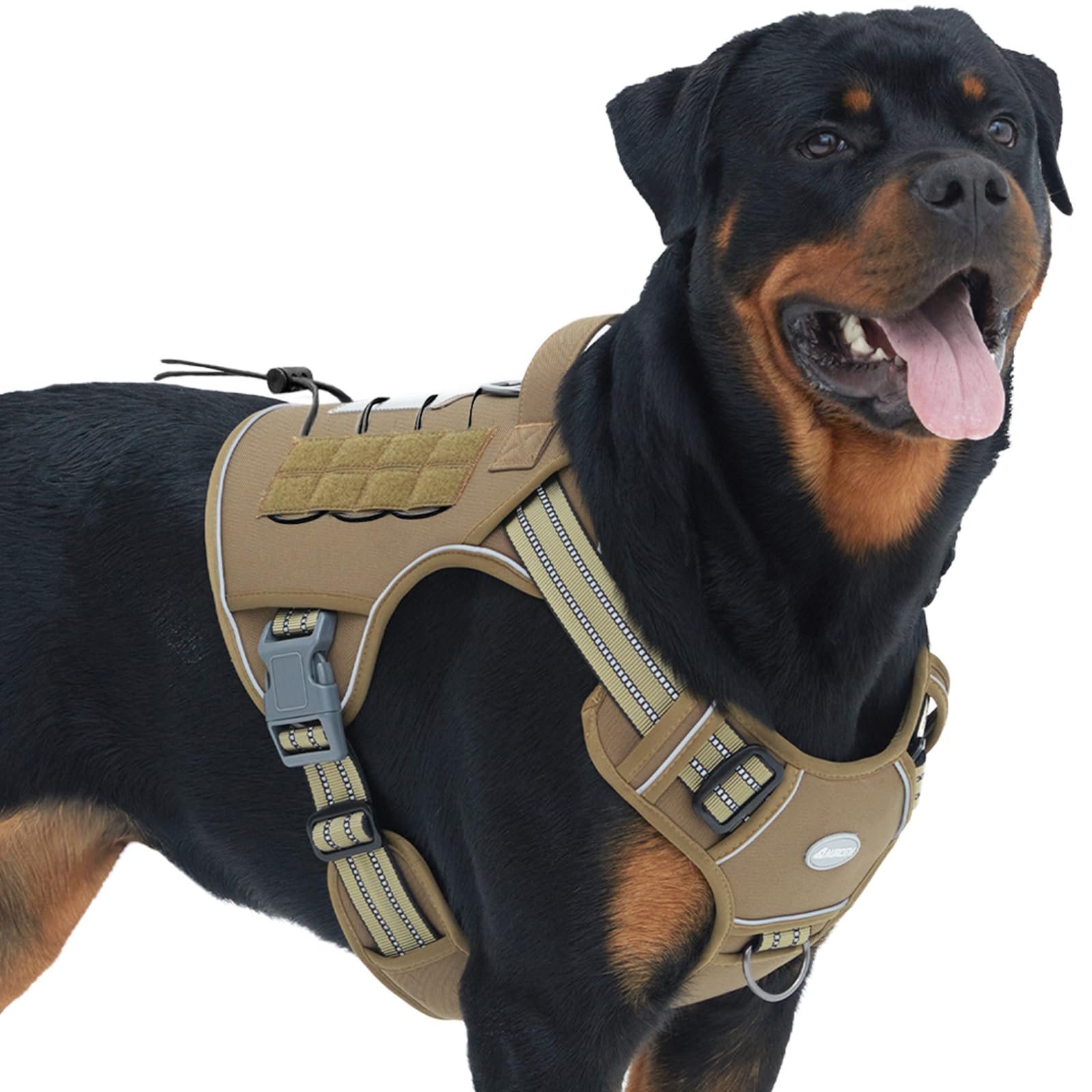
For the strongest pullers and working-dog builds, the Auroth is the heavy-duty answer: 900D nylon with reinforced stitching, two metal leash rings, wide padded straps, a sturdy grab handle, and MOLLE strips on both sides for pouches (water bottle, collapsible bowl, waste bags — genuinely useful on long travel days). Four sizes cover dogs up to 135 lbs with chests from 20 to 42 inches, and a vet review rated it 4.6/5 as its best pick for large dogs specifically.
The honest part: the same review’s con is blunt — “not suitable for all dogs.” The tactical look and bulk are overkill for a calm neighborhood walker, and all that 900D fabric is warmer than a minimal strap harness. MOLLE pouches are sold separately, and like any no-pull harness it manages pulling rather than training it away. Buy it for the dog you have, not the aesthetic.
Specs: L fits up to ~135 lbs · 900D nylon, reinforced stitching · 2 metal leash rings (front + back) · padded grab handle · MOLLE system · reflective trim · 4 adjustment points.
Pros: the toughest build here; great for very strong dogs; MOLLE carries travel gear; vet-rated for large dogs.
Cons: bulky and warm; overkill for easy walkers; pouches sold separately; doesn’t train pulling away.
Verdict: The heavy-duty option — maximum control hardware for maximum dog. Check the price on Amazon.
How to Choose a Harness for a Large Dog
Hardware first, everything else second. A 90-lb dog lunging generates serious force. Look for metal (not plastic) leash attachment points and reinforced stitching at stress points. Plastic side-release buckles are fine for holding straps, but the ring your leash clips to should be metal.
Count the adjustment points — and where they are. Two sliders on a girth strap can’t fix a harness that’s loose at the neck and tight at the belly. Four or more adjustment points (neck, chest, girth) let you fit deep chests and thick necks independently, which is the difference between secure and escapable on a big dog.
Front clip for training, back clip for cruising. A front (chest) attachment redirects a puller sideways and is the actual “no-pull” mechanism; a back attachment is for dogs that already walk well. The best large-dog harnesses give you both so the gear grows with the training.
Mind the heat. Padded vest harnesses are more comfortable but cover more torso — on a summer road trip through the desert, a minimal strap design (Freedom, Blue-9) keeps a heavy-coated dog cooler. Match coverage to climate.
Fit it like a seatbelt, then test the escape. You should barely fit two fingers under every strap. Then, at home — not at the rest stop — let the dog try to back out of it. If it can, it’s not fitted right or it’s the wrong design. Every harness here has documented cases of dogs defeating a loose fit.
Plan for the car. If your dog rides in the car (and as a travel-gear reader, yours does), a harness with a seatbelt loop or crash-test certification does double duty. The Kurgo is the only pick here designed for it — the rest are walking harnesses, and shouldn’t be improvised as car restraints.
Bottom line: the Ruffwear Front Range is the best all-rounder for large dogs — true big-dog sizing, padding, and dual clips. If pulling is the actual problem, get the 2 Hounds Freedom with its double leash. Road-trippers should look hard at the Kurgo Tru-Fit Smart for its seatbelt integration, and owners of hard-to-fit dogs will find the Blue-9 Balance worth its learning curve.
Frequently Asked Questions
What size harness does a large dog need?
Measure the widest part of the chest (right behind the front legs) and the neck, then use the manufacturer’s chart — never the breed label. Most “large” harnesses here fit 24–42 inch chests. If your dog falls between sizes, the general rule is to size up for comfort but check the return policy, since a too-big harness is an escapable one.
Are front-clip harnesses actually better for dogs that pull?
Yes — it’s physics, not marketing. A front (chest) attachment turns the dog sideways when it pulls, interrupting forward momentum; a back attachment gives a puller comfortable leverage to keep pulling — it’s essentially a sled-dog setup. That’s why every serious no-pull design here leads with the front clip. But no harness trains loose-leash walking by itself — pair it with actual training.
Can my dog wear the harness in the car?
Only a harness designed and tested for it. The Kurgo Tru-Fit Smart includes a seatbelt loop and crash-test certification. Standard walking harnesses — even excellent ones — aren’t engineered for crash forces, and clipping a seatbelt to a random back ring can injure the dog in a sudden stop.
How tight should a large dog’s harness be?
Snug enough that you can barely slide two fingers under any strap, with no strap sitting in the armpit. Too loose and a large dog can back out of nearly any design; too tight and you get chafing behind the front legs. Re-check fit monthly — weight changes and strap stretch loosen things over time.
Will a no-pull harness stop my dog from pulling completely?
It manages pulling; it doesn’t eliminate it. The martingale loop (Freedom), front clip (Front Range, Easy Walk-style), or control loop all make pulling less rewarding, and most dogs improve within a few walks. Determined, untrained pullers will still pull — the harness just gives you safer leverage while you train.
Are tactical/MOLLE harnesses good for everyday large dogs?
They’re good for strong dogs whose owners want maximum control hardware and gear-carrying capacity. For a calm, trained large dog they’re unnecessarily bulky and warm. Buy the control level your dog actually needs — you can always size down in complexity later.
