

Pet Travel Items is reader-supported. When you buy through links on our site, we may earn an affiliate commission at no extra cost to you. Read our affiliate disclosure.
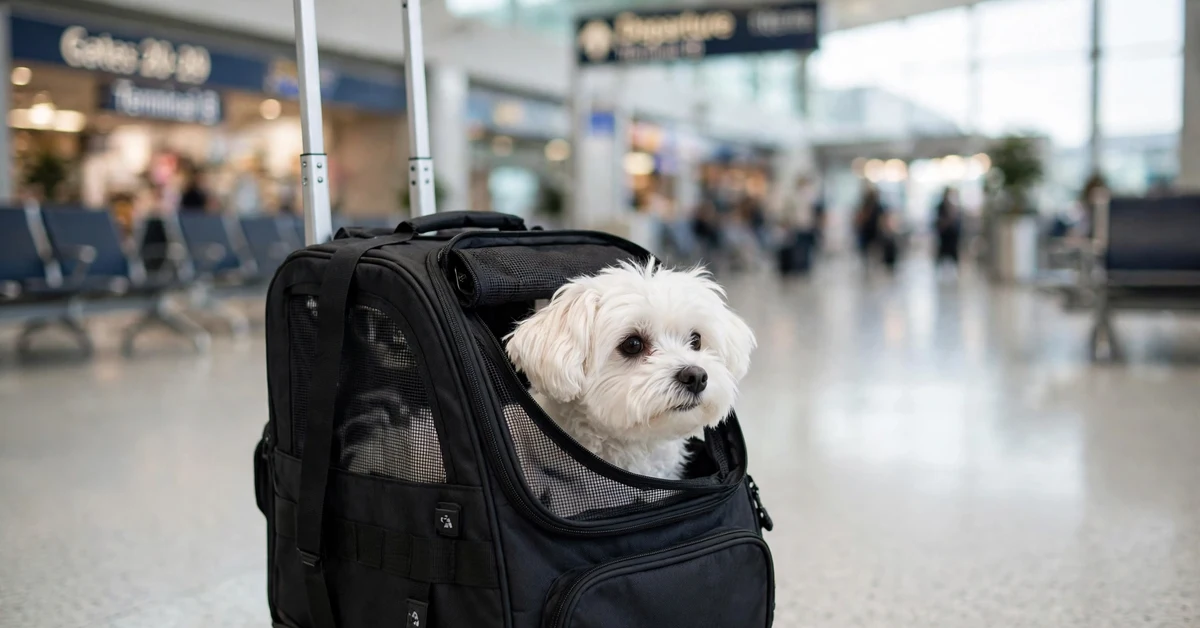
A wheeled dog carrier solves one problem beautifully: your back. A ten-pound dog gets heavy fast when you carry it through a mile of airport terminal, and a wheeled carrier turns that slog into a stroll. But this is also the pet-carrier category with the most honest engineering tradeoffs, and most listings bury them. Small plastic wheels are loud and fragile on anything rougher than polished floor. Telescoping handles wobble. And almost every “airline approved” claim quietly assumes you pop the wheels off at the gate, because the assembled carrier no longer fits under a seat.
So here is how this list was built. We read the listings the way an owner should: weight limits taken as hard limits, airline claims treated as manufacturer marketing, and wheel and handle design scrutinized, because those two parts decide whether the carrier survives a year of travel or dies at the first curb. Six carriers made the cut, each for a different reason. One has replaceable wheels. One has a six-wheel anti-tip base. One is built by an established American brand with five carry modes. None of them is perfect, and the write-ups below say what each one gives up.
Who actually benefits from a wheeled carrier? Older owners, anyone with a bad back or shoulder, and people who fly regularly with their dog. If your dog is five pounds and your vet is a five-minute drive, a basic soft carrier is lighter, cheaper, and simpler. Wheels earn their keep on distance: long terminals, convention centers, multi-block city walks, and the slow shuffle of a boarding line. Be honest about your own travel pattern before you buy. A wheeled carrier you only roll to the car is five pounds of hardware you carry for nothing.
One more note on honesty before the table: we did not physically test these carriers. Every spec below is quoted from the Amazon listing, marked as such, and anything we could not verify is marked Unknown. What we add is judgment: which design choices help, which are marketing, and which limits you must respect before buying.
| # | Product | Why it made the list | Check Price |
|---|---|---|---|
| 1 | PAWZIDEA Expandable Rolling Pet Carrier | Replaceable wheels + 18-lb ceiling; the only engineering answer to this category’s biggest failure point | Check Price |
| 2 | NULLA Rolling Pet Carrier for Small Dogs | Honest dimension warnings from its own listing; roll / shoulder / hand triple mobility | Check Price |
| 3 | Pet Gear I-GO2 Roller Backpack | Established US brand; five modes including a backpack for stairs and escalators | Check Price |
| 4 | KOPEKS Deluxe Backpack Pet Carrier | Two-wheel tilt design with the tallest interior; 18-lb ceiling | Check Price |
| 5 | Katziela Luxury Lorry Rolling Pet Carrier | Six-wheel base that resists tipping; 34-inch handle | Check Price |
| 6 | BNISE Expandable Rolling Pet Carrier | 25-lb ceiling; dual-side expansion for the most room | Check Price |
1. PAWZIDEA Expandable Rolling Pet Carrier
The PAWZIDEA gets top billing for one unglamorous reason: its wheels are replaceable. Every other carrier on this list treats the wheels as disposable, and since wheels are the first part to fail on a rolling carrier, that matters more than any mesh or pocket arrangement. The listing states outright that replacement wheels are available from the PAWZIDEA store, and the four 360-degree wheels detach tool-free. If you plan to roll a dog through airports more than twice a year, this is the feature that decides whether you own the carrier for three years or one.
The specs suit a genuinely small dog. The listing quotes 18 by 11 by 11 inches and a ceiling of 18 pounds, and describes the fit as right for a small dog, a puppy, or a rabbit. Expansion is the second headline: a zip-open front section that the listing claims nearly doubles interior space. Treat that claim with the skepticism it deserves. Expansion helps when the carrier is parked at a gate or a vet waiting room, not while it rolls. Still, extra stationary room is a real comfort gain on a long travel day, and few competitors offer it at this price tier.
Ventilation is thorough on paper: a roll-up top-load mesh door, a quick-access side door, dual side mesh doors, and rear mesh panels. The listing calls the mesh chew-proof and scratch-resistant. Those words grade the weave, not the dog. A calm traveler will be fine; a determined chewer is a problem for every mesh carrier ever made. The safety details are the standard good set: an internal leash clip, self-locking zippers, and seatbelt loops so the carrier can be strapped into a car.
What worries us is weight math. An 18-pound dog plus the carrier itself plus the telescopic aluminum handle’s leverage is a lot to ask of small wheels and velcro straps. The listing secures the bag to the rolling frame with dual velcro straps, and velcro collects hair and weakens with time. Check your dog’s actual measurements against the interior before ordering, and if your dog is at the top of the 18-pound ceiling, remember that the wheel base is doing heavy lifting it was never designed to do indefinitely.
Key specs (listing): 18 x 11 x 11 inches; pets up to 18 lbs; four 360-degree removable and replaceable silent wheels; telescopic aluminum handle; front expandable section; steel frame with leak-proof PP board base; removable washable double-sided pad; self-locking zippers; safety leash clip; folds flat; shoulder strap and car-seat loops included.
Pros:
- Replaceable wheels, the only real answer to the category’s main wear point
- 18-lb ceiling suits more small dogs than most competitors
- Expandable front gives extra room when parked at the gate
- Self-locking zippers and internal leash clip for escape-prone dogs
- Folds flat for storage between trips
Cons:
- Bag-to-frame connection relies on velcro straps that weaken with hair and age
- Carrier empty weight is not stated, so total travel weight is a guess
- Expansion helps only when stationary, not while rolling
- “Doubles space” claim is marketing math; real gain is smaller
Verdict: The pick for frequent travelers who want the longest useful life. Replaceable wheels are a rare, grown-up engineering decision. Measure your dog against the interior first.
2. NULLA Rolling Pet Carrier for Small Dogs
The NULLA earned its place with something almost no competitor does: its own listing warns you to measure first. The description states that the carrier “meets under-seat requirements for most major airlines” but immediately tells buyers to measure their airline’s under-seat space with the wheels attached and compare it to the 18 x 12 x 12-inch dimensions. That warning is the most useful sentence in the listing. At 12 inches tall and wide, this carrier exceeds the commonly published 18 x 11 x 11 box, so airline use depends on the soft sides compressing, and the brand at least admits it.
Fit is aimed squarely at the classic small breeds: the listing caps at 15 pounds and 16 inches of length, naming Yorkies, Pomeranians, and Chihuahuas. The interior is framed to hold its shape, with reinforced mesh panels and a firm removable base that the listing describes as built for “support and security rather than plush comfort.” That phrasing is refreshingly blunt. Short to medium trips are the intended use; nobody is pretending this is a sleeper car.
Triple mobility is the functional pitch: detachable spinner wheels with a telescopic handle for rolling, plus shoulder and hand-carry options. This matches how owners actually use these carriers. You roll through the terminal, you shoulder it up the stairs, you hand-carry it into the vet’s office. Designs that only roll leave you stuck at the first escalator, so the shoulder strap is not a bonus. It is half the product.
The honest drawback is weight. At 6.4 pounds empty, this is one of the heavier carriers here, and that weight counts against airline in-cabin allowances that combine pet and carrier. A 15-pound dog plus a 6.4-pound carrier is over 21 pounds on the scale, before wheels. The listing does not state the wheel material or diameter, and nothing about handle construction, so durability of the two parts that matter most is unknowable from the page. If you fly often, factor the weight into your airline’s published limit before you buy.
Key specs (listing): 18 x 12 x 12 inches; 6.4 lbs; pets up to 15 lbs and 16 inches long; detachable spinner wheels; telescopic handle; shoulder strap; reinforced mesh panels; firm removable base with washable cover; listing dated July 2024.
Pros:
- Listing openly warns buyers to measure with wheels attached
- Roll, shoulder, and hand carry cover every part of a travel day
- Structured frame holds shape so the interior does not sag
- Firm washable base is practical for accidents and muddy paws
- Reinforced mesh panels resist sagging better than loose mesh
Cons:
- 6.4 lbs empty eats into airline combined pet-plus-carrier limits
- 12-inch height and width exceed the common 18x11x11 published box
- No wheel material, diameter, or handle construction stated
- Aimed at short to medium trips; not a long-haul comfort carrier
Verdict: The honest mainstream pick. Good structure, real shoulder option, and a listing that tells you to measure first. Check your airline’s weight limit with a 6.4-pound carrier in the math.
3. Pet Gear I-GO2 Roller Backpack
Pet Gear is one of the few names on this list you might already know, an American pet brand with years of carrier history behind it, and that shows in the design. The I-GO2 Escort is a five-in-one: roller bag, backpack, tote, carrier, and car seat. That sounds like feature stuffing until you think about a real trip. Airports have escalators, parking lots have curbs, and hotel lobbies have crowds. The roller handles the terminal; the backpack handles the stairs. Most carriers on this list ask you to carry 15 pounds of dog and carrier by a handle when the wheels fail you. The I-GO2 gives you straps instead, and your shoulders will notice the difference.
The listing is specific about dimensions: 14 x 9 x 19 inches outside, with an interior of roughly 12 long by 8 wide by 17.5 tall. That tall, narrow profile suits dogs that sit upright rather than sprawl. The interior is 8 inches wide, so a broad-chested dog will feel the walls. The listing comes fully assembled, includes a removable washable pad, a tether, a wheel cover, and a storage pouch, and directs buyers to a sizing guide. Good. Use it. The one real gap is that no weight limit in pounds is stated on the listing text we reviewed, so fit must be decided purely by measurement against those interior numbers.
Mesh ventilation is stated but not detailed, and the backpack-strap padding, the part that decides whether backpack mode is a ten-minute mercy or a real option, is not described. These are the two things we would want answered before recommending it unconditionally. As a car seat, the listing’s own description includes it among the five modes, and the tether keeps the dog secured, which is more than most wheeled carriers offer on the driving leg of a trip.
Why this ranks above flashier options: brand accountability. When a small generic brand’s telescoping handle fails, the after-sales email goes nowhere. Pet Gear has a brand to protect, a model number, and a listed sizing guide. In a category where the handle is a known failure point, buying from a company that will still exist next year is a form of insurance.
Key specs (listing): 14 x 9 x 19 inches; 6.4 lbs; interior 12L x 8W x 17.5H inches; five modes (roller, backpack, tote, carrier, car seat); telescoping handle with wheels; removable washable pad; tether; wheel cover; storage pouch; fully assembled; model 1230WI.
Pros:
- Five modes cover rolling, backpack, tote, carrier, and car seat
- Established brand with a track record beats anonymous sellers on durability questions
- Backpack straps solve the stairs and escalator problem properly
- Comes fully assembled with pad, tether, and wheel cover included
- Tall narrow interior suits dogs that sit upright
Cons:
- No stated weight limit; fit must be judged from interior dimensions alone
- 8-inch interior width is tight for broad-chested small dogs
- Backpack strap padding quality is not described
- Mesh ventilation details are thin
Verdict: The versatile brand-name pick. If your trip mixes terminals, stairs, and cars, the five-mode design is the most complete answer. Measure your dog against the 12-by-8 interior before deciding.
4. KOPEKS Deluxe Backpack Pet Carrier
The KOPEKS takes a different mechanical path from every other carrier here: two wheels instead of four, arranged as a platform you tilt like luggage. This is an old, proven geometry. On smooth floors a two-wheel tilt carrier tracks straight and steers with the handle, and it does it with half the moving parts to break. The downside is physics. When a dog shifts its weight to one end, a two-wheel platform can tip past the wheelbase edge, especially on curbs. Owners should expect to steady it with the handle rather than trusting it to stand alone.
The interior is the tallest on this list: 12.5 by 15.5 by 18 inches inside, with the exterior reaching 20 inches tall including wheels and pockets. That height is the reason this carrier is here. Leggy small dogs that sit bolt upright, terriers, miniature poodles, beagles, fit badly in low-slung rolling carriers and end up crouching. The KOPEKS lets them sit. The 18-pound ceiling covers the same weight class as the PAWZIDEA, which puts it near the top of this lineup for solid small breeds.
Carry modes are four: backpack, rolling carrier, tote, and car seat. The listing names a telescoping handle, a strap handle, and backpack straps, plus two large storage pockets. Oxford fabric and three mesh ventilation panels complete the picture. It is a simple, legible design without the gadgetry some competitors lean on, and simple is usually what survives.
The honest limitation is air travel. At 20 inches of exterior height, this will not fit under a seat, and the listing makes no airline claim at all. Buy this for the airport terminal, the car, the vet, and the daily round. If you fly with the dog, you need a different carrier, or you need to accept this as the to-the-gate solution only. Also unknown: carrier weight, wheel material, and whether the two-wheel platform detaches. The telescoping handle extends the carrier to about 40 inches of total height, which is comfortable for most adults pulling it, but the handle’s lock strength is not documented.
Key specs (listing): Interior 12.5L x 15.5W x 18H inches; exterior 13L x 17.5W x 20H inches including wheels and pockets; handle extends total height by 20 inches; pets up to 18 lbs; two-wheel platform; telescoping handle plus strap handle and backpack straps; oxford fabric; three mesh panels; two large pockets; four modes (backpack, rolling, tote, car seat).
Pros:
- Two-wheel tilt design is mechanically simple with fewer parts to fail
- Tallest interior on this list suits dogs that sit upright
- 18-lb ceiling covers solid small breeds
- Four carry modes with honest, uncluttered feature set
- No airline pretense; the listing does not oversell what it is
Cons:
- 20-inch height rules out under-seat airline use
- Two-wheel tilt can tip if the dog shifts weight on uneven ground
- Carrier weight, wheel material, and handle lock strength all unstated
- Backpack-mode comfort depends on unlisted strap padding
Verdict: The tall-dog pick for ground travel. If your dog sits up and your trips are terminals, cars, and vets rather than flights, this geometry serves you well.
5. Katziela Luxury Lorry Rolling Pet Carrier
The Luxury Lorry’s signature is its six-wheel base, and it exists to answer the question four-wheel soft carriers keep failing: what stops it tipping over when a dog moves? The listing says the base extends beyond the carrier’s edge to keep it upright at a brisk airport pace, and six contact points do spread the load better than four small spinners. It detaches for boarding, which converts the carrier to a shoulder-carry bag, and that detachment is also the airline story: the listing claims airline and TSA compliance while carrying its own caveat that the carrier “might slightly exceed the exact dimensions specified by certain airlines” and advising independent verification. That caveat, buried in the product description, is more honest than the headline claim, and it is the sentence to believe.
The 34-inch telescopic handle is generous, long enough that tall owners are not hunched over the dog, and it can pull upright or at an angle. Entry points are the zippered top and sides with an L-shaped mesh arrangement, plus an outer zipper pocket for documents and treats. Inside is a removable fleece bed and an inner leash that clips to the collar, the two details that most affect whether a nervous dog settles.
Katziela offers a 60-day money-back or replacement guarantee, stated on the listing. Guarantees from small brands are only as good as the seller’s responsiveness, but a stated guarantee still beats silence, and it is one of the few on this list.
The gaps matter. The listing text we reviewed states no dimensions and no weight limit, which is remarkable for a carrier and means fit cannot be judged from the page at all. You must find the size chart or measure against owner photos before buying, because a carrier with no stated ceiling is a carrier you buy blind. The six-wheel base is also one more piece to detach at security and reassemble at the other end, adding friction to the airport routine. And the “airline approved” headline, set against the listing’s own admission that it might exceed published dimensions, should be read as marketing first, engineering second.
Key specs (listing): Removable six-wheel base with anti-tip extended footprint; 34-inch telescopic handle, pulls upright or angled; zipper top and sides; L-shaped mesh design; outer zipper pocket; removable fleece bed; inner safety leash; colors Black/Grey and Black/Red; 60-day guarantee; “Airline and TSA Approved” is a manufacturer claim with the listing’s own verification caveat.
Pros:
- Six-wheel base is the strongest anti-tip design on this list
- 34-inch handle suits taller owners without stooping
- Listing’s own dimension caveat is unusually honest for this category
- Removable fleece bed and inner leash help nervous dogs settle
- 60-day stated guarantee
Cons:
- No dimensions or weight limit stated in the reviewed listing text
- “Airline approved” headline conflicts with the listing’s own size caveat
- Wheel base must be detached at security, adding airport friction
- Wheel material and baseboard durability unstated
Verdict: The anti-tip pick with the most honest fine print. Confirm dimensions and your airline’s rules before buying, and do not trust the headline claim alone.
6. BNISE Expandable Rolling Pet Carrier
The BNISE closes this list with the biggest numbers: a 25-pound ceiling and dual-side expansion. For context, most wheeled carriers top out at 15 or 16 pounds. A 25-pound ceiling changes who can shop this category. Pugs, French bulldogs, sturdy corgis, and stocky beagles live in the 18-to-25-pound band, and their owners are usually told that wheeled carriers are not for them. The BNISE says otherwise, at least on paper.
The carrier measures 16.5 by 13 by 12 inches in the listing, with zippered expandable sections on both sides that open into a wider resting area. Expansion works the same way here as elsewhere: it helps when the carrier is parked, not rolling. But for a heavier dog, that stationary room matters more, because a cramped heavy dog fidgets, and a fidgeting heavy dog is exactly what tips a rolling carrier over. The listing specifies a reinforced steel frame and scratch-resistant polyester, plus 360-degree silent wheels and a telescopic handle, and it folds flat for storage.
Here is the physics warning the listing does not give you. Rolling resistance and tipping risk both scale with weight. Twenty-five pounds of dog on small plastic wheels, pulled by a telescoping handle, is a harder job than fifteen pounds, and the wheels and handle are the same category of part across all these carriers. If your dog is near the ceiling, treat the wheels as a terminal-floor luxury and plan on shoulder or hand carry everywhere else. Also note the 13-inch width, which exceeds standard under-seat boxes, so airline use leans on soft-sided compression plus the wheel-removal step.
One caution on availability: the listing view we worked from showed no featured offers at the time, which sometimes means a listing between sellers. Verify the product is actually purchasable and shipping normally before you commit, and re-check the price against comparable carriers, since pricing on low-competition listings can drift.
Key specs (listing): 16.5L x 13W x 12H inches; pets up to 25 lbs; 360-degree silent wheels; telescopic handle; zippered expandable sides, both sides; reinforced steel frame; scratch-resistant polyester; folds flat; “Airline Approved” and “TSA Approved” are manufacturer claims with a check-with-your-airline note.
Pros:
- 25-lb ceiling is the most forgiving on this list for solid small breeds
- Dual-side expansion gives the most stationary room
- Reinforced steel frame adds structure for heavier dogs
- Folds flat for storage
- Silent-wheel claim suits quiet terminal rolling
Cons:
- Heavier dogs stress wheels and handles faster; physics is not on your side near the ceiling
- 13-inch width exceeds standard under-seat boxes
- Wheel material, diameter, and detachability unstated
- Listing showed no featured offers at last view; verify availability
Verdict: The pick for dogs in the 18-to-25-pound band that other wheeled carriers exclude. Respect the physics: roll on smooth floors, carry everywhere else.
Sizing Your Dog for a Wheeled Carrier
The listing’s weight limit is a ceiling, not a suggestion. A 16-pound dog in a 15-pound carrier is not “close enough”; it is overloaded, and overloading shows up exactly where these carriers are weakest, in the wheels and the handle. Start with weight, then measure. Have your dog stand and measure nose to tail base for length, floor to top of head for sitting height, and across the chest for width. Compare all three to the interior dimensions, not the exterior. Exteriors include wheels, pockets, and frames.
Leave margin. A dog should be able to stand, turn, and lie down without touching all four walls at once. If your dog is between sizes or near a ceiling, size up or choose a different carrier. Interior padding, the dog’s winter coat, and the fact that soft carriers lose an inch to sagging all eat space that the spec sheet does not show.
For air travel, measure twice. Airline under-seat dimensions vary by aircraft, and the wheel base that makes the carrier roll is usually the part that has to come off. Confirm the carrier’s dimensions without wheels against your specific airline’s published limits, and check the combined pet-plus-carrier weight against the airline’s in-cabin allowance. The listing will not do this math for you.
Wheels and Handles: Where These Carriers Fail
Say it plainly: the wheels and the telescoping handle are the parts that break. Small plastic wheels crack on curbs, rattle apart on textured pavement, and seize when grit works into the axle. Telescoping handles develop play at the joints, then collapse under load, then refuse to lock at all. Every carrier on this list has some version of these parts, and no listing publishes wheel diameters or handle materials, which tells you how little confidence the category has in them.
What extends their life is simple. Roll only on smooth surfaces: terminals, malls, hotel corridors. Lift over thresholds, curbs, and the metal plates at jet bridges instead of bumping through them. Keep the dog’s weight comfortably under the ceiling rather than at it. Store the carrier with the handle retracted and the wheels clean, and if a carrier offers replacement wheels, as the PAWZIDEA does, that is the single most valuable durability feature in this category.
One more reality check: warranties in this category almost never cover wheels and handles as wear items. Read the fine print and you will find “normal wear and tear” excluded, which is exactly what kills a wheel. That makes replaceable wheels, like the PAWZIDEA’s, and simple mechanical designs, like the KOPEKS two-wheel platform, more valuable than any warranty paragraph. A part you can replace beats a promise you cannot collect on.
Buy for the failure mode. If your trips are mostly smooth-floor rolling, four-wheel designs are fine and steer easily. If your dog is heavy or your routes cross curbs and parking lots, the six-wheel Katziela base or a two-wheel tilt platform spreads the punishment better. And if the handle fails mid-trip on a carrier with backpack straps, you still have a way home. Redundancy is a feature.
Rolling vs. Backpack vs. Shoulder: Choosing Your Travel Mode
Wheels win on distance and lose on terrain. A mile of flat terminal is the roller’s natural habitat; one flight of stairs is its defeat. Backpack mode costs you sweat but works everywhere wheels cannot: stairs, escalators, gravel paths, crowded platforms. Shoulder carry is the in-between, fast for short hops but punishing over distance, because the weight hangs off-center.
Match the mode to the trip you actually take. Weekly vet visits across a parking lot argue for a simple roller with a hand-carry option. A commute that mixes subway stairs and city blocks argues for a backpack-first design. A flying trip needs all three, because the airport alone contains flat concourses, escalators, security lines, and the walk down the jet bridge.
The carriers that acknowledge this are the ones with multiple honest modes rather than one mode plus decoration. A backpack strap that is thin and unpadded is not a second mode; it is a handle by another name. When you compare listings, look for padded straps, a real telescoping handle with a lock, and wheels that detach for the parts of the trip where rolling is impossible. The best carrier is the one that never strands you in a single mode.
Are wheeled dog carriers allowed on airplanes?
There is no universal approval. No airline certifies carriers, so every “airline approved” label is the manufacturer’s claim, not the airline’s. Most wheeled carriers only fit under a seat with the wheel base removed, and even then the assembled dimensions must fit your specific airline’s published under-seat box, which varies by aircraft. Check with your airline before you fly, and measure the carrier without wheels.
What size wheeled carrier does my small dog need?
Measure your dog’s length, sitting height, and chest width, then compare against the listing’s interior dimensions, not the exterior. The dog should stand, turn, and lie down without touching all four walls. Treat the listing’s weight limit as a hard ceiling with margin to spare, and remember that padding and soft-wall sag eat an inch or more of stated space.
Do the wheels work on rough ground?
Not really. The small wheels on soft carriers are designed for smooth indoor floors. Curbs, gravel, textured pavement, and the metal plates at jet bridges crack wheels and rattle the dog. Lift the carrier over rough patches, and treat backpack or shoulder straps as the mode for stairs, escalators, and anything that is not flat.
Can my dog ride in the carrier while I roll it?
Yes, that is the intended use, but keep the dog’s weight comfortably under the listing’s ceiling and the zippers fully closed with the internal leash clipped. A dog that shifts weight suddenly can tip a four-wheel carrier, especially on uneven ground. The six-wheel and two-wheel-tilt designs on this list handle shifting weight better.
How do I clean a wheeled pet carrier?
Most of these carriers have removable, washable pads or liners; wash those on gentle and air dry. Wipe the fabric shell with a damp cloth and mild soap, and keep the wheels clear of hair and grit so they keep turning. Detach the wheel base before washing anything, and let everything dry fully before folding the carrier for storage.
Should I get a carrier with a telescoping handle or backpack straps?
Ideally both, which is why several carriers here offer them. The telescoping handle is for flat distance; backpack straps are for stairs, escalators, and rough ground where wheels are useless. If you must choose one, pick based on your trips: smooth terminal walks favor the handle, mixed city travel favors the backpack.
Wheeled carriers are the rare pet product where the honest answer is also the useful one: buy for your back, respect the weight limits, maintain the wheels, and never trust an airline claim you have not verified yourself. Any of the six carriers above serves a real travel pattern well, and the right one is the one whose strengths match your trips and whose limits you can live with. Measure your dog, check your airline, and roll easy.
