

Pet Travel Items is reader-supported. When you buy through links on our site, we may earn an affiliate commission at no extra cost to you. Read our affiliate disclosure.
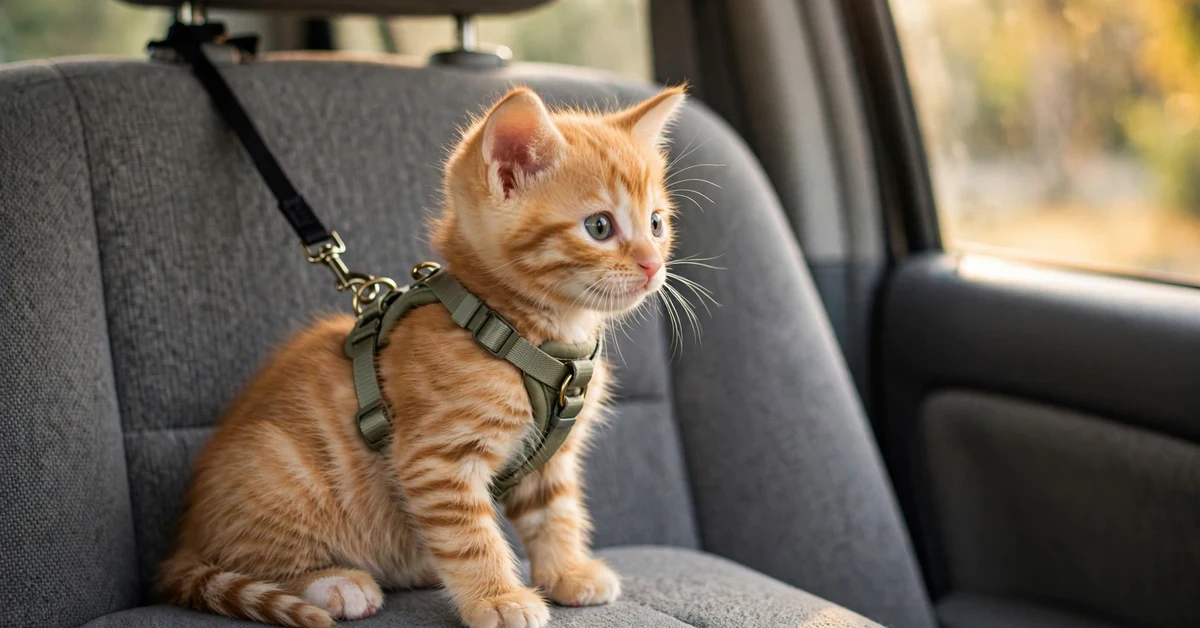
A loose kitten in a moving car does not sit nicely on the seat the way product photos suggest. She goes straight for the interesting places: the footwell by the brake pedal, the gap behind the dashboard, your lap at sixty miles an hour. Every one of those places is a catastrophe with a four-pound animal involved. A headrest leash exists for exactly this problem. It is a short, adjustable strap that runs from your car’s headrest to your kitten’s harness and keeps her in the back seat, where she belongs.
Here is the part the listings will not say plainly: a headrest leash is not crash protection. It will not hold a kitten in a collision the way a secured hard carrier does. What it does is keep a small, fast animal from roaming the car, climbing onto the driver, and vanishing under a seat at a rest stop. Think of it as a containment tether, not a seatbelt. And one rule is absolute: it clips to a harness, never to a collar. A kitten’s neck cannot take the load of a sudden stop, and kittens slip collars the way water slips through fingers.
Kittens also break the assumptions these products are designed around. Most listings are written for dogs, with minimum tether lengths of eighteen to twenty-five inches. At twenty-five inches of reach, a two-pound kitten is visiting the dashboard. The spec that matters most for a kitten is the minimum adjustable length, not the maximum. You want the shortest tether you can find, cinched down so she can sit, stand, and lie down on the back seat and reach nothing else. Kittens chew, too. Any nylon strap in this roundup can be chewed through by a determined kitten, so no tether on this list should ever be used with a kitten left alone in the car.
I pulled six real, currently listed options that work for kittens: four headrest-loop straps and two seatbelt-buckle tethers for cars where the headrest won’t take a loop. Every one is adjustable, every one names small pets or cats in its listing or adjusts short enough to keep a kitten on the seat, and every one is presented here with what the listing actually says rather than what the marketing implies.
| # | Product | Why it made the list | Check Price |
|---|---|---|---|
| 1 | Flower-Decor Dual-Use Pet Seat Belt (xingmao) | Only listing that names cats; 15-inch minimum, lightest at 2.47 oz | Check Price |
| 2 | Lukovee 2-in-1 Seatbelt Leash, 2-Pack | Two anchor systems (headrest + buckle/latch) in one box; bungee and 360-degree swivel | Check Price |
| 3 | AUBELL 3-in-1 Locking Tether (Purple) | Locking carabiner; buckle/latch anchor for cars where headrest loops don’t fit | Check Price |
| 4 | AUBELL 3-in-1 Locking Tether (Black) | Same locking 3-in-1 design in black; hides fur and road grime | Check Price |
| 5 | BWOGUE Headrest Restraint Strap, 2-Pack | Simple headrest strap, 18-inch minimum, “small pets” in the listing; spare included | Check Price |
| 6 | BWOGUE Headrest Restraint Strap, 1-Pack | Same strap as #5, sold singly for one-car buyers | Check Price |
1. Adjustable Pet Car Seat Belt with Cute Flower Decor, Dual-Use Dog Cat Safety Leash for Car Headrest & Seatbelt Buckle (xingmao)
Most pet seat belt listings are written for a twenty-pound dog and sized accordingly. This is the only listing in this roundup that names cats outright — “cats of all sizes” — which means the sizing assumptions at least considered an animal under ten pounds. That alone puts it at the top of a kitten list.
Fifteen inches is the shortest minimum length here, and for a kitten that number is the whole game. Looped over a back-seat headrest and cinched to its shortest setting, this tether gives a kitten room to sit, stand, turn around, and lie down on the seat — and not much else. Stretch it to the full thirty inches and the deal changes completely, which is why the buying guide below spends real time on fitting.
At 2.47 ounces it is also the lightest tether in the roundup, and weight matters more than it sounds. Heavy zinc hardware hanging off a kitten’s harness drags the harness sideways and gives a small animal something to fight against all drive long. A light strap with a simple metal snap hook is kinder on a two- or three-pound body. The dual-use design is practical too: headrest loop where headrests cooperate, seatbelt-buckle clip where they don’t.
Two honest caveats. The flower decoration is a chew target with a bow on it — inspect it the way you inspect the strap, because a kitten will. And this listing is new, first appearing in April 2026, so there is no long buyer history to lean on. You are buying the specs on the page, which are good, not a track record, which does not exist yet.
The seatbelt-buckle mode deserves a closer look, because it is the fallback that makes this tether work in cars where the headrest is a fixed slab. You click the tether’s buckle tab into the car’s seatbelt receiver the way a seatbelt clicks in, then clip the snap hook to the harness. The catch — and it applies to every buckle-mode tether — is that car receivers vary, and a tab that clicks confidently in one car may sit loose in another. Test it in your own car before the first drive, and give it a hard tug. If it releases or wobbles, use the headrest loop instead.
Key specs (listing): Dual-use: car headrest mount or standard seatbelt-buckle clip; adjustable 15–30 inches; thickened tear-resistant nylon webbing with reinforced stitching; metal snap hook (attaches to harness; harness not included); flower decoration on strap; 2.47 oz; manufacturer xingmao; listing states suitability for “small, medium, and large dogs as well as cats of all sizes.”
Pros:
- Shortest minimum length in this roundup (15 in) — the best geometry for a tiny kitten
- Lightest tether here (2.47 oz), so it won’t drag a small harness sideways
- Dual anchor modes cover cars where the headrest won’t take a loop
- The only listing that explicitly names cats
Cons:
- New listing (April 2026) with no long buyer track record
- Flower decoration is an extra chew target and a potential snag point
- No elastic bungee, so sudden stops transmit more jolt than bungee designs
- Metal snap hook is containment-grade hardware, not load-rated
Verdict: The best starting point for a genuinely small kitten: the shortest tether, the lightest hardware, and the only listing that says the word “cat.” Buy it for the specs on the page, fit it short, and check the flower the way you check the strap.
2. Lukovee Dog Seatbelt Leash for Cars, 2 Pack Pet Safety Car Seat Belt with Adjustable Buckle & Reflective Bungee (Black)
This box contains two different belts, not two of the same belt. One anchors to the seatbelt buckle or the latch bar; the other pairs a seatbelt attachment with a headrest restraint. For a buyer who doesn’t know which anchor their car will accept — or whose household runs two different cars — that is genuinely useful. You test both mounts and keep the one that fits.
The feature set is the most complete here: an elastic bungee to soften sudden stops, a 360-degree rotating clip so a spinning kitten doesn’t wind the strap around her own legs, and reflective stitching that earns its keep at night rest stops. These are not gimmicks on a small animal. A kitten changes direction the way a fly does, and tangle resistance is a safety feature, not a luxury.
The honest gap is the one spec a kitten buyer needs most. The listing does not state a minimum tether length. The marketing is written for dogs — small, medium, and large dogs — and kitten suitability is inferred from the adjustability and the small-dog end of the range, not documented. If you buy this for a kitten, fit it at its absolute shortest before she ever gets in the car and confirm she cannot reach the front seats.
Weight is the other watch item. At 4.9 ounces of strap and all-metal hardware, this is the heaviest tether in the roundup. On a ten-pound cat that is nothing. On a two-pound kitten it is noticeable, and it will pull a loosely fitted harness off-center. Pair it with a snug vest harness and check the fit every drive.
One more practical point on the two-belt system: for a kitten, start with the headrest unit. The headrest anchor keeps the attachment point high and behind her, so the strap runs back over her shoulders instead of forward where she can step over it. The buckle/latch belt is the backup for the second car, or for the day you discover your headrest posts are too wide for the loop. And when you do use the headrest belt as a hand leash at a rest stop — gripping the headrest loop as the handle, exactly as the listing suggests — remember that a kitten on a long leash in a parking lot is a kitten with options. Keep it short there too.
Key specs (listing): 2-pack with two designs — belt one anchors to latch bar or seatbelt buckle, belt two combines seatbelt attachment with headrest restraint; durable nylon strap with reflective stitching; elastic buffer bungee; all-metal hardware, dual-safe hooks, quick-release swivel buckles, 360-degree rotating clip; 4.9 oz / 140 g (listing); model LUP122-B-NA; first available August 2021; listing recommends harness over collar.
Pros:
- Two anchor systems in one box — test headrest vs. buckle/latch in your own car
- Elastic bungee softens sudden stops instead of jolting the kitten
- 360-degree swivel clip resists tangling around small legs
- Reflective stitching for visibility at night rest stops
Cons:
- Listing does not state a minimum tether length — the key kitten spec is unknown
- Dog-first marketing; kitten fit is inferred, not documented
- Heaviest tether here (4.9 oz); can drag a loosely fitted harness sideways
- Two different belt designs means more parts to keep track of
Verdict: The most versatile box on the list, with the best anti-tangle hardware. Buy it if you want to test both anchor types — but fit it at its shortest and confirm reach before trusting it with a kitten.
3. AUBELL Dog Seat Belt for Car, Updated 3-in-1 Adjustable Reflective Bungee Heavy Duty Dog Car Harness Tether (Purple)
This one is not a headrest leash at all, and it is here on purpose. It anchors to the seatbelt buckle or the child-seat latch bar instead of the headrest, which makes it the answer for cars with fixed, wide, or missing headrests that a loop cannot fit. It does the same job — keeps the kitten in the back seat — from a different anchor.
The standout detail is the locking carabiner on the harness end. Most tethers in this price range use a simple snap clip, and a squirming kitten working a snap clip for twenty minutes is a genuine escape risk. A clip that locks shut removes that failure mode entirely. For a small animal whose whole travel strategy is “wriggle until free,” that is the single most meaningful hardware upgrade in this roundup.
Now the warning, stated plainly: the minimum length is twenty-five inches, the longest minimum on this list. Run at its shortest, this tether still gives a kitten generous reach, and in a small car that can mean the front seat. This is a pick for kittens old enough and large enough that twenty-five inches keeps them on the back seat. Measure your back seat before you buy, not after.
The listing’s marketing is dog-first, down to the breed language, so kitten suitability is inferred from the adjustability rather than documented. And like every buckle-style tether, it depends on your car’s seatbelt receiver accepting the clip — “universal” is a marketing word, not an engineering guarantee. Test the click at home before the kitten’s first ride.
The latch-bar anchor is the sleeper feature here. The metal latch bar sits in the crease of the back seat — the same bar child seats clip to — and it is the strongest anchor point in the car that isn’t the seatbelt itself. Hooking there instead of the seatbelt receiver also leaves the receiver free, which matters if a human passenger is sharing the back seat with the kitten. The trade is reach: the latch bar sits low, so the tether runs upward to the harness, and with a 25-inch minimum the geometry favors an older kitten who has outgrown the dashboard-reach phase.
Key specs (listing): 3-in-1: hooks to vehicle’s latch bar AND car seatbelt buckle (not a headrest loop); adjustable 25–32 inches (63.5–81 cm); 0.98-inch (2.5 cm) strap width; 5.78 oz / 164 g; 360-degree locking-function swivel carabiner (stainless/zinc alloy); elastic buffer; reflective thread; one tether per package; listing says use with a harness, never attach directly to a collar; Purple.
Pros:
- Locking carabiner can’t pop open under squirming — the best clip security here
- Buckle/latch anchor works where headrest loops can’t fit
- Elastic buffer softens sudden stops
- Reflective thread for night visibility
Cons:
- 25-inch minimum is the longest here — too generous for very small kittens
- Buckle-receiver compatibility isn’t truly universal despite the claim
- Dog-first marketing; kitten fit is inferred, not documented
- Single tether per package, no spare
Verdict: The pick for cars that defeat headrest loops, and the most escape-resistant clip in the roundup. Respect the twenty-five-inch minimum — this one suits older kittens, not eight-week-olds.
4. AUBELL Dog Seat Belt for Car, Updated 3-in-1 Adjustable Reflective Bungee Heavy Duty Dog Car Harness Tether (Black)
This is the same 3-in-1 locking tether as the purple version above, in black. There is no performance difference and no reason to pretend otherwise — it earns its place as a separate listing because color is a practical choice. Black hides fur, road dust, and the general grime of a well-used car strap. Purple shows all of it.
Everything in the purple review applies unchanged: the locking carabiner a kitten cannot work open, the buckle-or-latch anchor for headrest-defying cars, the elastic buffer, and the same twenty-five-inch minimum that makes this a pick for older kittens rather than tiny ones. If you read the section above, you have read this product’s engineering.
The buying decision between the two colors is genuinely just preference and visibility. One practical note: a black strap against a dark interior is harder to inspect for chew damage, so run your fingers along it before every drive instead of trusting your eyes. A lighter color shows wear sooner — for a chewer, that is arguably a feature.
When does this style beat a headrest loop outright? Three cases. Your headrests are fixed slabs. You regularly move the tether between cars and don’t want to re-thread loops. Or your kitten has learned that the headrest loop’s slider is a toy — some kittens fixate on the hardware above them and bat at it until the slider walks. A buckle-anchored tether puts the adjustment point down at the seat, out of the batting zone. None of this makes it better in absolute terms; it makes it better for specific cars and specific kittens.
Key specs (listing): Same 3-in-1 design: latch-bar and seatbelt-buckle anchors (not a headrest loop); adjustable 25–32 inches; 1-inch strap width; 360-degree rotating locking clip; elastic bungee; reflective thread; listing says harness only, never a collar; Black.
Pros:
- Identical locking-carabiner security to the purple version
- Black hides fur and road grime between washes
- Same buckle/latch versatility for difficult headrests
- Same elastic buffer and reflective thread
Cons:
- Same 25-inch minimum — not for the smallest kittens
- Dark strap makes chew damage harder to spot visually
- Same buckle-compatibility caveat as the purple version
- Same dog-first, kitten-inferred marketing
Verdict: Buy the color you prefer; the engineering is identical. Black for low-maintenance looks, with a fingers-along-the-strap chew check before every drive.
5. BWOGUE 2 Packs Dog Cat Safety Seat Belt Strap Car Headrest Restraint Adjustable Nylon Fabric (2-Pack)
This is the straightforward pick: a headrest loop strap, eighteen to thirty inches, that converts to a hand leash when you reach your destination. No locking carabiners, no dual-mode engineering, no decorations. The listing names “small pets” in its sizing language, which is more than most competitors manage, and the eighteen-inch minimum is short enough to keep a kitten on the back seat.
The two-pack format is the real argument here. Kittens have accidents, straps go in the wash, and a household with two cars needs two straps. The second strap is a spare for the day the first one shows chew marks — and with a kitten, that day comes sooner than you think. At this end of the market, a spare strap is worth more than a fancy clip.
The hardware is honest, basic containment gear: nylon webbing and a zinc-alloy swivel snap. It will hold a kitten in the back seat all day long. It is not load-rated, not crash-rated, and not chew-proof, and the listing doesn’t pretend otherwise. One mechanical habit to know: the adjustable sliders on this style of strap loosen under repeated tugging, and a kitten testing the tether at every red light will walk the slider longer over a week. Re-check tension before every drive.
There is no bungee here, so sudden stops transmit directly through the strap. Keep it short and the kitten can’t build up momentum — that is the entire technique with non-bungee tethers, and it works.
A note on care, because kitten gear gets dirty fast. These straps are nylon webbing with metal hardware: hand wash in warm soapy water, rinse, air dry. Never machine wash — the swivel snap will beat up the drum and the drum will beat up the snap. While one strap dries, the second strap is on duty, which is the quiet luxury of the two-pack. Inspect the stitching where the snap meets the webbing every few washes. That junction takes all the load, and it is where a worn strap fails first.
Key specs (listing): 2-pack of headrest restraint straps; adjustable 18–30 inches; 0.98-inch (2.5 cm) nylon webbing; zinc-alloy swivel snap; converts to a hand-held leash; listing says the strap fits “small pets to large breed”; use with a harness, never attach directly to a collar.
Pros:
- Two straps: a spare for the wash or a second car
- 18-inch minimum keeps a kitten on the back seat
- Converts to a hand leash at rest stops
- “Small pets” named in the listing’s sizing language
Cons:
- No elastic bungee — sudden stops transmit directly through the strap
- Zinc-alloy hardware is containment-grade, not load-rated
- Sliders loosen under repeated tugging; tension must be re-checked
- Basic feature set next to locking or dual-mode competitors
Verdict: The honest workhorse: two simple, short-enough headrest straps for the price of one fancy one. Best for buyers who value a spare over features.
6. BWOGUE Pet Dog Cat Seat Belts, Car Headrest Restraint Adjustable Safety Leads (1-Pack)
Same strap as the two-pack above, sold singly. If you have one car, one kitten, and no interest in a spare, this is the no-waste version of the same honest containment tether: headrest loop, eighteen-to-thirty-inch adjustment, hand-leash conversion, small pets named in the sizing.
The trade is obvious and worth stating: there is no backup. The day this strap shows chew damage — frayed edges, thinned webbing, a slider that no longer holds — you are buying again instead of reaching into the drawer. With a kitten, budget for that day arriving within the first year.
Buy this one when your setup is settled: the headrest accepts a loop, the kitten is harness-trained, and you want exactly one strap. Everyone else should take the two-pack.
The single-pack buyer should also know the failure mode to watch for, since there is no spare in the drawer. The zinc-alloy swivel snap is the hardest-working part of this strap: it rotates under load every time the kitten turns, and pot-metal swivels eventually develop play. Once a year — or the moment the snap feels gritty or loose instead of smooth — replace the strap. At this price point, replacement is maintenance, not a tragedy.
Key specs (listing): 1-pack headrest restraint strap; adjustable 18–30 inches; 0.98-inch (2.5 cm) nylon webbing; zinc-alloy swivel snap; converts to a hand-held leash; listing says it fits “small pets to large breed”; harness recommended over collar.
Pros:
- Same simple design as the two-pack, without paying for a spare you won’t use
- 18-inch minimum suits kittens
- Hand-leash conversion at rest stops
- Simplest install on the list
Cons:
- No spare — chew damage means buying again
- No bungee; same direct-transmission stops
- Same containment-grade hardware caveats
- Sliders need re-checking before each drive
Verdict: One strap, no waste, no backup. The right buy for a settled one-car, one-kitten setup.
The harness matters more than the leash
A headrest leash is only as good as what it clips to, and for a kitten that means a harness — always, no exceptions. A collar concentrates the force of a sudden stop on a neck the width of your thumb, and kittens are escape artists who back out of loose collars in seconds. Get a snug vest-style or H-style harness sized for kittens, and fit it the way every listing on this page says: one to two fingers under the straps. Then test it at home, because most kittens defeat a harness by backing up while you pull forward — exactly the motion a tethered kitten makes when she wants to go somewhere. If she can back out of it in the living room, she can back out of it in the back seat. Size up only when the current one is genuinely tight. A harness she’ll “grow into” is a harness she’ll escape from.
Fit the tether short, then check it every single drive
The technique with every tether on this list is the same: adjust it to its shortest comfortable setting, clip it to the harness, and confirm the kitten can sit, stand, turn around, and lie down — and reach nothing beyond the back seat. The front seat, the dashboard, the gap under the front seats, and your lap are all out of bounds. If the shortest setting still gives her the dashboard, the tether is too long for her and she needs a shorter one or a few more weeks of growing. Then make the check a ritual. Before every drive, run the strap through your fingers feeling for chew thinning, confirm the slider hasn’t walked longer, and confirm the clip is fully closed — and locked, on the locking designs. A tether is a wear item. Treat it like one.
Set up the car before the kitten gets in
Everything is easier when the car is ready before the passenger arrives. Loop the headrest strap around the headrest posts — not over the top of a fixed headrest where it can slide off — and close the loop fully. Back seat only: the front passenger seat puts a kitten in the airbag zone, and no tether fixes that. Windows up, or cracked an inch at most — never wide enough for a head. Keep a regular leash by the door for rest stops, because the moment of maximum escape risk is the door opening at a gas station, and a headrest tether unclipped is a free kitten in a parking lot. And the rule that never bends: never leave a kitten tethered and unattended in a parked car. Not for a minute. Heat, chewing, tangling — a parked car multiplies every risk on this list.
What to do when the kitten hates the tether
Some kittens accept a tether the way they accept everything new: with suspicion, then indifference. Others stage a protest. The protest usually takes one of three forms: freezing in place, chewing the strap, or backing out of the harness. Freezing is the easiest to fix — it means the tether is too long and the kitten feels exposed, or too short and she feels trapped. Adjust in small increments, and let her wear the harness without the tether around the house first. Chewing means the strap is sitting in her mouth’s idle zone: shorten it so there is less slack to mouth, and redirect with a toy. Never punish; it only teaches her the car is a bad place. Backing out of the harness means the harness doesn’t fit, full stop — go back to the fitting section and start over. What never works is forcing it. A kitten wrestled into a tether learns that the car means a fight, and you will spend months undoing that lesson. Two or three short, treat-heavy practice sessions in a parked car beat one long miserable drive every time.
Is a headrest leash actually safe for a kitten?
As a containment tether, yes — with a harness, fitted short, and with you watching. It keeps a kitten in the back seat and off the driver, which removes the most likely car danger: a four-pound animal under the brake pedal. What it is not is crash protection. No tether on this list is crash-tested, and none will hold a kitten in a collision the way a secured hard carrier will. Buy the tether for calm, contained rides; use a carrier for genuine crash safety.
Can I attach a headrest leash to my kitten’s collar?
No. Never. This is the one absolute rule of this entire article. A collar puts the full force of a stop or a panicked lunge on a kitten’s neck, and kittens slip collars easily. Every listing in this roundup says the same thing: attach to a harness. If your kitten doesn’t have a harness yet, buy the harness first and the tether second.
What length headrest leash does a kitten need?
The shortest minimum you can find — fifteen to eighteen inches is the sweet spot on this list. The minimum matters more than the maximum, because a tether is only ever used at its short end with a kitten. Fit it so she can sit, stand, turn around, and lie down on the back seat, and reach nothing beyond it. If the shortest setting still lets her reach the front seats, the tether doesn’t fit her yet.
Will a headrest leash fit my car’s headrest?
If your headrest has posts — the removable kind with two metal stalks — yes: the loop goes around the posts and closes. If your headrest is a fixed slab with no gap, a loop-style tether won’t sit securely, and you should use a seatbelt-buckle or latch-bar tether instead (two are included in this roundup for exactly that reason). Test the loop at home before the first drive. A loop that slides is a loop that fails.
My kitten chews the strap. What should I do?
Assume every nylon strap on this list is chewable, because to a kitten it is. Inspect the full length before every drive — run it through your fingers and feel for thinning, fraying, or a slider that no longer grips. A chewed strap is a retired strap; replace it, don’t trust it. Never leave a kitten alone with a tether, even for a minute. A bitter-tasting deterrent spray on the strap slows most chewers down, though it won’t stop a determined one.
Does my kitten still need a carrier if I use a headrest leash?
For crash safety, yes. A tether and a carrier solve different problems: the tether keeps a calm kitten contained and findable on ordinary drives, while a carrier secured with the seatbelt is the only option here that offers real collision protection. For long highway trips, use the carrier. For the vet run across town with a harness-trained kitten, a short, well-fitted tether is a reasonable choice.
None of the six tethers on this list will save a kitten in a crash, and any article that implies otherwise is selling something. What they will do — fitted short, clipped to a snug harness, checked before every drive — is buy you the two things that actually make car travel with a kitten workable: a back seat she stays in, and a kitten you can find the moment a door opens. That is a smaller promise than “car safety,” and it is one these straps can keep. Pick the shortest tether your car and your kitten’s size allow, pair it with a harness that fits today rather than one she’ll grow into, and make the pre-drive check as automatic as your own seatbelt click.
