

As an Amazon Associate, pettravelitems.com earns from qualifying purchases. Prices and availability change, so check the current Amazon listing before you buy.
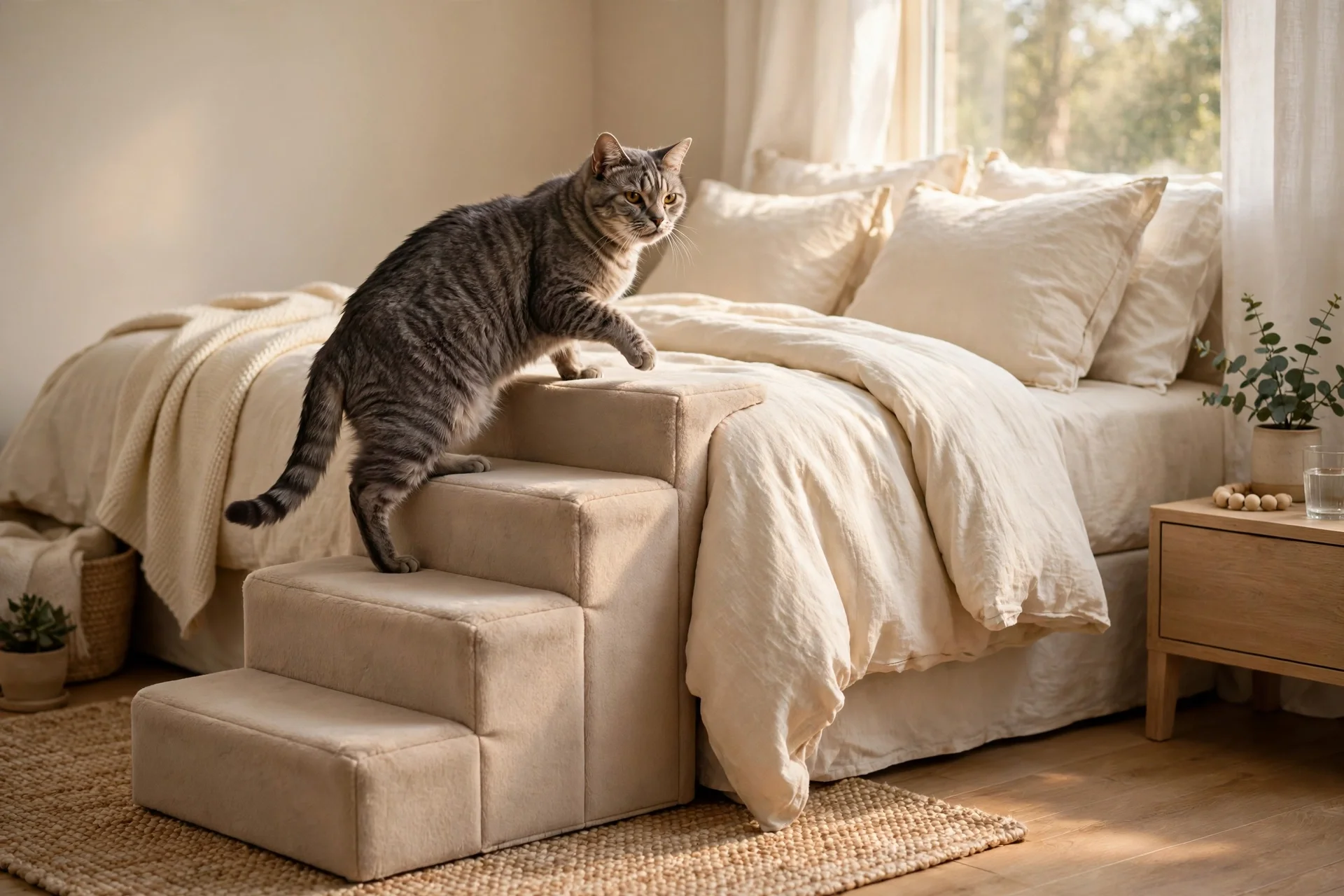
Most cats can jump. That is the problem. A senior cat with stiff hips will keep jumping onto the bed long after it hurts, because cats do not do self-preservation the way we wish they would. Every hard landing loads the same sore joints. A set of pet steps does not cure arthritis. It just turns a 24-inch leap into four small hops, and for a twelve-year-old cat that difference matters.
I put together this roundup with one rule: no fairy tales. Foam steps slide. Plastic steps are hard. Wooden steps need assembly and do not forgive a misstep. Every product below has real owner complaints attached, because the complaint is usually the part that decides whether the thing works in your house.
| # | Product | Steps / Size | Weight limit / Build | Check price |
|---|---|---|---|---|
| 1 | Pet Gear Easy Step III | 3 steps, 25×16×23 in | 150 lbs, hard plastic | Check Price on Amazon |
| 2 | Best Pet Supplies Foldable Foam, 4-Step | 4 steps, 28×16×22 in | ~75 lbs, CertiPUR-US foam | Check Price on Amazon |
| 3 | Majestic Pet 4-Step Heavy-Duty | 4 steps, 24×16×20 in | 250 lbs, sherpa/foam | Check Price |
| 4 | PEITA PET Wooden 3-Step | 3 steps, 16×12×14 in | 40 lbs, wood | Check Price on Amazon |
| 5 | Sweet Home Collection 4-Tier | 4 tiers, 28×16×20 in | Not published, foam, 2 lbs | Check Price on Amazon |
| 6 | Best Pet Supplies 5-Step | 5 steps, 30×16×22.5 in | Foam, for high beds | Check Price on Amazon |
1. Pet Gear Easy Step III Pet Stairs, 3-Step for Cats/Dogs
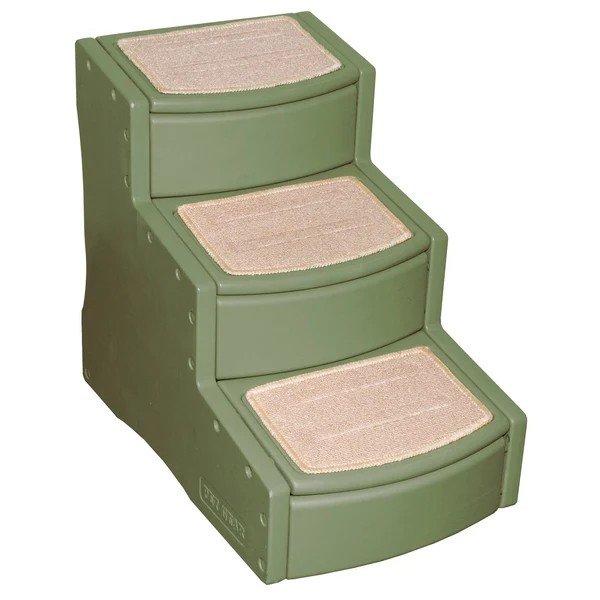
This is the tank of the group. Hard molded plastic, three wide steps, rated for pets up to 150 pounds. It has been around for years, and there is a reason it keeps selling: it does not compress, it does not wobble on carpet, and the carpet treads pull off for washing. For a heavy cat, a clumsy cat, or a house where a cat and a small dog share one staircase, rigidity is the whole argument. Foam gives under weight. This does not.
The honest part. It is plastic, not foam, and a few owners bought it expecting something soft and were annoyed. The top step sits 23 inches up with no side rails, so a wobbly senior has nothing to lean on. Assembly is snap-together with no tools, which sounds easy until you are wrestling the joints; owners say a drop of dish soap on the contact points fixes it. And the deep nine-inch treads that suit bigger animals can feel like a stretch for a tiny kitten. It also juts into the room. Measure before you order.
Specs: 25″L x 16″W x 23″H assembled; 6-inch step rise; tread depths 9.5″ (top), 9″, 9″; 150 lb capacity; rubber grippers on the base; snaps together, no tools.
Pros:
- Rigid plastic holds its shape under heavy pets; no sinking or tipping on carpet
- Wide, deep treads suit larger cats and multi-pet homes
- Carpet treads remove for machine washing
- Rubber grippers keep the base from walking on hard floors
Cons:
- Hard plastic, not foam; unforgiving if your cat dislikes hard surfaces
- No side rails on a 23-inch-tall stair
- Snap assembly can be very stiff out of the box
- Bulky footprint that sticks into the room
Verdict: Buy this when the cat using it is heavy, clumsy, or shares the stairs with a dog. Skip it if your cat only trusts soft surfaces. Check the current price on Amazon.
2. Best Pet Supplies Foldable Foam Pet Steps, 4-Step (Gray Lattice)
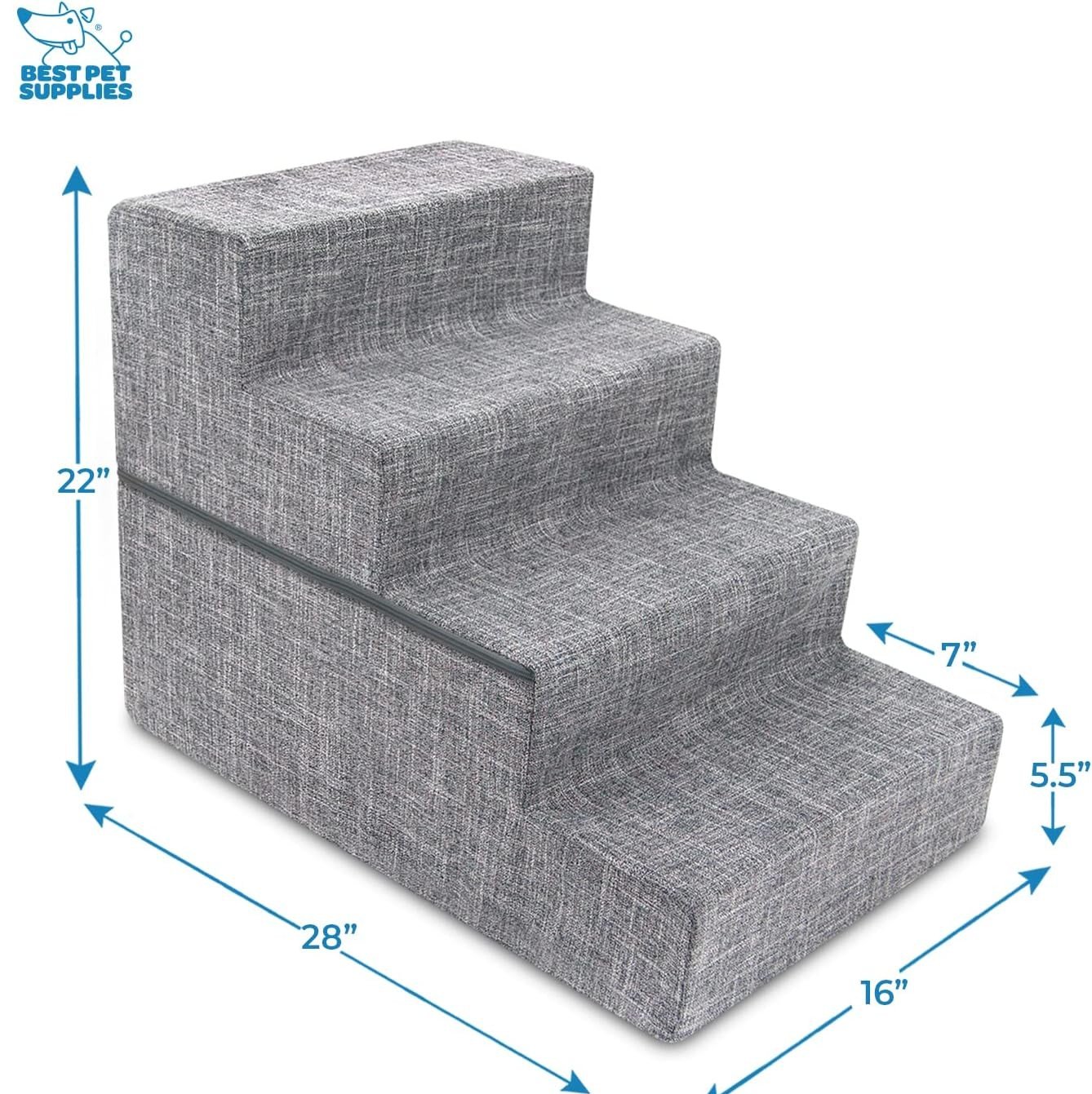
The classic foam stair. CertiPUR-US certified foam, which means it was made without the nasty flame retardants and heavy metals you do not want your cat kneading. It unfolds from flat, needs zero assembly, and the cover zips off for washing. For a senior cat with sore joints, foam has one unbeatable quality: it is silent and soft. A nervous cat that flinches at the hollow knock of plastic will often accept foam on the first day. It comes in 2, 3, 4, and 5-step versions, so you can match your furniture height instead of guessing.
Now the complaints, because foam stairs earn them. It slides on hard floors. Several owners report it only stays put on carpet or a rug; on wood or tile, plan on a non-slip pad underneath or bracing it against the bed. Lightweight foam plus a tall stack means a heavy animal hitting the top tread can tilt it sideways. For a 10-pound cat this is a non-issue; for a 20-pound Maine Coon, brace it. And the washable cover: getting it off is a puzzle, and owners describe getting it back on as nearly impossible even with help. Wash it only when you must.
Specs: 28″L x 16″W x 22″H; 5.1 lbs; CertiPUR-US foam; removable machine-washable cover; folds flat; 90-day manufacturer warranty; holds up to about 75 lbs per retailer Q&A.
Pros:
- Soft, silent foam that arthritic and noise-shy cats accept readily
- CertiPUR-US certified foam, no assembly, folds flat for storage
- Four step heights and 17 colors/patterns to match furniture
- Removable washable cover
Cons:
- Slides on hard floors unless braced or paired with a grip pad
- Can tilt under heavy weight on the top tread; not ideal for very heavy pets
- Treads are shallow and the grade is steep for timid cats
- Refitting the cover after washing is genuinely difficult
Verdict: The best soft option for an average-weight senior cat on carpet. Brace it on hard floors and never wash the cover casually. Check the current price on Amazon.
3. Majestic Pet 4-Step Portable Pet Stairs, Heavy-Duty
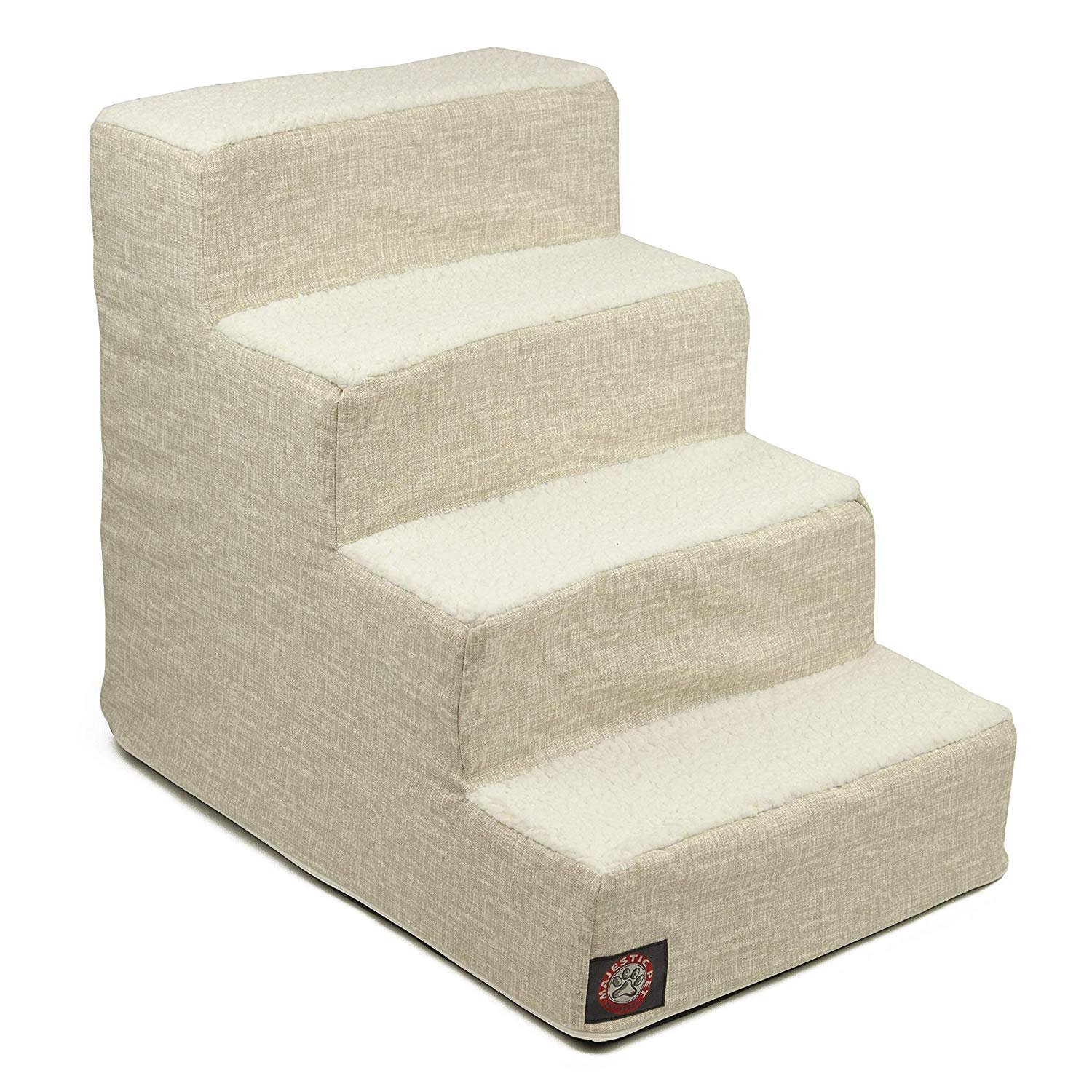
Majestic Pet has made pet furniture in the US since the nineties, and this is their answer to the foam-stair weight problem: a soft sherpa-topped stair with a corrugated insert, rated up to 250 pounds. That number matters. Most foam stairs either publish no weight limit or top out around 75. If your cat is a 22-pound gentle giant, or a cat and a beagle share one staircase, this is the only soft stair here with a rating that covers them. The sherpa tops are the grippiest tread surface in this roundup, and the cover is machine washable.
Read the listing carefully before you click buy. Majestic Pet sells two 4-step lines that look almost identical: one rated for 25 pounds or less, and this heavy-duty one rated for 250. Buyers have ordered the wrong one. Confirm the weight rating on the exact variant in your cart. The soft construction also dents and holds impressions over time; it will not look as crisp in year two as a plastic stair. A determined scratcher can claw the upholstery, so keep a scratching post next to it. And the warranty is only 30 days, which is thin at this price.
Specs: 24″D x 20″H x 16″W; 7 lbs; up to 250 lbs capacity; sherpa-topped steps over a corrugated insert; machine-washable removable cover; designed and assembled in the USA; 3 and 4-step versions.
Pros:
- 250 lb rating, the highest soft-stair capacity here by far
- Sherpa treads give excellent grip for hesitant paws
- Quiet, joint-friendly, and the insert will not bruise your shins at night
- Washable cover; US-assembled
Cons:
- Two lookalike variants with wildly different weight ratings; easy to order the wrong one
- Soft body dents and shows wear faster than hard plastic
- Upholstery is a scratching temptation
- Short 30-day warranty for a premium-priced stair
Verdict: The pick for heavy cats and multi-pet homes that still want a soft stair. Double-check the 250 lb rating on your exact variant. Check the current price on Amazon.
4. PEITA PET Wooden Cat Stairs, 3-Step (CT03)
The only wooden stair in this roundup, and wood changes the equation. It does not compress, it does not slide once assembled, and a cat that chews foam cannot destroy it. At 16 by 12 by 14 inches it is compact enough for a small bedroom, with carpeted treads for grip and a triangular frame rated to 40 pounds. For cats that shred soft stairs or owners who simply do not trust foam, this is the honest alternative.
The trade-offs are real. You assemble it yourself, about five minutes, and the instructions live in a video on the product page rather than in the box. The treads are 12 inches wide. An average cat fits fine, but a long cat walks single-file with paws near the edges, and there is no margin for a wobbly misstep. Wood does not forgive the way foam does; an arthritic cat that stumbles will meet a hard edge. The carpet treads shed and pill under claw traffic and cannot be replaced the way Pet Gear’s can. And it only reaches furniture 14 to 17 inches high, so measure your bed. Many are taller.
Specs: 16″D x 12″W x 14″H; 5.39 lbs; wood panels with non-slip carpet treads; 40 lb capacity; fits furniture 14-17″ high; assembly required; 1-year quality guarantee per the listing.
Pros:
- Rigid wood; zero compression, zero tipping, chew-proof
- Compact footprint for small rooms
- Carpeted treads add grip on an otherwise slick material
- Simple design that wipes clean
Cons:
- Assembly required with video-only instructions
- Narrow 12-inch treads; tight for large or unsteady cats
- Hard edges punish missteps; less forgiving than foam for arthritic cats
- Only suits low furniture up to 17 inches
Verdict: Good for a sturdy adult cat that destroys foam, or a low sofa in a small room. Not the pick for a frail arthritic cat. Check the current price on Amazon.
5. Sweet Home Collection Pet Stairs, 4-Tier
Two pounds. That is the whole story of this stair, for better and worse. It is the lightest option here by a wide margin, which makes it the easiest to move between the bedroom and the living room, and the zippered cover comes off for the washing machine. The high-density foam and four tiers reach a 20-inch height, enough for most sofas and lower beds.
The lightness is also the warning. Lightweight foam stairs are the ones owners most often report sliding across hard floors; plan to brace this against the furniture or put a grip pad under it. The listing publishes no weight limit at all, so you are trusting the foam-density claim with no number behind it. That is a gamble for a heavy cat. Foam dents under concentrated weight over time, and at 16 inches wide the landings are on the narrow side for a nervous cat that wants room to plant all four paws.
Specs: 4-tier: 28″L x 16″W x 20″H; 2 lbs; high-density foam; zippered machine-washable cover; also sold in 3-tier and 5-tier; weight limit not published.
Pros:
- Extremely light; easy to carry from room to room
- Zippered washable cover
- Three height options including a 5-tier for tall beds
- Soft and quiet for noise-sensitive cats
Cons:
- Slides on hard floors; needs bracing or a grip pad
- No published weight limit
- Foam dents over time under heavy use
- Narrow landings for timid cats
Verdict: A fine budget mover for a light cat on carpet. Do not buy it for a heavy cat without a published weight limit to stand on. Check the current price on Amazon.
6. Best Pet Supplies 5-Step Foam Pet Steps (Ash Gray Linen)
High beds are the hard case. A 4-step that tops out at 22 inches still leaves a real jump onto a tall mattress, and that last jump is the one that hurts. This 5-step version exists for exactly that situation: five increments to the top of a high bed, same CertiPUR-US foam and washable cover as its 4-step sibling, in 17 colors.
It inherits the family traits, good and bad. Thirty inches deep is the largest footprint in this roundup; in a small bedroom it will eat floor space and sit exactly where you walk at night. The same lightweight-foam physics apply: a heavy pet lunging onto the top tread can shift it, so brace it against the bed. Owners of the 4-step report the cover is brutally hard to refit after washing, and this one shares the design. And a blunt truth: five steps will not convert a cat that refuses stairs on principle, and at this size it is an expensive experiment if yours is that cat. Borrow a friend’s stair for a weekend first if you can.
Specs: 30″L x 16″W x 22.5″H; 4 lbs; CertiPUR-US foam; removable machine-washable cover; 3, 4, and 5-step options; 17 colors.
Pros:
- Five steps genuinely solve high beds where 3 and 4-steps fall short
- Soft foam, quiet, no assembly
- CertiPUR-US certified foam
- Wide color range
Cons:
- 30-inch depth dominates a small bedroom
- Can shift under heavy weight on the top tread; brace it
- Cover is very hard to refit after washing
- Expensive way to discover your cat ignores stairs
Verdict: The right answer for a high bed and a cat that already uses stairs. Measure your floor space first. Check the current price on Amazon.
How to choose cat pet steps without wasting money
Start with a tape measure, not a product page. Measure from the floor to the top of the mattress or sofa cushion. That number picks your step count: up to about 17 inches, a 3-step works; 20 to 22 inches wants 4 steps; above that, 5 steps or a ramp. Buying too few steps leaves the painful final jump in place, which defeats the purpose.
Next, be honest about the cat. A 9-pound senior with arthritis needs soft, grippy, and quiet: foam with a fabric cover, on carpet, braced against the bed. A 20-pound bruiser needs rigidity and a real weight rating: hard plastic or the Majestic heavy-duty line. A cat that chews everything needs wood or hard plastic, because foam becomes confetti.
Flooring decides the rest. Foam stairs on hardwood slide; that is the single most common complaint across every brand. If your floors are hard, budget for a non-slip pad or push the stairs tight against the furniture so they cannot walk. And train the cat. Put treats on each step for a few days. Most cats that “refuse” stairs were simply never introduced to them. A stair the cat will not climb is furniture, not a mobility aid.
One last thing: none of these are car seats or crash-tested travel gear. They help a cat reach a sofa, a bed, or the seat of a parked car. They do not make a cat safe riding in one.
Frequently asked questions
Do cats actually use pet steps, or will mine ignore them?
Most cats use them if introduced properly, and seniors with sore joints often take to them fast because the steps hurt less than jumping. The cats that ignore stairs are usually either young and athletic (they do not need them) or were never trained. Put a treat on each step for three or four days. Do not carry the cat up the steps; let it discover them.
Are foam or hard plastic steps better for cats?
Foam is quieter, softer on arthritic joints, and less scary for nervous cats, but it slides on hard floors and can tip under heavy weight. Hard plastic stays put and holds heavy pets, but it is noisy and unforgiving. For an average senior cat on carpet, foam wins. For a heavy cat or a multi-pet house, plastic wins.
How many steps does my cat need?
Match the step count to your furniture height. Three steps reach furniture about 14 to 17 inches high (low sofas). Four steps cover 20 to 22 inches (most beds). Five steps are for high beds above 22 inches. Measure the furniture first; guessing is how stairs end up unused in a closet.
Can pet steps help an arthritic cat?
They reduce the impact of jumping, which is genuinely useful for arthritis management, but they are not treatment. If your cat has started hesitating before jumps, missing landings, or crying, see a vet. Steps manage the symptom; the vet manages the cause.
Why do my foam pet stairs keep sliding?
Because foam is light and hard floors are slick; this is the most reported problem with foam stairs. Fix it by pushing the stairs firmly against the furniture, putting a non-slip rug pad underneath, or choosing a heavier rigid stair. Do not let a cat use a stair that walks across the room mid-climb.
Are pet steps safe to use for getting a cat into a car?
They can help a cat climb into a parked car, which is useful for vet trips with a senior cat. They are not travel safety equipment. Once the car moves, the cat belongs in a carrier, preferably secured. No pet stair is crash-tested.
