

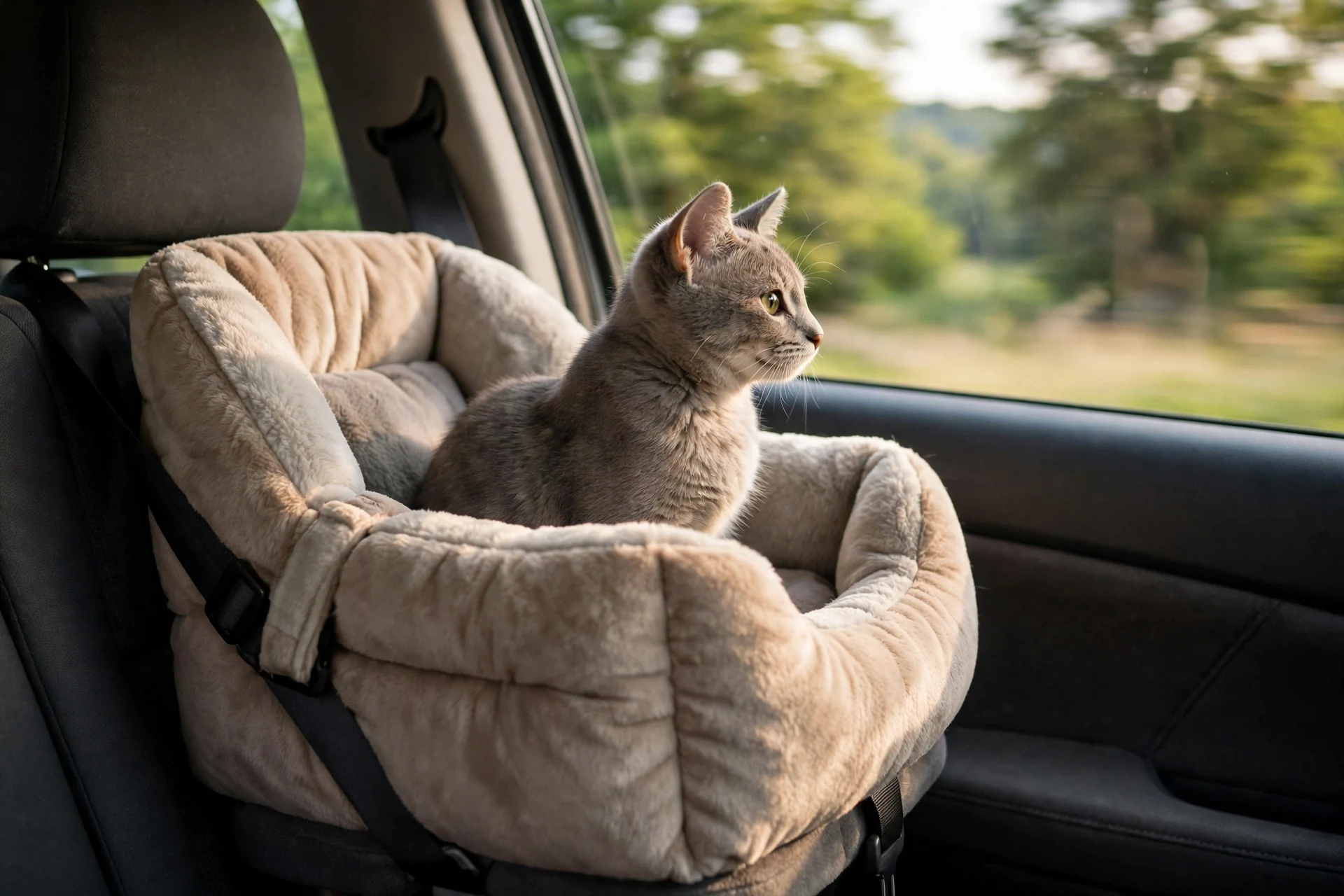
Let’s start with the honest part, because it determines whether you should buy anything on this page: a booster seat is an open bed on your car seat. Dogs take to them naturally. Cats — who did not consent to this arrangement — often try to climb out within minutes. A booster seat only works for a calm cat that already tolerates car rides, and it must always be paired with a harness and the seat’s tether. It is containment for a relaxed passenger, not a crash restraint.
If that describes your cat — the rare small cat that sits, watches the world, and stays put — a booster is genuinely lovely: elevation for the window view, closeness to you, and a defined spot instead of a lap under the steering wheel. We reviewed six seats that either market to cats directly or explicitly list cats as suitable, complaints included.
Pet Travel Items is reader-supported. When you buy through links on this page, we may earn a commission at no extra cost to you. Our picks are driven by documented owner feedback, never by commission rates.
Cat Booster Seats at a Glance
| # | Booster Seat | Weight Limit | Best For | |
|---|---|---|---|---|
| 1 | Pawsome Avenue | 13 lbs | Designed for cats | Check Price |
| 2 | K&H Bucket Booster | Small–med pets | Most trusted brand | Check Price |
| 3 | Snoozer Lookout I (S) | 18 lbs | Premium pick | Check Price |
| 4 | Petbobi Reinforced | 15 lbs | Best structure | Check Price |
| 5 | BurgeonNest Console | 11 lbs | Console/armrest style | Check Price |
| 6 | SWIHELP | 13 lbs | Budget pick | Check Price |
1. Pawsome Avenue Dog & Cat Booster Seat — Best for Cats Specifically
Most booster seats are dog products that tolerate cats. The Pawsome Avenue is designed for both from the start — up to 13 lbs, best under 10, which is exactly the small-cat range. The plush faux-lambswool lining is the kind of texture cats actually choose to sit on, and the elevated design gives the window view that keeps calm cats occupied instead of restless.
It mounts three ways — armrest, front seat, or back seat — with adjustable straps, a non-slip base, a seatbelt loop, and a built-in harness clip. The removable cover unzips for washing, and it doubles as a soft carrier for vet runs, which is genuinely useful for a cat product.
Owner complaints, honestly: it’s a newer brand with a thinner review base than K&H or Snoozer, so long-term durability is less documented. Armrest mounting wobbles in some cars — the seat mount is more stable. And the universal booster caveat: only a calm cat stays in an open seat. Test your cat’s temperament with a laundry basket on the passenger seat before you buy anything.
Specs: Up to 13 lbs (best under 10) · armrest/front/back mounting · harness clip · washable cover · doubles as carrier.
Pros: Cat-first design; three mounting options; plush lining cats accept; doubles as a carrier.
Cons: Thinner review history; armrest mount can wobble; open design needs a calm cat.
Verdict: The most cat-considered booster here. If your cat is small and calm, start here. Check the price on Amazon.
2. K&H Bucket Booster Pet Seat — Most Trusted Brand
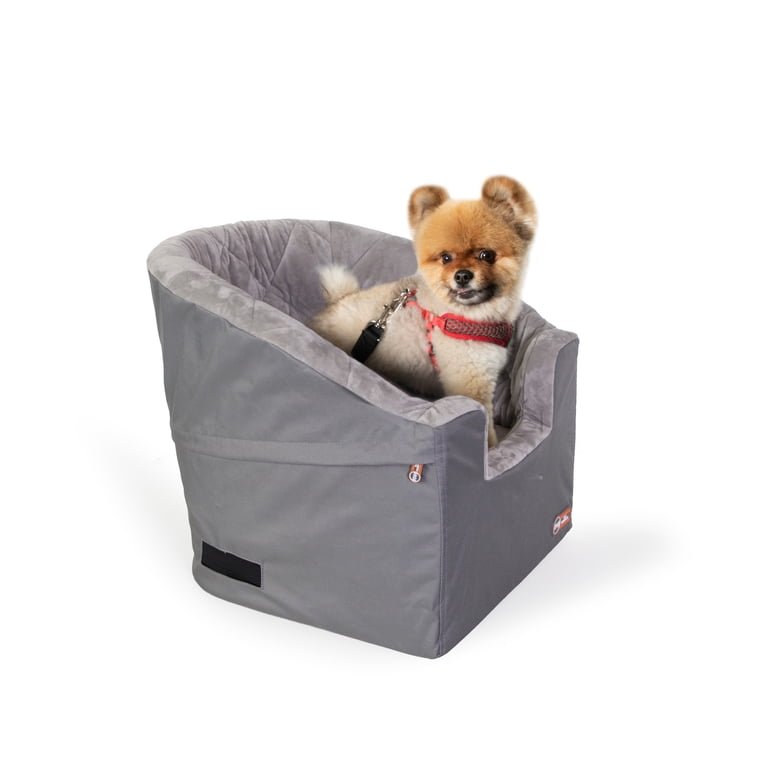
K&H has been making the Bucket Booster for over two decades, and it’s the reference design the whole category copies: a bucket with a firm foam bolster around the edge, a seat belt that hides under the removable cushion, and tethers that clip to the pet’s harness. K&H explicitly markets it for cats and kittens, not just dogs.
Why it works for cats: the bolster creates a defined nest with edges, which matters — cats accept bounded spaces far better than flat open beds. The front dips down so the cat can climb in on its own terms (being lifted into a car seat is how you get a cat that hates the car seat). Two adjustable tethers come in the box.
Complaints: the foam bolster softens after years of heavy use. The quilted cover can pill in the wash. And the Large (20″ x 22″) is roomy for one small cat — if yours is under 8 lbs, K&H’s Small size is the better fit. The design is old, but old here means debugged.
Specs: Large 20″ x 22″ (Small also available) · foam bolster · 2 harness tethers · machine-washable fleece cover.
Pros: 20-year track record; bolster creates a cat-accepted nest; 2 tethers included; washable.
Cons: Foam softens with age; cover can pill; Large is roomy for petite cats.
Verdict: The safe, boring, correct choice. Two decades of owners can’t be wrong. Check the price on Amazon.
3. Snoozer Lookout I (Small) — Premium Pick
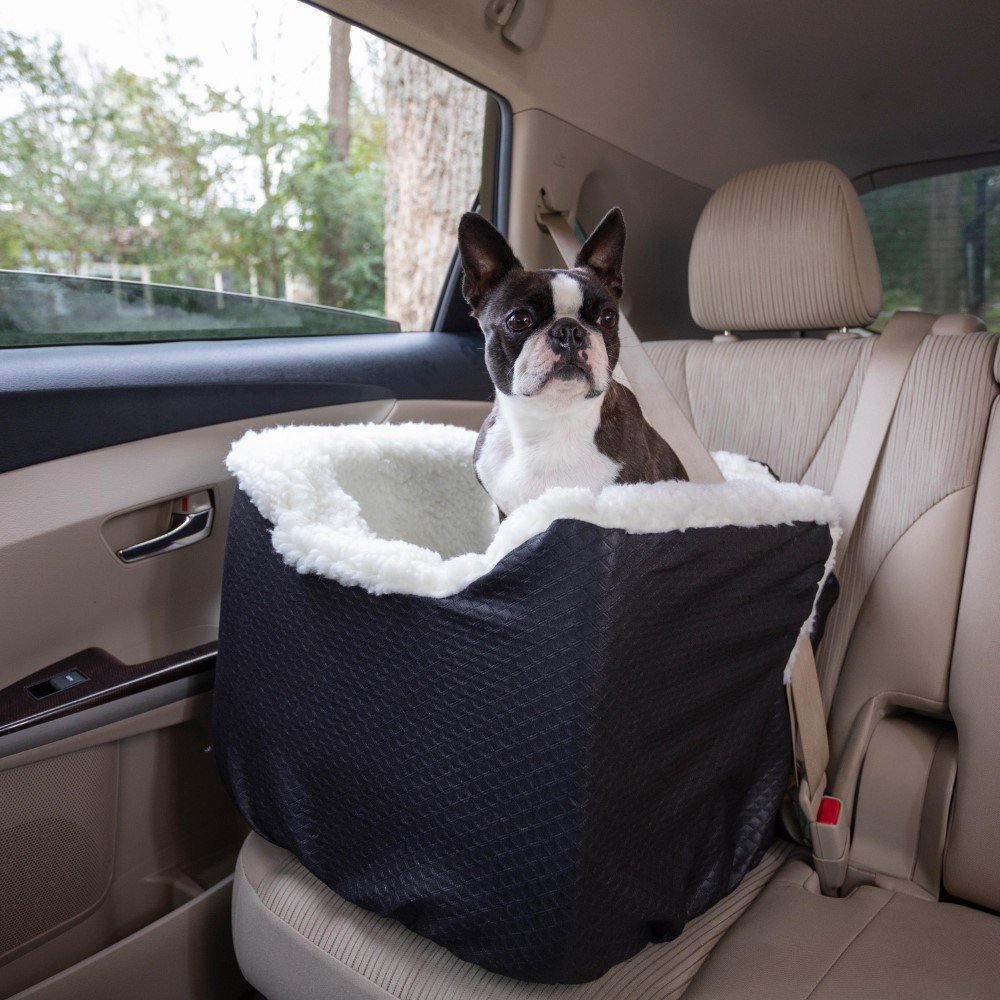
The Snoozer Lookout I is the luxury end of the category: shock-absorbing foam base, rigid foam sidewalls, a 6-inch elevated bed for the window view, and a removable machine-washable sherpa cover. It ranks in Amazon’s top 100 in booster seats with a deep owner history, and it’s handcrafted in the USA with a 1-year warranty.
For cats, the relevant features: the 6-inch elevation genuinely helps with car sickness (seeing the horizon stabilizes the inner ear — this works for cats as well as dogs), the sherpa interior is the right texture, and at 19″ x 15″ x 17″ the Small fits a cat with room without swimming in space. The included harness strap clips to the seatbelt.
The price is the obvious complaint — it’s the most expensive seat here. The foam compresses over years (Snoozer sells replacement filling, which tells you it’s a known thing). And made-to-order can mean a shipping wait. You’re paying for materials and build, not magic.
Specs: 19″ H x 15″ W x 17″ L · up to 18 lbs · foam base + sidewalls · sherpa interior · harness strap.
Pros: Best materials here; elevation eases car sickness; deep owner history; USA-made.
Cons: Premium price; foam compresses over time; possible shipping wait.
Verdict: The buy-it-once seat. If the budget stretches, the materials justify it. Check the price on Amazon.
4. Petbobi Reinforced Booster Seat — Best Structure
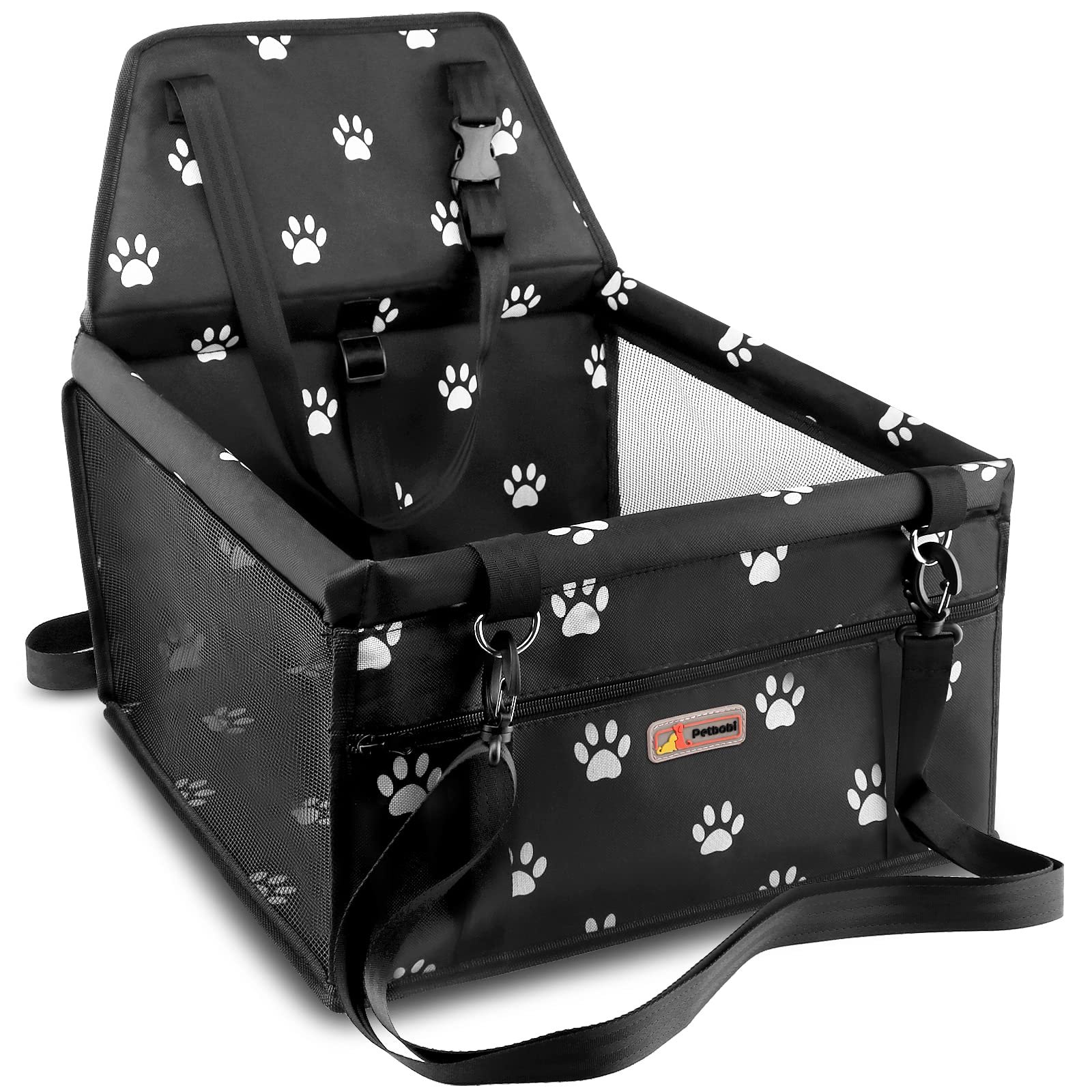
The Petbobi’s selling point is structural honesty: thicker PE panels in the back, bottom, and front, plus reinforced PVC tube supports on the sides — an upgraded design the brand says came from buyer feedback. At 15.75″ x 13.38″ x 9.8″ for pets up to 15 lbs, it fits small cats with room to spare.
Attachment is thorough: dual seat-belt loops, adjustable headrest straps, and an internal leash that clips to the harness (shortened, per the brand, to limit excess movement). The Oxford-and-mesh build is water-resistant and wipes clean, and it folds flat for the trunk.
Caveats: it’s still a soft-sided seat, not a rigid one — “reinforced” means it holds its shape, not that it’s a crate. Generic-brand longevity is less documented than K&H or Snoozer. And mesh panels plus cat claws are a combination to watch; keep nails trimmed.
Specs: 15.75″ x 13.38″ x 9.8″ · up to 15 lbs · PE panels + PVC tubes · mesh/Oxford · folds flat.
Pros: Best shape retention here; thorough attachment system; water-resistant; folds flat.
Cons: Still soft-sided; thinner long-term record; mesh vs. claws.
Verdict: The structure-first mid-range pick. Holds its shape where cheaper seats sag. Check the price on Amazon.
5. BurgeonNest Center Console Car Seat — Best Console Style
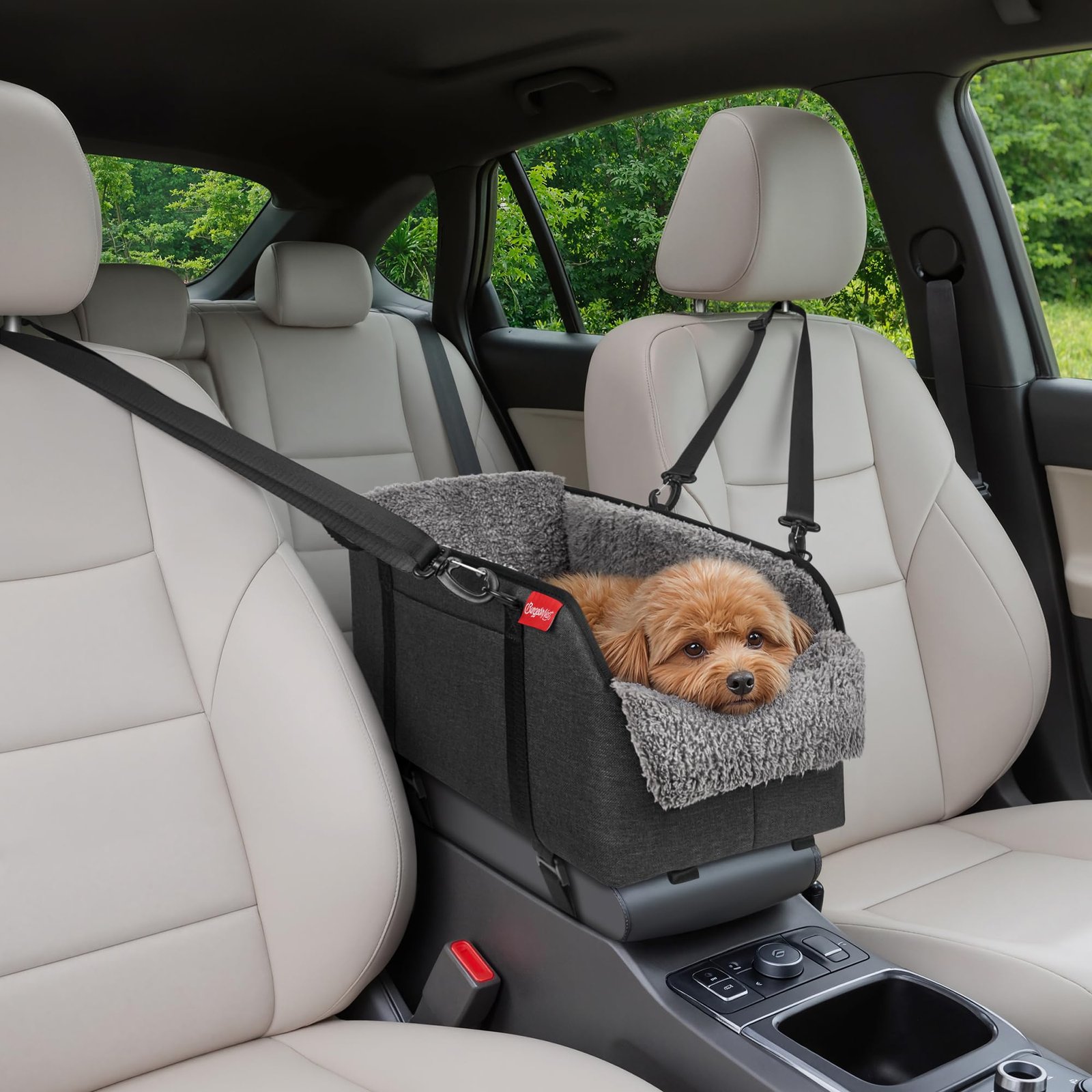
Console seats are a different philosophy: instead of a bed on the passenger seat, the cat rides on the center armrest, right beside you. For cats that need contact to stay calm — and many do — this is the format that actually works. The BurgeonNest fits pets under 11 lbs and 12 inches long, with a reinforced honeycomb-board surround and plush pearl-cotton interior.
Mounting uses dual side straps to both front headrests plus bottom straps around the console lid. The raised front pillow supports the head, everything detachable is machine washable, and it doubles as a shoulder carry bag for vet visits.
Honest limitations: measure your console first — it needs roughly a 17″ x 9.8″ armrest, and not all cars qualify. The 11-lb limit excludes bigger cats. And console mounting can shift on sharp turns despite the straps; this is a calm-driving accessory, not a rally setup.
Specs: Console mount · up to 11 lbs / 12″ length · honeycomb board · washable plush · doubles as carrier.
Pros: Best format for contact-seeking cats; solid mounting system; washable; doubles as carrier.
Cons: Console must be the right size; 11-lb limit; can shift on sharp turns.
Verdict: The closeness pick. For cats that ride calm only when touching you, this is the answer. Check the price on Amazon.
6. SWIHELP Pet Car Booster Seat — Budget Pick
The SWIHELP is the cheapest credible booster here: 600D waterproof Oxford, mesh ventilation panels, adjustable straps for front or back seat, a front storage pocket, and a fold-flat design — for pets under 6 kg (about 13 lbs).
At this price, expectations should be calibrated: the padding is thinner than premium seats, the safety leash clip feels flimsy (use your own harness tether — you should anyway), and the generic sizing guidance means you should measure your seat rather than trusting the listing. But the fundamentals — elevation, a defined spot, attachment straps — are all present.
It’s the right buy for one scenario: you’re not sure your cat will accept a booster at all, and you want to test the concept cheaply before investing in a K&H or Snoozer. If the cat takes to it, upgrade. If not, you’re out the price of a pizza.
Specs: 40 x 32 x 24 cm · under 6 kg · 600D Oxford · mesh panels · folds flat.
Pros: Lowest price; waterproof fabric; folds flat; fine as a concept test.
Cons: Thin padding; flimsy leash clip; generic sizing guidance.
Verdict: The experiment pick. Test whether your cat accepts boosters before spending more. Check the price on Amazon.
How to Choose a Booster Seat for a Small Cat
First, test the concept for free. Put a laundry basket with a towel in it on the passenger seat and drive around the block. If your cat sits in it, a booster will probably work. If your cat immediately climbs out, no product on this page will fix that — buy a carrier instead. This five-minute test saves more money than any review.
Always use a harness and tether. Every seat here includes some form of leash or tether; use it, attached to a harness (never a collar — a sudden stop on a collar leash can injure a cat’s neck). The tether is what makes an open booster acceptable; without it, it’s just a bed the cat can walk out of at 60 mph.
Bounded beats flat. Cats accept spaces with edges. The K&H’s bolster, the Snoozer’s sidewalls, the BurgeonNest’s surround — these aren’t just comfort features, they’re the reason a cat stays put. A flat pad on a seat is not a booster seat in any meaningful sense.
Match the format to the cat. Independent cats that like watching: a window-facing seat booster (Pawsome Avenue, K&H, Snoozer). Contact-seeking cats: a console seat (BurgeonNest). Anxious cats that hide: honestly, a covered carrier, not a booster.
No booster is a crash restraint. None of these are crash-tested. They reduce driver distraction and keep the cat in one place — real safety benefits — but in a serious collision, a secured hard-sided carrier is safer. Drive accordingly.
Bottom line: the K&H Bucket Booster is the safest default, the Pawsome Avenue is the most cat-considered design, and the BurgeonNest wins for contact-seeking cats. And if the laundry-basket test fails, get a carrier — there’s no shame in it.
Frequently Asked Questions
Are booster seats safe for cats?
They’re safer than a loose cat — a cat under the brake pedal is a genuine hazard — but they’re not crash restraints. Use the seat’s tether attached to a harness (never a collar), mount the seat securely, and understand that a hard-sided carrier secured with a seatbelt is safer in a serious collision. Boosters are for calm cats on normal drives.
Will my cat stay in a booster seat?
Maybe — and that’s the honest answer. Calm cats that tolerate car rides usually settle into a bolstered seat, especially with a window view. Anxious or exploratory cats climb out. Test with a laundry basket on the passenger seat first; if your cat won’t stay in that, a booster won’t change the outcome.
Should I put the booster seat in the front or back?
The back seat is safer — same logic as for children, away from the airbag. That said, many owners use the front seat so they can reach the cat. If you use the front, disable the passenger airbag if your car allows it, and keep the cat harnessed and tethered either way.
What size booster seat does a small cat need?
Most small cats (7–11 lbs) fit the small/medium sizes: roughly 15–20 inches long. The cat should be able to sit, lie down, and turn — boosters run snug by design, since a defined nest is the point. When between sizes, smaller is usually better for cats.
Can I use a dog booster seat for my cat?
Yes, if the size and weight rating fit — several picks above (K&H, Snoozer, Petbobi) are marketed for dogs but explicitly list cats as suitable. The main difference in cat-specific designs is usually just sizing and softer textures. Check the weight limit and interior dimensions, not the species on the box.
Booster seat vs. carrier for a cat in the car?
A carrier wins on safety and works for every temperament — an anxious cat in a covered carrier is calmer than an anxious cat in an open booster. A booster wins on comfort and view for the subset of cats that ride calmly and stay put. If in doubt, choose the carrier; graduate to a booster only once the cat proves it rides relaxed.
