

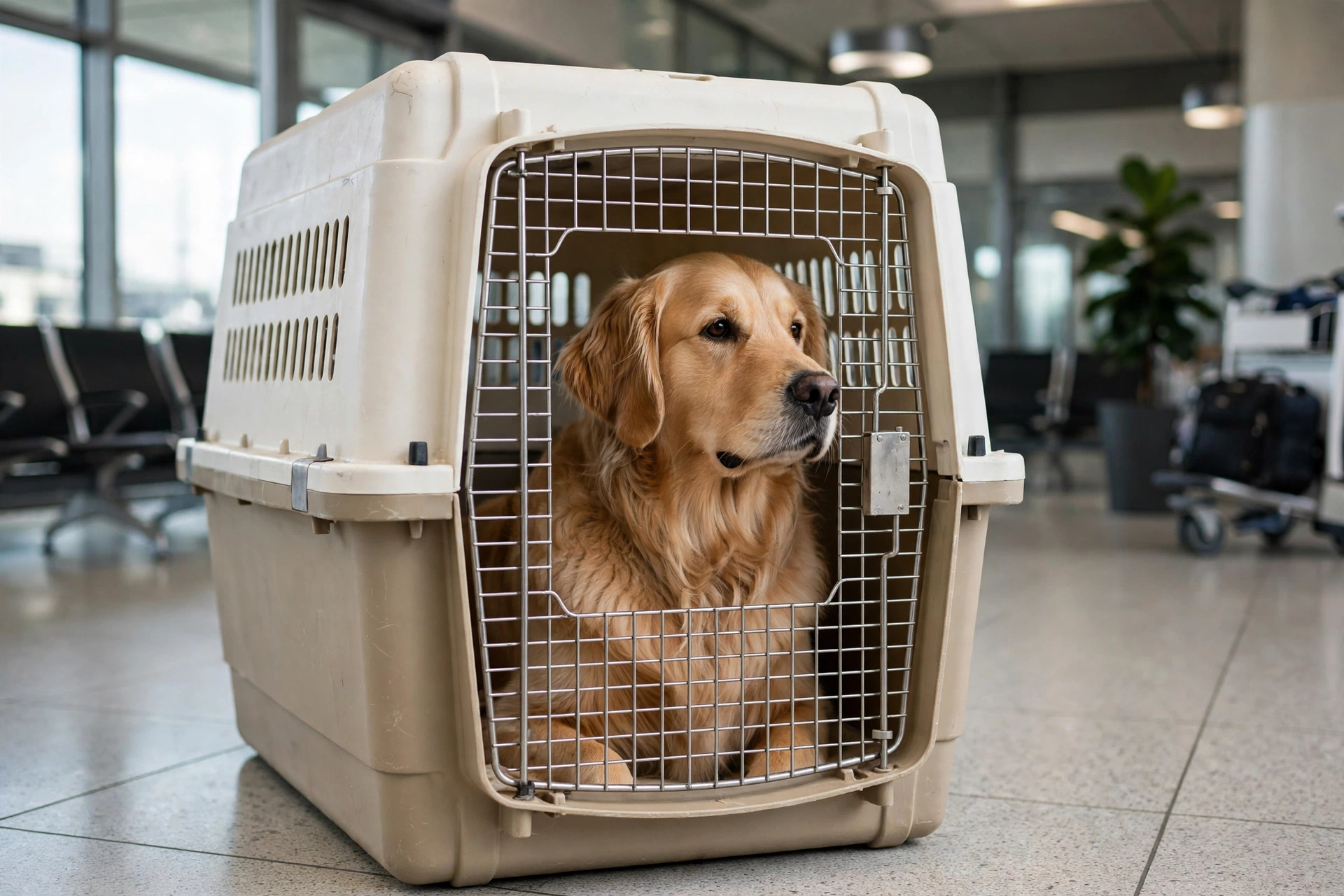
Before anything else, read this sentence twice: no kennel is universally “airline approved.” That phrase is a brand claim, not a certification. No airline signs off on crates in advance. Every airline publishes its own rules for crate dimensions, construction, and hardware, and those rules change by aircraft and destination. A kennel that sails through on one carrier gets turned away at the counter on another.
What exists instead is the IATA Live Animals Regulations baseline. An airline-style kennel should have a rigid plastic shell, a steel or wire door with a positive-locking mechanism (not just a spring latch), ventilation on at least three sides, a “LIVE ANIMAL” label, food and water dishes attached to the door, and a shell assembled with secure hardware. Many airlines specifically require metal nuts and bolts rather than plastic fasteners. Everything below is judged against that standard, not against marketing copy.
One more reality check before you spend: large dogs fly as cargo, period. There is no cabin option for a 70-pound dog. The crate goes in the hold, the dog plus the crate count against your airline’s weight limit, and your job is to make sure the kennel is the right size, the right construction, and acceptable to YOUR airline on YOUR flight. Call them with the exact crate model before you buy.
We compared six of the most established hard-sided airline-style kennels on Amazon that genuinely fit large dogs, judging real dimensions, door and hardware design, ventilation, and what owners report after actual use.
Pet Travel Items is reader-supported. When you buy through links on this page, we may earn a commission at no extra cost to you. Commissions never decide our picks: every con below stays published whether or not the product has a buy button.
Airline Kennels for Large Dogs at a Glance
| # | Kennel | Size / Fit | Standout Feature | Link |
|---|---|---|---|---|
| 1 | Petmate Sky Kennel (Giant 48″) | 48″ / 90-125 lbs | 360° ventilation; travel kit included | Check Price |
| 2 | Petmate Ultra Vari Kennel (48″) | 48″ / 90-125 lbs | 5-year warranty; wire vents | Check Price |
| 3 | Petmate Vari Kennel (40″) | 40″ / 70-90 lbs | Metal hardware; stay-dry moat | Check Price |
| 4 | Aspen Pet Porter (40″) | 40″ / 70-90 lbs | Lightest at 19.5 lbs | Check Price |
| 5 | SportPet Designs (X-Large) | 35.5″ / Labs up to 32″L | Wheels + metal bolts included | Check Price |
| 6 | SportPet Designs (XXX-Large) | 48″ / under 44″L dogs | Lightest 48-incher at 38.1 lbs | Check Price |
1. Petmate Sky Kennel, Giant 48-Inch (90-125 lbs)
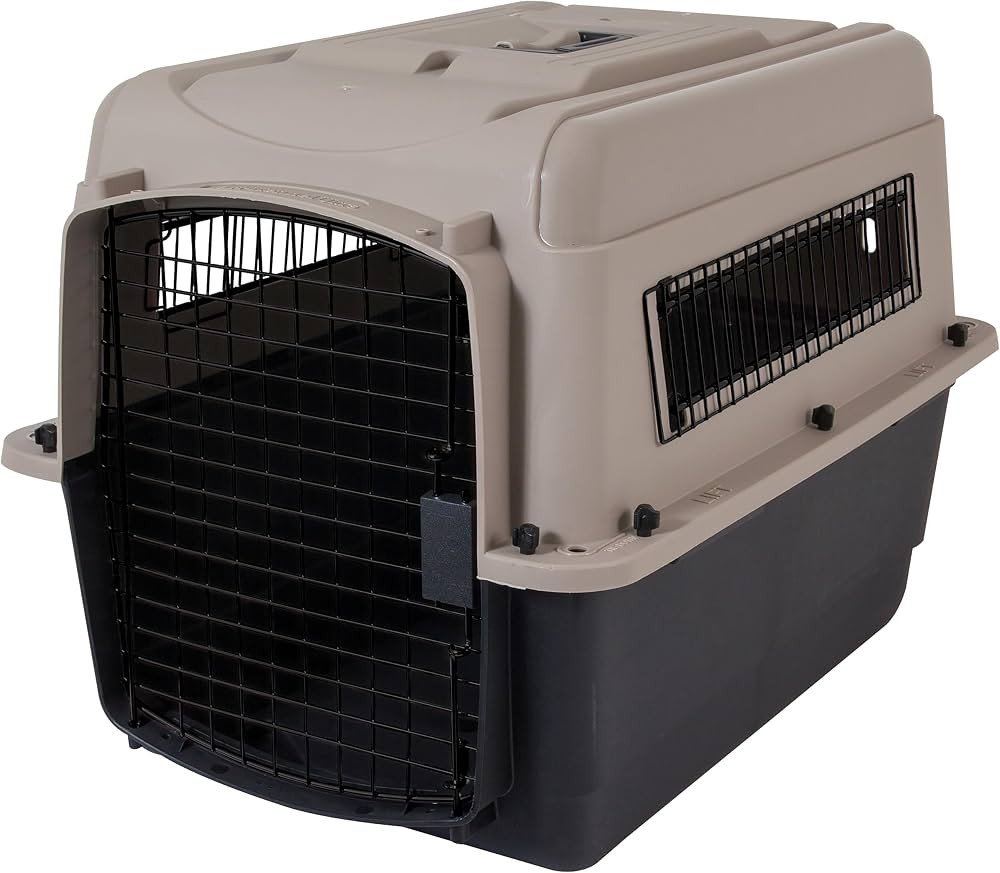
If there is a reference standard for IATA-style kennels, this is it. The Sky Kennel is the crate airline staff see most often, which is itself a practical advantage: ground crews know how the door works, know where the tie-down points are, and are less likely to flag it for inspection. It is 48 by 32 by 35 inches, rated for dogs 90 to 125 pounds, made in the USA from recycled plastic, and the listing claims compliance with IATA requirements plus most airline cargo specifications.
The ventilation is the genuine differentiator here: 360-degree airflow rather than the usual front-and-side pattern, which matters in a cargo hold. The twist-to-unlock door with interlocking posts is the positive-locking mechanism airlines want to see, and the box comes with the actual travel accessories instead of making you hunt for them: two LIVE ANIMAL stickers, a food and water cup, ID stickers, and an absorbent pad.
Now the honest part. The Sky Kennel ships with plastic-covered wing-nuts, and this is the single most common stumbling block owners report: several airlines require metal nuts and bolts, and people end up buying a separate metal hardware kit before flying. The included water cup is also undersized for a hundred-pound dog on a long flight; owners who have done this recommend a larger clip-on bowl. And the 48-inch size specifically has drawn door-fit complaints, with the large door not seating cleanly and shifting side to side on some units. At 51.5 pounds empty, it is also the heaviest crate here, and that weight eats into your airline’s combined weight limit.
Key specs: 48 x 32 x 35 in exterior; 44 x 29 x 32.5 in interior; 90-125 lbs; 51.5 lbs; 360° ventilation; twist-lock door; tie-down strap holes; travel kit included; made in USA.
Pros: The most recognized airline-style crate; best ventilation here; positive-locking twist door; travel accessories in the box.
Cons: Plastic wing-nuts may fail airline hardware rules (metal kit often needed); included water cup too small for big dogs; door-fit complaints on the 48″ size; heaviest crate in this roundup.
Verdict: The default choice for a reason. Buy the metal hardware kit at the same time and size up the water bowl, and it is the crate most likely to be accepted without questions. Check Price on Amazon
2. Petmate Ultra Vari Kennel, 48-Inch (90-125 lbs)
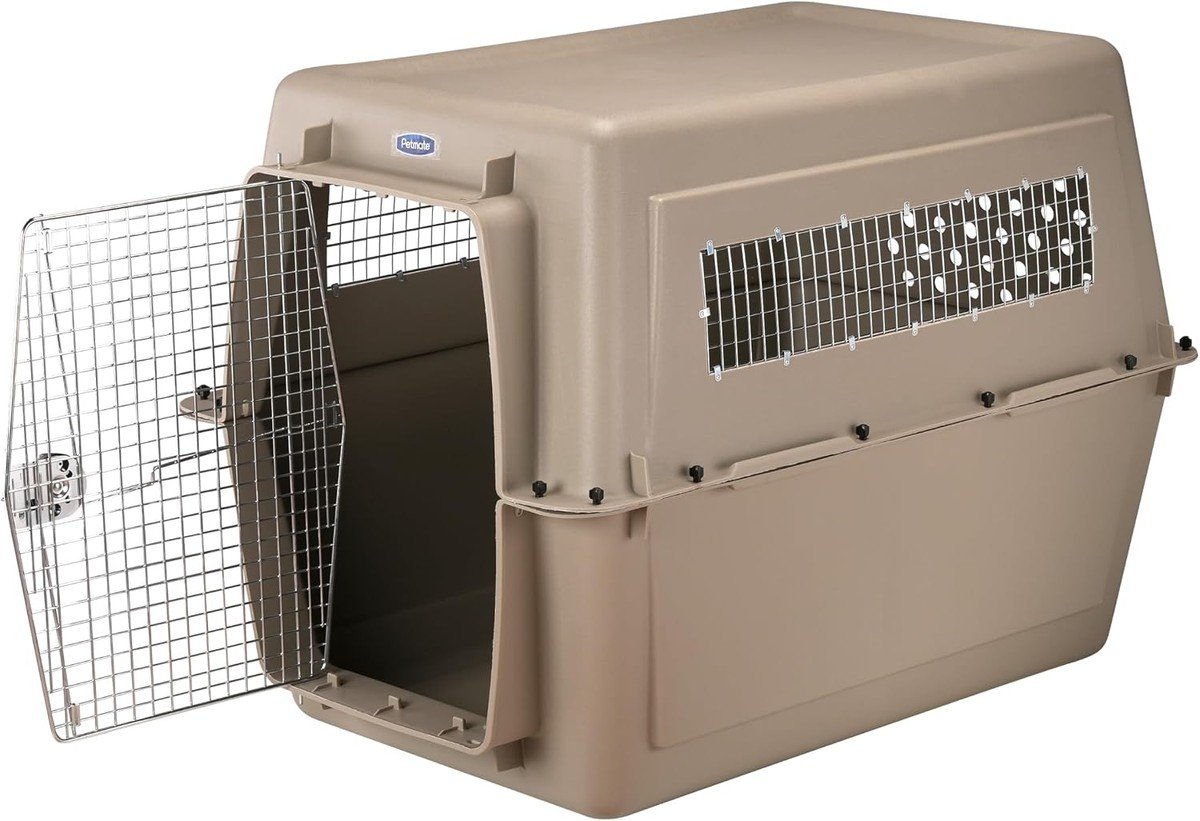
The Ultra Vari is Petmate’s sibling to the Sky Kennel at the same 48-inch giant size, and the differences are real rather than cosmetic. Where the Sky has molded 360-degree vents, the Ultra Vari uses wire ventilation openings: more airflow and better visibility for the dog, at the cost of a shell that is slightly less enclosed. The door latch is the push-down style rather than the Sky’s twist lock, with covered door posts and tamper-proof holes that accept zip ties, which is an actual airline requirement, not decoration.
It carries a 5-year limited warranty, the longest here, and it weighs 48.4 pounds, a few pounds less than the Sky. The listing claims it meets most airline cargo requirements, and it has tie-down holes and a raised interior floor.
The trade-offs: the listing does not promise the travel accessory bundle the Sky Kennel explicitly includes, so expect to buy your own live-animal labels and bowls. The wire vents, while airier, are also the part a determined chewer will work on. And it shares the large-size concerns of the category: verify your airline’s maximum crate dimensions before committing to a 48-incher, because height and length limits vary.
Key specs: 48 x 32 x 35 in; 90-125 lbs; 48.4 lbs; wire ventilation openings; push-down easy-open latch; tamper-proof zip-tie holes; tie-down holes; 5-year limited warranty; made in USA.
Pros: Longest warranty in the roundup; wire vents give better airflow and visibility; built-in zip-tie holes meet the airline security requirement.
Cons: No promised travel accessory bundle; wire vents less chew-proof; 48″ size must be cleared with your airline.
Verdict: Pick this over the Sky if the 5-year warranty and airier wire ventilation matter more to you than the included travel kit. Check Price on Amazon
3. Petmate Vari Kennel, 40-Inch (70-90 lbs)
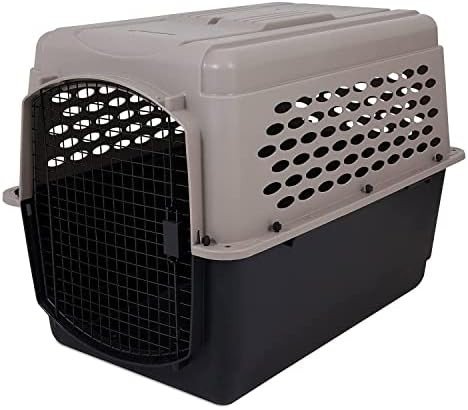
Most large dogs do not need a 48-inch crate. A Labrador, a German shorthaired pointer, a standard poodle: the 40-inch Vari Kennel is their size, rated for 70 to 90 pounds with an interior of 36.2 by 24.7 by 28.8 inches. At 31 pounds it is dramatically easier to handle than the giant crates, and 40 inches sits under more airlines’ maximum crate dimensions, which is a real acceptance advantage.
The construction details are the ones airlines actually check for: a metal nut and bolt assembly (not plastic wing-nuts), tamper-proof holes for zip ties on the door, four-sided ventilation, and a stay-dry moat in the floor that pulls fluids away from the dog. The sturdy wire door opens with an easy squeeze latch, and there is a fold-down handle for carrying. It is made in the USA and the listing claims it meets most airline cargo specifications.
What it does not do: the listing does not mention included travel accessories, so budget separately for dishes, labels, and an absorbent pad. And the sizing logic still applies in reverse: if your dog is at the top of the 70-to-90 range or long-bodied, measure nose-to-tail rather than trusting the weight band, because an airline will measure the dog in the crate, not the number on the box.
Key specs: 40 x 27 x 30 in exterior; 36.2 x 24.7 x 28.8 in interior; 70-90 lbs; 31 lbs; metal nut and bolt assembly; four-sided ventilation; stay-dry moat; fold-down handle; made in USA.
Pros: Metal hardware out of the box (clears the most common airline objection); zip-tie holes and four-sided vents hit the IATA checklist; 40″ size is accepted more widely than 48″; much lighter to handle.
Cons: No travel accessories promised in the listing; long-bodied dogs at the top of the range may need measuring, not guessing.
Verdict: The sweet spot for most large breeds. If your dog is 70 to 90 pounds, start here before looking at the giant crates. Check Price on Amazon
4. Petmate Aspen Pet Porter, 40-Inch (70-90 lbs)
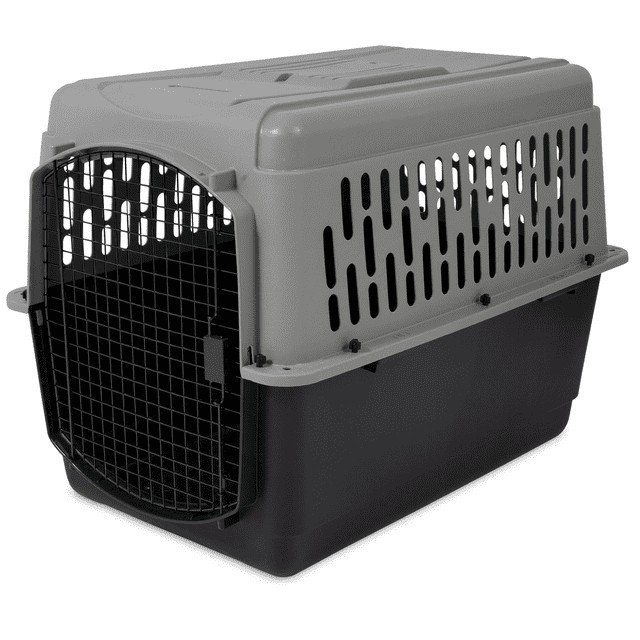
The Aspen Pet Porter is Petmate’s budget line, and at 40 inches for 70-to-90-pound dogs it covers the same dogs as the Vari Kennel. The headline difference is weight: 19.5 pounds, roughly two-thirds of the Vari. If you are the one lifting the crate into the car and through the terminal, that matters more than any spec sheet suggests.
It still hits the airline-style basics: metal nuts and bolts, tie-down holes, a one-hand easy-open latch, and ventilation on three sides, which is the IATA minimum. It is made in the USA and the listing claims it meets most airline cargo specifications.
The honest read is that the lighter weight comes from a lighter build. The shell is thinner than the Vari or Sky, the ventilation meets the minimum rather than exceeding it, and the one-hand latch is about your convenience, not airline-grade security, so bring zip ties and use the tamper points. This is the crate for the occasional flight and for owners who will store it between trips, not the one to choose if your dog flies monthly or chews.
Key specs: 40 x 27 x 30 in; 70-90 lbs; 19.5 lbs; ventilation on 3 sides; metal nuts and bolts; one-hand easy-open latch; tie-down holes; made in USA.
Pros: Lightest 40-inch option by a wide margin; metal hardware included; covers the core airline-style features at a lower price tier.
Cons: Thinner shell than its siblings; ventilation is minimum-spec; latch needs zip-tie backup for real security.
Verdict: The light-and-simple pick. Best for the dog that flies once or twice a year and an owner who values easy lifting. Check Price on Amazon
5. SportPet Designs X-Large Travel Dog Kennel
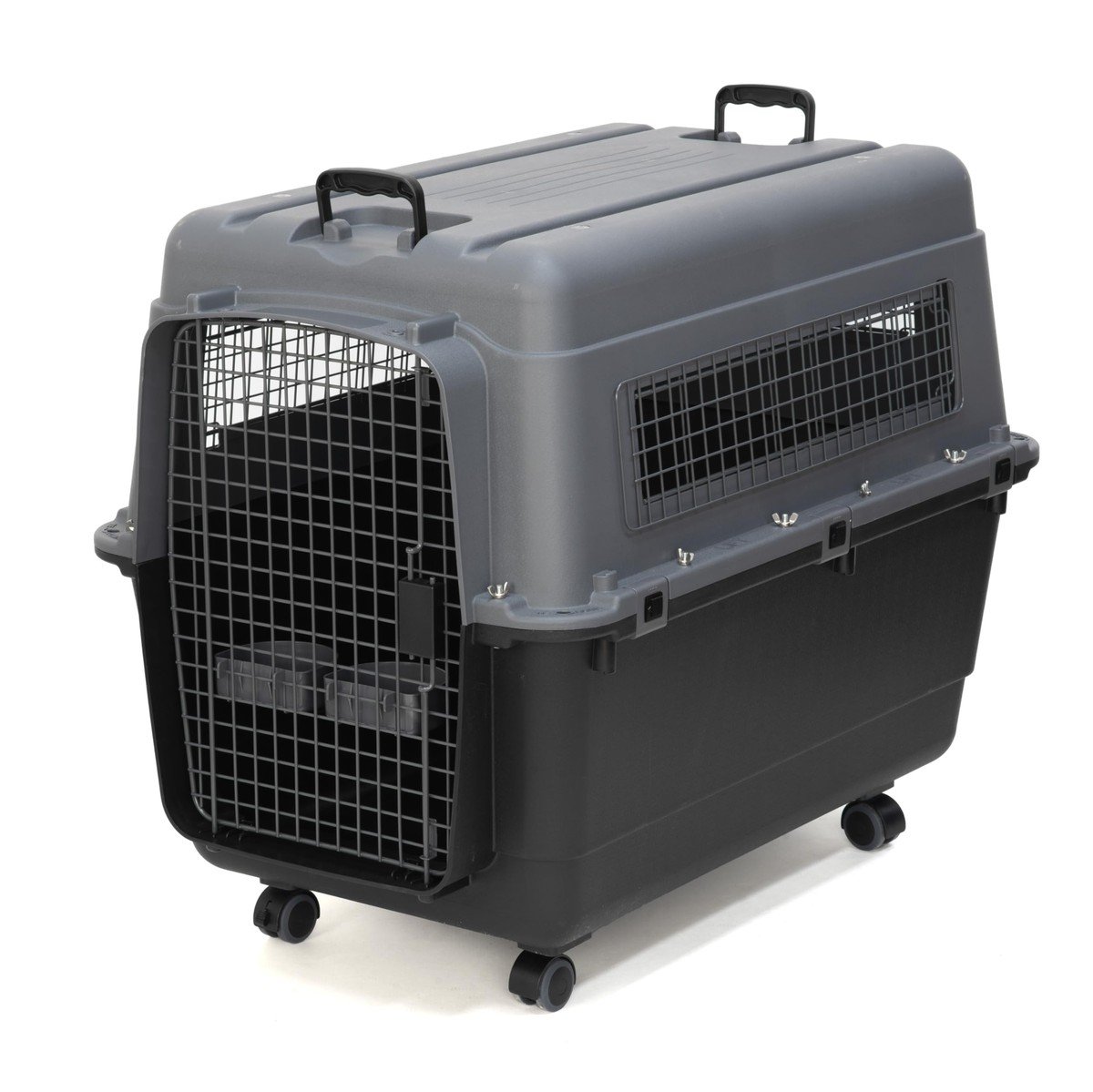
SportPet Designs built its kennel line specifically around airport travel, and it shows in the details. This X-Large is 35.5 by 23.75 by 29 inches with an interior of 32.25 by 21 by 25.25, sized for dogs up to 32 inches long and 23 inches tall: Labrador territory, not giant-breed territory. The listing claims compliance with the 51st edition (2025) of the IATA Live Animals Regulations, the most current IATA reference cited by any crate here.
The practical wins are all about the airport. Removable snap-on wheels and a top handle turn a heavy crate into rolling luggage through the terminal, then the wheels come off for the hold, which many airlines require. Metal bolts and nuts are included in the box, which directly answers the hardware objection that trips up Petmate’s plastic fasteners. Two food and water dishes, four live-animal stickers, tie-down holes, ventilation on all sides, and an accident moat round out a genuinely complete package.
The caveats are about track record. SportPet is a newer brand with a much shorter documented history than Petmate, and the warranty here is 6 months against the Ultra Vari’s 5 years. The sizing also tops out below true giant dogs; if your dog is over 32 inches long, you need the XXX-Large below, not this one.
Key specs: 35.5 x 23.75 x 29 in exterior; 32.25 x 21 x 25.25 in interior; dogs up to 32″L and 23-24″H; 20 lbs; metal bolts and nuts included; removable wheels; 2 dishes; 4 live-animal stickers; tie-down holes; ventilation on all sides; accident moat.
Pros: Most current IATA edition cited; metal hardware and travel accessories all included; removable wheels make airports manageable; collapses into two pieces for storage.
Cons: Newer brand, shorter track record; 6-month warranty; tops out at Labrador-sized dogs.
Verdict: The airport-practical pick. If terminal logistics and included metal hardware matter most, this is the best-equipped crate for the money. Check Price on Amazon
6. SportPet Designs XXX-Large (3XL) Travel Dog Kennel
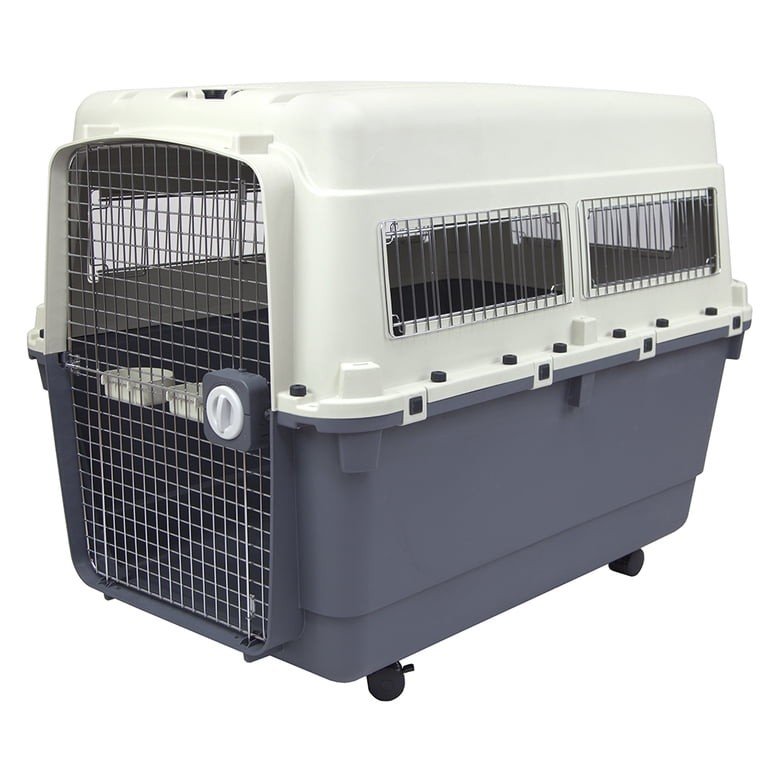
The 3XL is SportPet’s answer to the giant crates: 48 by 32 by 36 inches for dogs measuring under 44 inches long and 33 inches tall. The number that should catch your eye is 38.1 pounds. Petmate’s 48-inchers weigh 48 to 51.5 pounds empty. That 10-plus-pound difference is not a footnote when the airline weighs crate plus dog together against a hard limit; it can be the difference between acceptance and a surcharge or refusal.
It carries the same airport-focused feature set as its smaller sibling: metal bolts and nuts included, two dishes, four live-animal stickers, tie-down holes for bungees, removable wheels, and a claim of compliance with the 51st edition of the IATA Live Animals Regulations. One detail stands out: the rear window uses metal slats instead of plastic vents, which is a direct answer to dogs that chew their way through plastic ventilation holes.
The height is the thing to watch. At 36 inches tall it is the tallest crate here, and height is the dimension airlines reject most often, because hold doors and loading equipment have hard ceilings. Confirm your airline’s maximum crate height before buying, not after. And the same track-record caveat applies: 6-month warranty, newer brand, less long-term documentation than Petmate.
Key specs: 48 x 32 x 36 in; dogs under 44″L x 33″H; 38.1 lbs; metal rear-window slats; metal bolts and nuts included; removable wheels; 2 dishes; 4 live-animal stickers; tie-down holes; 6-month warranty.
Pros: Lightest 48-inch crate by a wide margin (matters for airline weight limits); metal chew-proof rear slats; full metal hardware and accessories included.
Cons: 36″ height is the most likely dimension to hit airline limits; shorter track record; 6-month warranty.
Verdict: The weight-saver for giant dogs. If your dog needs a 48-incher and every pound of the airline limit counts, this is the rational choice. Check Price on Amazon
How to Choose an Airline Kennel for a Large Dog
Start with your airline, not the product page. Call them with the exact crate model and your flight number and ask three questions: the maximum crate dimensions they accept, whether they require metal nuts and bolts, and the combined weight limit for dog plus crate. Write down the answers. Everything else flows from those numbers, and skipping this call is how crates get rejected at the counter.
Then measure the dog, because weight bands lie. Measure nose to base of tail and add 3 to 4 inches for length; measure floor to top of head (or ears, whichever is higher) and add 3 to 4 inches for height. The dog must stand, turn around, and lie down inside. Airlines measure the dog in the crate, not the weight rating on the box, and a crate that is technically “for 90-pound dogs” will be rejected if your 90-pound dog cannot stand in it.
Check the IATA basics yourself before you buy: a rigid two-piece shell, a steel or wire door with a positive-locking mechanism, ventilation on at least three sides, a LIVE ANIMAL label, and food and water dishes that attach to the door. Confirm the hardware. If the crate ships with plastic wing-nuts and your airline requires metal, buy the metal hardware kit with the crate, not the week of the flight.
Then the flight-week work. Crate-train for at least two to three weeks before flying: the crate should smell like home, with familiar bedding inside, long before it ever sees an airport. Exercise the dog hard on flight day, skip a big meal four to six hours before departure, and freeze water in the attached bowl so it melts during the flight instead of sloshing at takeoff. Pack zip ties, a spare leash, and a copy of the health certificate in your own bag, not in the crate. And confirm everything again 48 hours out, because airline pet policies change.
Frequently Asked Questions
Is any dog kennel truly “airline approved”?
No. There is no universal airline approval for pet crates; it is a manufacturer claim that the kennel is built to the IATA Live Animals Regulations baseline and fits most airlines’ cargo specifications. Each airline sets its own rules for dimensions, hardware, and weight, and those rules vary by aircraft and route. Always verify the exact crate against your airline’s published pet policy before buying.
Can my large dog fly in the cabin with me?
No. Cabin travel is limited to small pets in under-seat carriers, generally under 20 pounds including the carrier. A large dog travels as checked baggage or cargo in the hold, in a rigid crate that meets the airline’s construction rules. Book the pet spot when you book your ticket, since airlines cap the number of animals per flight.
What does IATA require in a kennel?
The baseline: a rigid plastic or fiberglass shell, a steel or wire door with a positive-locking mechanism (latches that cannot be jolted open), ventilation on at least three sides, a “LIVE ANIMAL” label with orientation arrows, and food and water dishes accessible without opening the door. Many airlines add their own requirements on top, most commonly metal nuts and bolts instead of plastic fasteners, and zip ties securing the door.
Do I need metal bolts instead of the plastic ones?
Often, yes. Many airlines require metal nuts and bolts assembling the crate shell, and crates that ship with plastic wing-nuts can be rejected at check-in. Some crates in this roundup include metal hardware; for those that do not, buy a metal hardware kit when you buy the crate and install it before flight day.
How do I measure my dog for a kennel?
Measure from the tip of the nose to the base of the tail and add 3 to 4 inches for the crate length. Measure from the floor to the top of the head or ears (whichever is higher) and add 3 to 4 inches for the crate height. The dog must be able to stand without crouching, turn around, and lie down comfortably. Size by these measurements first; use the weight rating only as a secondary check.
Should I sedate my dog for the flight?
Talk to your veterinarian well in advance, but know that most vets advise against sedation for air travel. Sedatives can affect breathing, blood pressure, and temperature regulation at altitude, and some airlines will not accept a visibly sedated animal. The safer strategy is crate training, exercise before the flight, and familiar bedding. This is especially important for flat-faced (brachycephalic) breeds, many of which airlines restrict or refuse outright.
