

Pet Travel Items is reader-supported. When you buy through links on our site, we may earn an affiliate commission at no extra cost to you. Read our full affiliate disclosure. Our picks are based on real product research and owner feedback, not on commission rates.
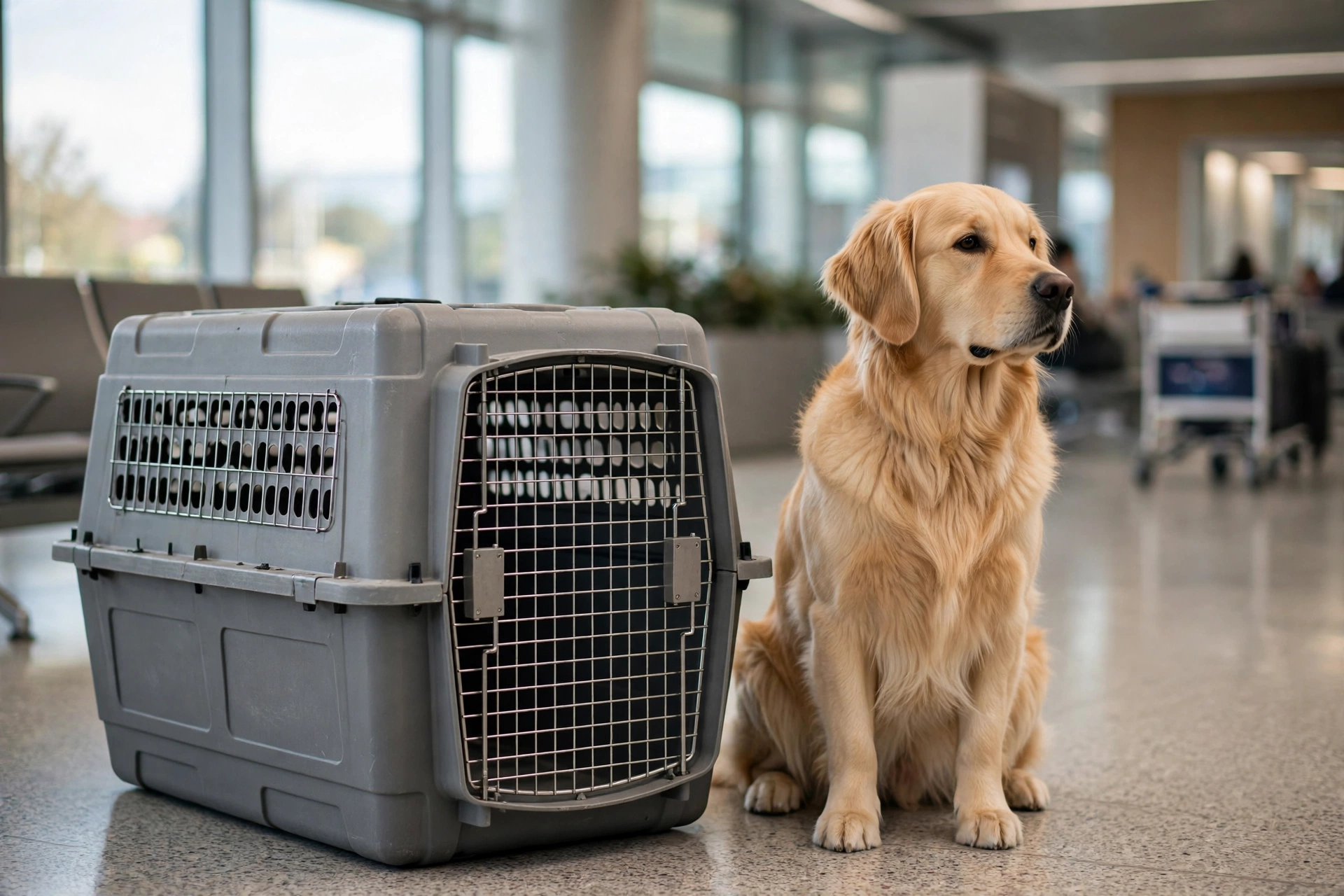
Let us clear up the two biggest misunderstandings first, because they decide everything else on this page. No large dog flies in the cabin. Every commercial airline limits in-cabin pets to carriers that slide under the seat in front of you, which caps out around twenty pounds. If your dog is a Labrador, a German Shepherd, or anything bigger, the only way it flies is in the pressurized cargo hold, inside a hard crate. And second, there is no such thing as an official “airline approved” certification. No authority stamps a crate as approved for all airlines. IATA publishes the Live Animals Regulations, each airline writes its own crate rules on top of those, and “airline approved” printed on a box is marketing language. What you actually need is a crate that satisfies your airline’s published requirements for your specific flight.
That narrows the field fast. The six crates below are the large-size cargo kennels actually sold on Amazon, and they come from just two brands, Petmate and SportPet Designs. That is not a lack of research. It is the reality of this market: these are the crates with the flight hardware, the ventilation layout, and the track record that airlines recognize. The table gives you the short version. The reviews below tell you what owners complain about after real flights, because the complaints are where the buying decision lives.
| # | Product | Why It Made the List | Check Price |
|---|---|---|---|
| 1 | SportPet Designs Rolling Plastic Wire Door Travel Dog Crate, XXL | Most complete flight kit in the box: bowls, stickers, metal hardware, plus removable wheels | Check Price on Amazon |
| 2 | Petmate Sky Kennel, Giant 48″ (90-125 lbs) | The industry standard airlines see daily; true giant-breed interior | Check Price on Amazon |
| 3 | Petmate Ultra Vari Dog Kennel, 48″ (90-125 lbs) | Heaviest-duty shell here with zip-tie-ready door holes airlines ask for | Check Price on Amazon |
| 4 | SportPet Designs Rolling Plastic Wire Door Travel Dog Crate, XXXL | The biggest rolling crate on Amazon for dogs that max out everything else | Check Price on Amazon |
| 5 | Petmate Sky Kennel, XL 40″ (70-90 lbs) | Sweet spot for Labs and Goldens; cheaper and easier to fly than the 48″ models | Check Price on Amazon |
| 6 | Petmate Vari Dog Kennel, 40″ (70-90 lbs) | The classic budget crate with the longest flight history of anything here | Check Price on Amazon |
1. SportPet Designs Rolling Plastic Wire Door Travel Dog Crate, XXL
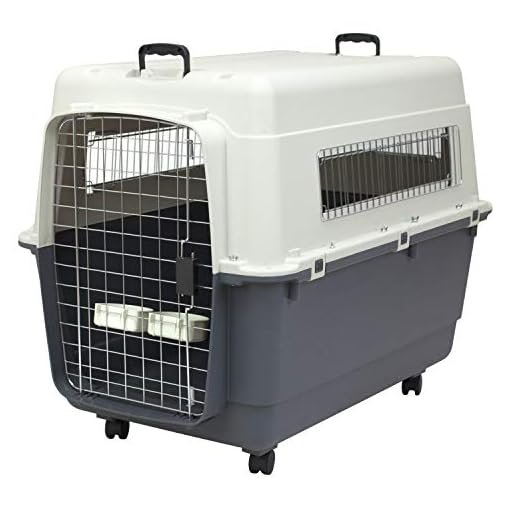
This is the pick for owners who want to open one box and be done. The XXL measures 39.5 inches long, 26.5 wide, and 29.25 high on the outside, weighs about 26 pounds empty, and the manufacturer rates it for dogs up to 36 inches long and 26 inches tall. What sets it apart is everything that comes with it: two food and water dishes, four live-animal stickers, metal bolts and nuts, and tie-down holes in the shell. Those are the exact bits airlines require, and with most crates you buy them separately the week before the flight while mildly panicking. The manufacturer states compliance with the 2025 (51st) edition of the IATA Live Animals Regulations, which is the most specific compliance claim any crate in this roundup makes.
Then there are the wheels. They snap on and off, and they change the airport experience completely. A loaded 26-pound crate is miserable to carry through a terminal. Rolling it is not. Owners who flew with German Shepherds report the wheels working well right up until they do not: a few reviewers had wheels pop out under a heavy dog, and one resorted to glue. The honest read is that the wheels are an airport convenience, not load-bearing flight equipment, and they come off before the crate goes into the hold anyway.
The complaint you should take most seriously is about sizing. The dimensions on the box are exterior. The interior is smaller, and several owners found the “giant breed” labeling optimistic. A 60-pound shepherd mix, in one owner’s words, only just fits. Measure your dog against the interior space, not the marketing. There is also at least one report of the plastic cracking near the gate after baggage handling, and the top carry handles have been called flimsy.
Specs:
- Exterior: 39.5″L x 26.5″W x 29.25″H; 26.25 lbs
- Rated for dogs up to 36″ long / 26″ tall (manufacturer)
- Manufacturer states IATA Live Animals Regulations 51st edition (2025) compliance
- Includes 2 dishes, 4 live-animal stickers, metal bolts & nuts, tie-down holes
- Removable snap-on wheels and top handle
Pros: complete flight kit in one box; wheels included; most specific IATA compliance claim here; collapses for storage
Cons: exterior dimensions overstate usable space; wheels can pop out under heavy dogs; crack-near-gate report; flimsy top handles
Verdict: the best all-in-one buy for a Lab or shepherd-sized dog. Size by the interior measurements, confirm the height clears your airline’s cargo limits, and you will walk into the airport with everything the airline asks for.
2. Petmate Sky Kennel, Giant 48″ (90-125 lbs)
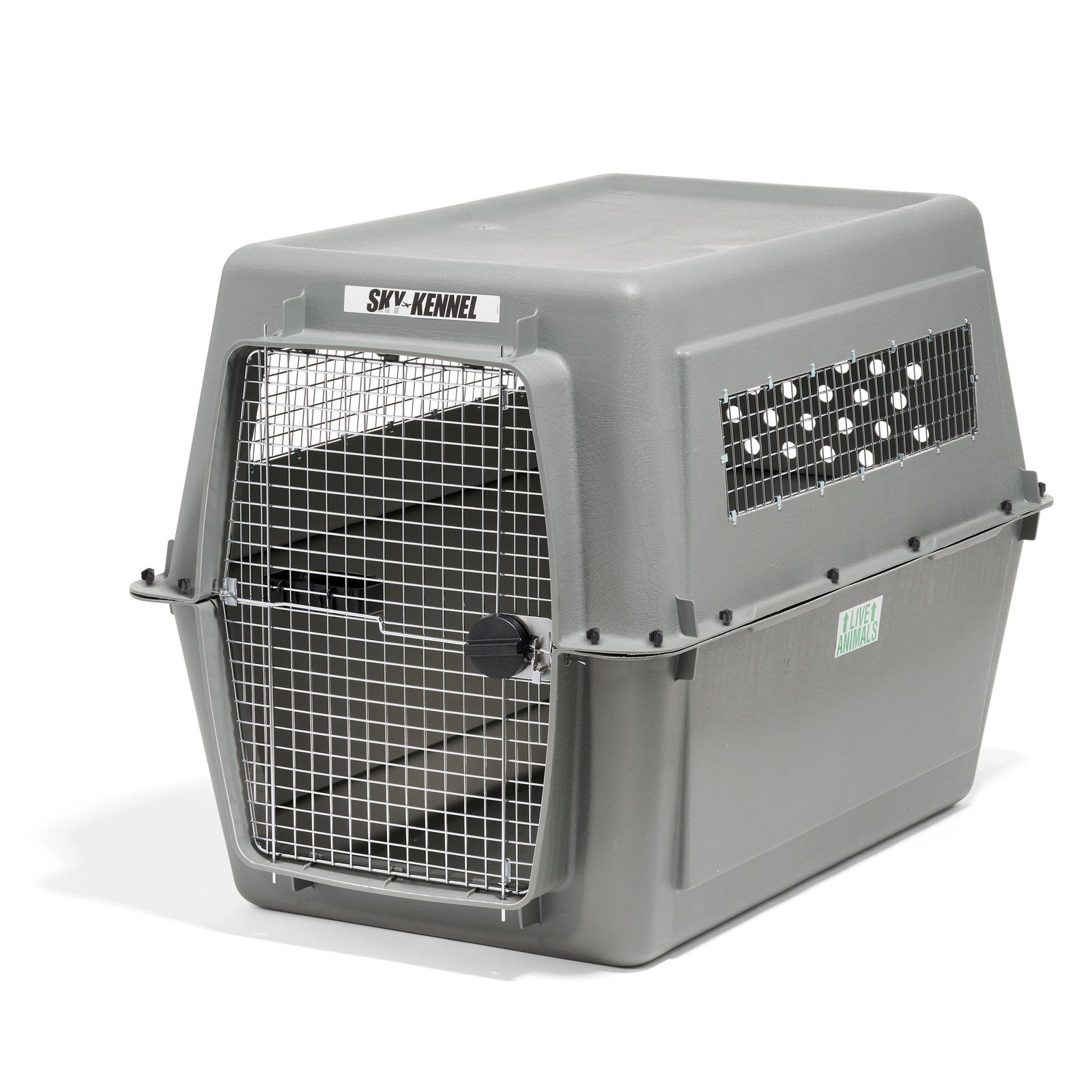
The Sky Kennel is the crate airline cargo staff have seen ten thousand times. That familiarity is worth more than any feature list. When the agent at the counter glances at your crate and waves you through instead of pulling out a tape measure, that is the Sky Kennel’s reputation doing the work. The Giant is 48 inches long, rated for dogs from 90 to 125 pounds, with an interior around 44 inches long, 29 wide, and 32.5 high. It is made in the USA from heavy-duty plastic, with an easy-squeeze latch door, ventilation on all four sides, and the standard kit of live-animal stickers, a food and water cup, and ID stickers in the box.
Now the parts nobody puts in the product title. The wing nuts are plastic, not metal, and that matters because some airlines specify metal hardware. This comes up in owner questions about Alaska Airlines in particular. Check your airline’s hardware rule before you assume. The door latch draws mixed reports: some owners find it secure and simple, others call it fiddly, and on the 48-inch size specifically there are complaints about the door not seating squarely. A few owners report warped plastic on arrival that made the door hard to align, and long-time Petmate buyers say newer production feels thinner than the crates they bought a decade ago.
Size is the other honest conversation. At 48 inches long, this crate exceeds some airlines’ maximum crate dimensions on certain aircraft. It is also enormously heavy and awkward once your dog is inside, and no wheels are included. If your dog is anywhere near the bottom of the 90-pound rating, ask yourself whether the 40-inch Sky Kennel below would do. Bigger is not better here. Bigger is a dimension check you might fail.
Specs:
- 48″ kennel; rated 90-125 lbs; interior approx. 44″L x 29″W x 32.5″H
- Heavy-duty plastic, made in USA; 360-degree ventilation
- Easy-squeeze latch door with interlocks
- Includes live-animal stickers, food/water cup, ID stickers; plastic-covered wing nuts and bolts
Pros: the recognized industry standard; true giant-breed room; parts and replacement doors easy to find; four-side ventilation
Cons: plastic wing nuts vs. some airlines’ metal-hardware rules; no wheels; door-fit complaints on some units; 48″ length can exceed airline limits
Verdict: the default for genuinely giant dogs. Not the cheapest, not the toughest anymore, but the crate the check-in agent recognizes, and that recognition smooths the hardest part of the day.
3. Petmate Ultra Vari Dog Kennel, 48″ (90-125 lbs)
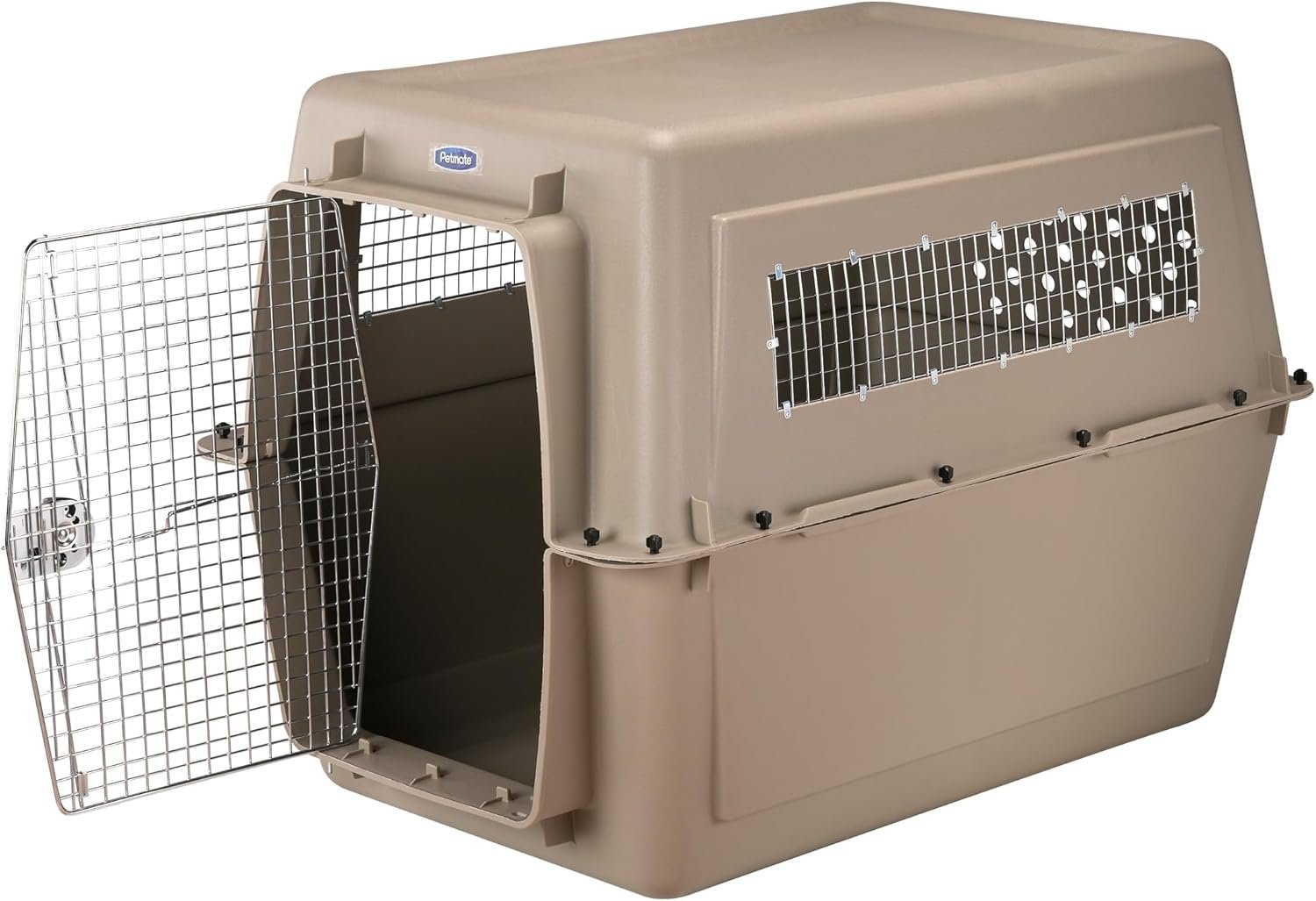
If the Sky Kennel is the familiar choice, the Ultra Vari is the substantial one. Same 48-inch footprint, same 90 to 125 pound rating, but a heavier-duty shell, a raised interior floor that keeps your dog off any pooled liquid, and a door with tamper-proof holes designed for zip ties. That last detail is not cosmetic. Zip-tying the door shut is an actual airline requirement on many carriers, and a crate with proper holes for it saves you from improvising with a drill at the airport. The manufacturer says it meets most airline cargo requirements, assembly is tool-free with metal screws and fasteners, and the latch opens one-handed.
The tradeoff is money and bulk. It costs more than the SportPet equivalents while including fewer flight accessories in the box, so budget for bowls and stickers separately. It is heavy, and when you are not flying it occupies a serious amount of garage. The shell is Petmate’s EcoTEC recycled plastic, and long-time Vari Kennel owners are split on whether the new material matches the old stuff. The wing-nut assembly that has annoyed buyers for thirty years is still fiddly.
One more check before you buy: at 35 inches tall, verify against your airline’s maximum crate height. Several carriers cap height below this on certain aircraft, and height is the dimension people forget to check.
Specs:
- 48″L x 32″W x 35″H; rated 90-125 lbs
- Meets most airline cargo requirements (manufacturer claim)
- Raised interior floor; wire ventilation openings
- Tamper-proof zip-tie holes on door; easy-open one-handed latch
- Tool-free assembly; made in USA from EcoTEC recycled plastic
Pros: sturdiest shell in this roundup; zip-tie-ready door; raised floor; secure one-handed latch
Cons: pricier with fewer included accessories; heavy and bulky to store; recycled-plastic feel debated by owners; fiddly hardware
Verdict: the pick for owners who want the most substantial crate and are willing to pay for it. The door-security details are the best thought out here, which is exactly what you want inspected at cargo check-in.
4. SportPet Designs Rolling Plastic Wire Door Travel Dog Crate, XXXL
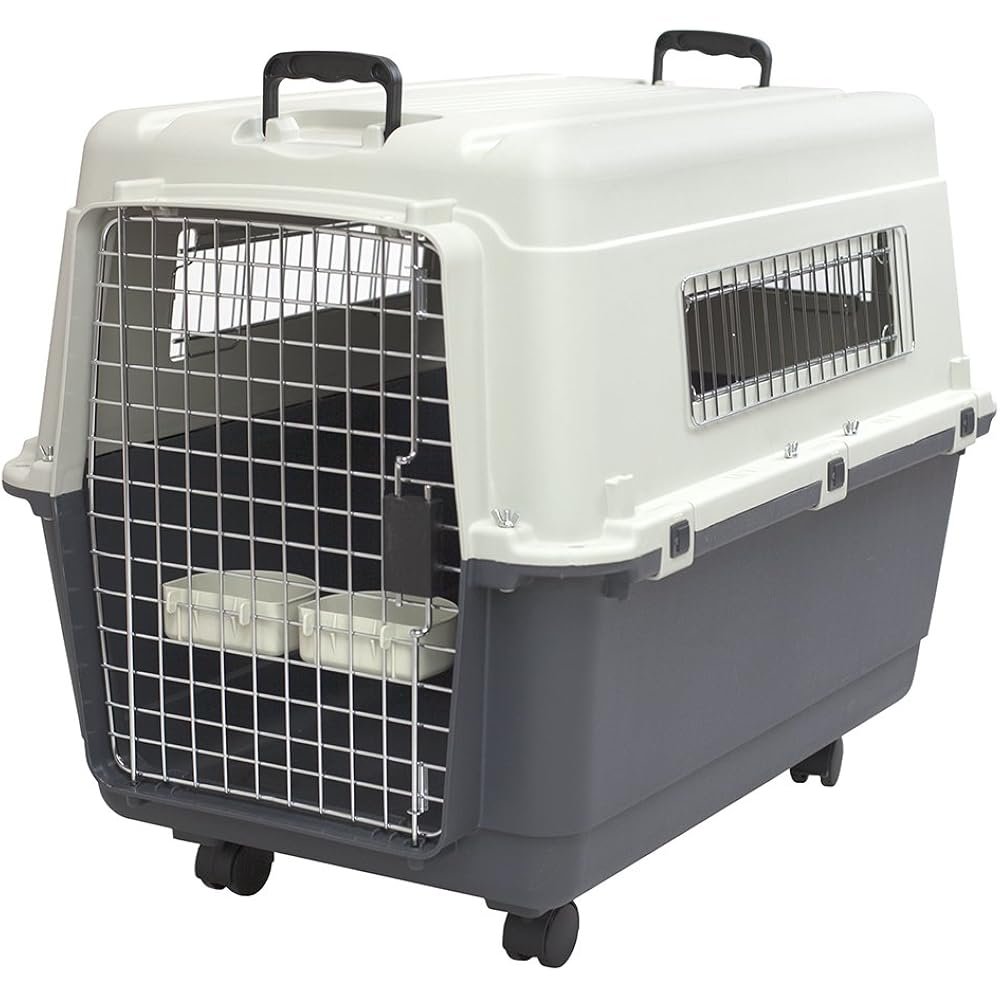
This is the same crate as the XXL, scaled up to 48 by 32 by 35 inches and 38 pounds empty. It exists for one reason: dogs that do not fit in anything else. If your dog maxes out the XXL, this is the next step, and it is the only 48-inch rolling crate sold on Amazon. It ships with the same complete flight kit, bowls, stickers, metal hardware, tie-down holes, and the same snap-on wheels, which matter even more here because a loaded 38-pound crate is not something you carry.
Everything said about the XXL’s sizing honesty applies double. The dimensions are exterior, the interior is smaller, and one owner found even this size too small for a tall Afghan hound. At 35 to 36 inches tall, this crate sits right at or above several airlines’ maximum crate heights. This is the product in the roundup most likely to be rejected at the airport, which sounds like a strange thing to write in a review, but it is the truth. The room that makes it appealing is the same room that breaks airline limits.
So the buying process for this one is: measure the dog, measure the interior, then call the airline with the exact exterior numbers before you order. If the airline clears it, it is the roomiest wheeled option available. If not, you have saved yourself the worst possible outcome, which is discovering the problem at the cargo counter.
Specs:
- Exterior 48″ x 32″ x 35″ (some variants list 36″H); 38.1 lbs
- Largest size in the SportPet rolling line
- Same flight kit: 2 bowls, 4 live-animal stickers, metal bolts & nuts, tie-down holes
- Removable wheels included; metal wire door
Pros: roomiest rolling crate on Amazon; complete flight kit; wheels essential at this weight; collapses for storage
Cons: heaviest crate here; interior smaller than exterior suggests; height risks airline rejection; wheel durability questions shared with XXL
Verdict: buy this only if your dog genuinely outgrows the XXL. Verify airline dimensions first, buy second. In that order, always.
5. Petmate Sky Kennel, XL 40″ (70-90 lbs)
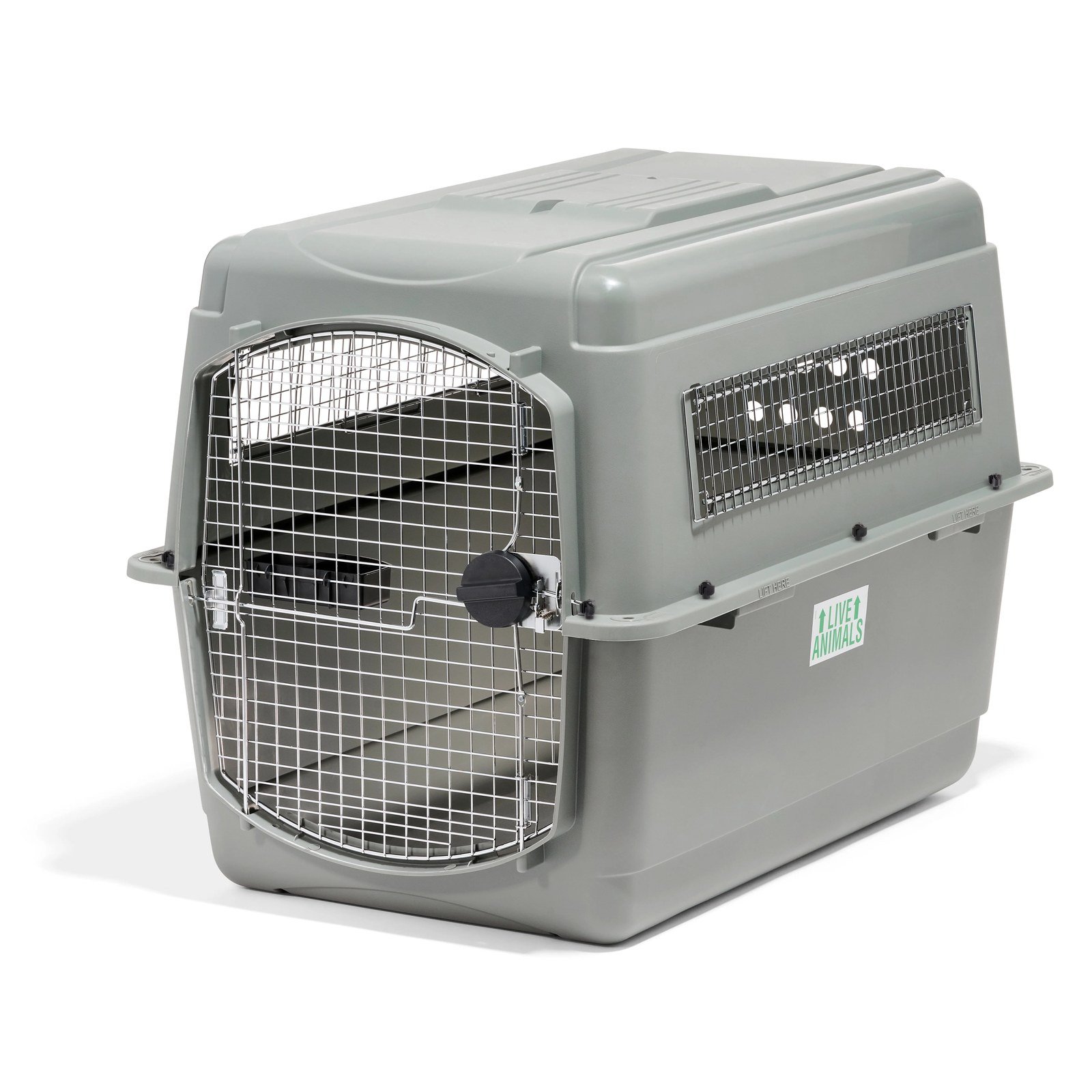
For the most common large breeds, this is the sensible crate. The 40-inch Sky Kennel is rated for 70 to 90 pounds with an interior around 36 inches long, 24.75 wide, and 28.8 high. That fits the average Labrador or Golden Retriever with room to stand, turn, and lie down, which is the actual test. It is the same familiar Sky Kennel design as the Giant, with the easy-squeeze latch, four-side ventilation, and the sticker and cup kit in the box, but it costs noticeably less, weighs less, and fits through more aircraft cargo doors.
The honest caveat is the top of the weight range. A dog pushing 90 pounds will be snug in here, and owner photos confirm the range is optimistic at the upper end. Measure your dog’s standing height, add three to four inches, and compare against the 28.8-inch interior height. If the numbers are close, size up to the 48-inch Giant rather than hoping the airline will not notice. They will notice. They measure.
It shares the family’s quirks: plastic wing nuts that some airlines will not accept, occasional door-fit complaints, and no wheels. None of that is disqualifying. It is the price of buying the standard design.
Specs:
- 40″ kennel; rated 70-90 lbs; interior approx. 36.25″L x 24.75″W x 28.8″H
- Heavy-duty plastic, made in USA; 360-degree ventilation
- Easy-squeeze latch door with interlocks
- Includes live-animal stickers, food/water cup, ID stickers
Pros: ideal size for Labs, Goldens, and similar breeds; cheaper and lighter than 48″ models; airline-familiar design; fits more aircraft
Cons: snug at the top of the 90-lb rating; plastic wing nuts; no wheels; occasional warped-plastic reports
Verdict: the sweet spot of the whole roundup for most buyers. If your dog is a typical 70 to 80 pound large breed, start here and only size up if the tape measure says so.
6. Petmate Vari Dog Kennel, 40″ (70-90 lbs)
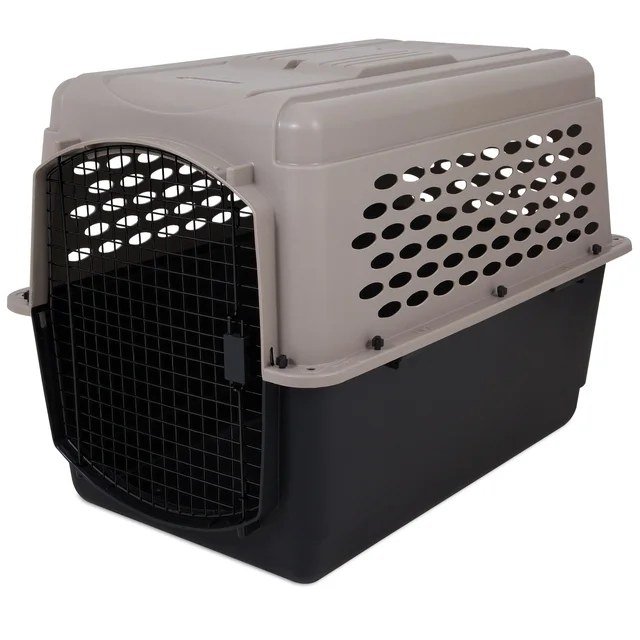
The Vari Kennel is the oldest design here and it shows in the best way: price. This is usually the cheapest credible 40-inch airline crate you can buy, and it has flown more dogs than everything else on this page combined. The specs are familiar. Forty inches, 70 to 90 pounds, interior around 36 by 24.7 by 28.8 inches, four-sided ventilation, tamper-proof holes for the zip ties airlines require, and a stay-dry moat in the floor that channels liquid away from your dog. That last feature earns its keep on long flights.
What you give up is refinement. The wing-nut assembly is the same fiddly job owners have complained about for decades. The shell can flex under a strong, anxious chewer. And this needs saying plainly: the Vari Kennel is a containment crate, not a fortress. A determined escape artist can defeat the latch, and if your dog is that dog, you need the Ultra Vari or a metal-reinforced crate instead.
For a calm, crate-trained large dog and an owner watching the budget, though, the math is hard to argue with. The design is proven, the parts are standard, and every cargo agent on earth has seen one.
Specs:
- 40″ kennel; rated 70-90 lbs; interior approx. 36.2″L x 24.7″W x 28.8″H
- Meets most airline cargo specifications (manufacturer claim)
- Four-sided ventilation; tamper-proof zip-tie holes
- Stay-dry moat floor; tool-free assembly; made in USA
Pros: lowest price of the credible options; unmatched flight history; stay-dry moat; universally recognized design
Cons: tedious wing-nut assembly; shell flex with heavy chewers; not escape-proof; hardware quality varies by run
Verdict: the budget classic. Buy it for a calm, crate-trained dog and spend the savings on the vet check and the direct flight, which matter more than any crate feature.
Buying Guide: How to Choose an Airline Crate for a Large Dog
Start with the tape measure, not the weight rating. Have your dog stand. Measure from the floor to the top of the head (or ear tips, whichever is higher), then add three to four inches: that is your minimum interior height. Measure from nose to base of tail, add three to four inches: minimum interior length. Your dog must be able to stand without crouching, turn around, and lie down naturally. Airlines enforce this, and they carry tape measures. Weight ratings are secondary and, as the owner complaints above show, optimistic across the industry.
Call your airline with exact numbers. This is the step people skip and regret. Ask for three things: the maximum crate dimensions for your specific aircraft, the hardware rules (metal vs. plastic nuts and bolts, zip-tie requirements), and any breed restrictions. Rules vary not just by airline but by aircraft type and route. A crate that flies on one airline’s wide-body may be rejected on another’s regional jet. Get the answer in writing if you can, such as an email from the cargo desk.
Understand the hardware question. IATA-style rules generally want the crate fastened with metal hardware rather than plastic clips, and many airlines require the door secured with zip ties (not locks, so staff can open it in an emergency). Several crates here ship with plastic wing nuts. That is fine on some airlines and a rejection reason on others. A bag of metal bolts, nuts, and heavy zip ties costs a few dollars at a hardware store and removes the entire question.
Wheels come off before the flight. The SportPet wheels are for the terminal, not the hold. Airlines will not accept a crate with wheels attached in cargo. Practice removing them at home so you are not learning at the counter.
Acclimate the dog for weeks, not days. The most common cargo-travel problem is not the crate. It is a stressed dog in an unfamiliar box. Set the crate up at home, feed meals in it, and build up to naps inside over two to three weeks. A dog that walks into its crate calmly at the airport has a fundamentally better flight than one being shoved in for the first time.
Book direct flights and watch the weather. Every layover is another loading cycle and another chance for a delay on hot tarmac. Most airlines embargo cargo pet travel above roughly 85°F, and some restrict brachycephalic (flat-faced) breeds like Bulldogs and Pugs entirely. If your dog is flat-faced, talk to your vet before you talk to the airline. Many vets advise against cargo travel for these breeds, and several airlines agree.
Frequently Asked Questions
Is there an official “airline approved” certification for dog crates?
No. No government body or airline alliance certifies crates as “airline approved.” IATA publishes the Live Animals Regulations, which set the widely used standards for container construction, ventilation, and size. Individual airlines then write their own rules on top, covering maximum dimensions, hardware types, and breed restrictions. When a manufacturer prints “airline approved” on the box, it means the crate was designed to satisfy the common requirements, not that any airline certified it. Always verify against your airline’s current published rules.
Can my large dog fly in the cabin with me?
No. In-cabin pets must travel in a carrier that fits under the seat in front of you, which limits the dog to roughly 20 pounds depending on the airline. There is no cabin option for a 60, 80, or 100-pound dog on commercial flights. The choices are the pressurized, climate-controlled cargo hold in a compliant crate, a dedicated pet air transport service, or driving. (Trained service dogs are a separate legal category with different rules.)
What size crate does my large dog actually need?
Measure the dog, not the marketing. Standing height plus three to four inches gives minimum interior height. Nose-to-tail-base length plus three to four inches gives minimum interior length. The dog must stand without ducking, turn around, and lie down comfortably. Use interior dimensions, since the numbers on the box are usually exterior. When your dog falls between sizes, size up, but then confirm the larger crate still fits your airline’s maximum dimensions.
Do airlines really care about metal bolts versus plastic wing nuts?
Some do, and the ones that do will reject the crate. The general IATA-style expectation is metal hardware fastening the crate halves, and several US airlines state this explicitly. Many crates ship with plastic wing nuts, including the Petmates in this roundup. The cheap fix is a hardware-store bag of metal bolts, nuts, and washers, plus heavy-duty zip ties for the door. Bring spares. This is the single most common avoidable rejection at cargo check-in.
Can the crate keep its wheels on during the flight?
No. Wheels must be removed before the crate goes into the cargo hold. They are strictly a terminal convenience for getting a heavy loaded crate from the curb to the counter. Practice taking them on and off at home. If your crate did not come with wheels, a folding luggage cart or a friendly skycap solves the same problem.
How far in advance should I prepare my dog for a cargo flight?
Start at least two to three weeks out. Set up the crate at home with the door open, feed meals inside it, and gradually build to closed-door naps. Get the vet check and health certificate within the window your airline requires, usually ten days before travel. Confirm the booking with the airline’s cargo or pet desk directly, not just the regular reservations line, and reconfirm a day or two before the flight. On travel day, exercise the dog well, attach the food and water dishes, and freeze water in the dish the night before so it melts into drinkable water instead of spilling during loading.
