

Pet Travel Items is reader-supported. If you buy through links on this page, we may earn a commission at no extra cost to you. Read our affiliate disclosure.
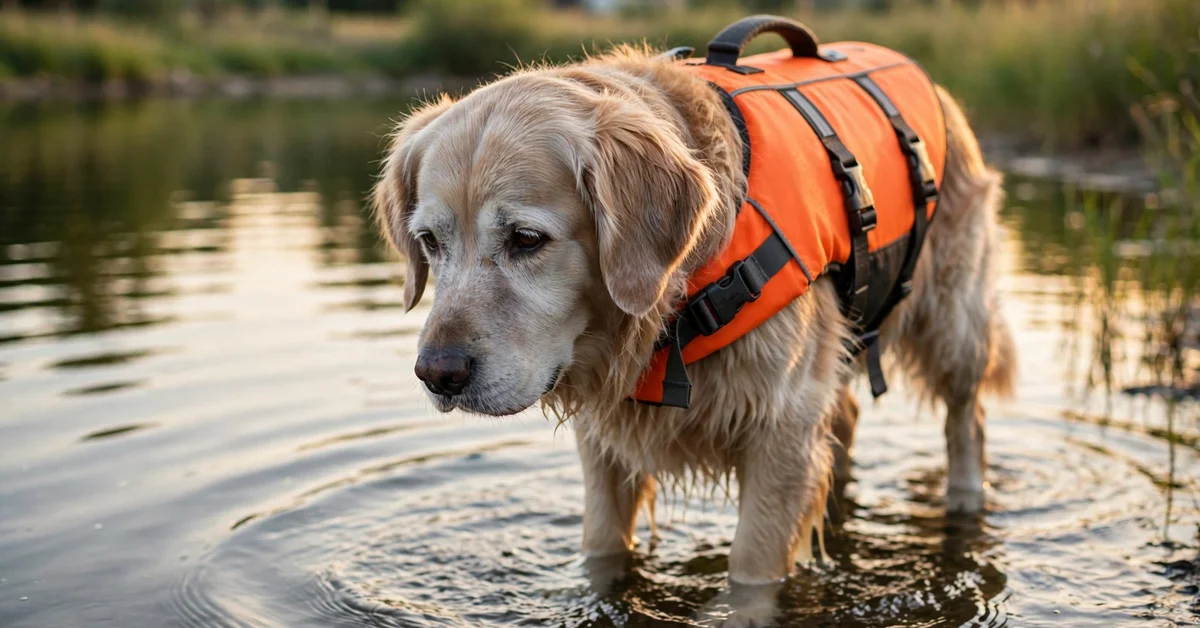
An older dog in the water is a different animal than the one you remember from his prime. The legs still move. The instinct is still there. But the stamina is not. A nine-year-old retriever who once fetched a bumper fifty times now swims hard for ten minutes, starts riding low in the water, and comes back to shore with his chin barely clearing the surface. That is the moment life jackets stop being boat-trip accessories and start being the reason the outing continues.
This guide is written for that exact dog. Not the young athlete on a paddleboard. The grey-muzzled one with stiff hips who still lights up at the sight of the lake. The six jackets below were picked for senior-specific needs: head and chin support for dogs that tire, strong grab handles because you will be doing more of the lifting now, closures that go on without wrestling arthritic legs, and foam placement that keeps a heavy older body level in the water.
One thing needs saying plainly before the list. A life jacket is buoyancy support, not a guarantee. It cannot keep an unsupervised dog safe, it cannot teach a weak swimmer to float, and no vest on the market makes drowning impossible. What it does is give a tired dog more time: time for his chin to rest above the water, time for you to spot him in the chop, time to get him out. Every recommendation below assumes you are within arm’s reach or close to it, every single time he swims.
Senior dogs also deserve an honest word about fit. Older bodies change. The chest fills out, the belly sags, the muscle over the shoulders thins. The size your dog wore at six may not be his size at eleven. Measure him again before you order anything, and treat the size charts below as the starting point, not the answer.
Quick Comparison: Best Life Jackets for Senior Dogs
| # | Product | Why it made the list | Check Price |
|---|---|---|---|
| 1 | Ruffwear Float Coat (Wave Orange, Small) | Premium foam placement and the strongest lift handle on this list; built for frequent boaters | Check Price |
| 2 | Fragralley Dog Life Jacket with Self-Lock ing Zipper | The only listing here that calls out older-dog support; zipper-top entry plus dual handles and a chin rest | Check Price |
| 3 | Dogcheer Shark Dog Life Jacket (Pink, M) | Chin support designed to fight fatigue; the standing fin makes a tired senior easy to spot | Check Price |
| 4 | ZLX Dog Life Jacket (Blue, M) | Front neck float props up a weary head; 3-year warranty is rare at this price | Check Price |
| 5 | Kuoser Dog Life Jacket (A-Orange, Large) | Ripstop shell with pearl-cotton foam; the dependable middle of the road | Check Price |
| 6 | VIVAGLORY High Buoyancy Dog Life Vest (Pink, S) | Neoprene construction adds warmth in cold water; good shape for small seniors | Check Price |
1. Ruffwear Float Coat Dog Life Jacket (Wave Orange, Small)
Ruffwear makes the jacket that the rest of the market imitates, and the imitation has not caught up. The Float Coat is the one pick on this list I would trust with a senior dog who swims every week all summer. The difference is not a single feature. It is the whole build: foam panels placed so the dog stays level instead of riding nose-up or sinking at the rear, a telescoping neck closure that adjusts where most brands put a fixed strap, and stitching at the handle that is designed to take a real lift. When you are hauling a wet 55-pound senior out of a boat, handle stitching is not a detail. It is the entire product.
The listing describes strategically placed foam and a strong handle positioned for lifting d ogs out of the water, plus reflective trim and a light loop for low-light outings. For seniors specifically, the six-size range matters more than it sounds. Older dogs land between sizes all the time because their bodies have changed shape, and having XXS through XL with detailed girth measurements means fewer returns and a better shot at a vest that does not ride forward and jam into the front legs. Between sizes, the listing says to take the smaller one, which is the right call. A snug vest stays put. A loose one rotates.
The argument against the Float Coat is price and weight of decision. It costs roughly two to three times the budget jackets here, and for a dog who swims twice a summer, that is money spent on a feature set you will not use. It is also the heaviest vest on this list in the larger sizes, and a heavy vest on a dog with little muscle is its own burden. But if your senior is a weekly swimmer with a boat in the picture, this is the buy-once jacket.
Key specs:
- Strategically placed foam panels for level flotation (listing)
- Strong lift handle, optimally positioned for lifting dogs out of the water (listing)
- Six sizes by girth: XXS 13-17 in, XS 17-22 in, S 22-27 in, M 27-32 in, L 32-36 in, XL 36-42 in; choose the smaller size if between (listing)
- Durable polyester shell; hand wash with mild detergent, air dry (listing)
- Reflective trim plus light loop for attachment (listing)
- All life stages; all breed sizes (listing)
Pros:
- Best-in-class handle strength and stitching for lifting seniors out of boats and onto docks
- Foam placement keeps an older, heavier dog swimming level instead of sinking at the rear
- Six sizes with real girth measurements, which helps oddly shaped senior bodies
- Reflective trim and light loop for early morning or dusk outings
Cons:
- Noticeably more expensive than every other pick here
- Heavier than the budget vests in large sizes, which adds load on a tired dog
- No dedicated chin rest or neck float, so head support depends on overall fit
Verdict: If your senior dog swims often and you are regularly lifting him in and out of a boat, buy the Float Coat and stop shopping. For occasional dips at the lake, one of the cheaper picks below does the job for less.
2. Fragralley Dog Life Jacket with Self-Locking Zipper
This is the only vest in the roundu p whose listing speaks directly to older dogs. It says so outright: the extra-long handle setup provides assistance for swimming, with extra stability and comfort for older dogs. Marketing copy on Amazon is usually noise. This one is still marketing, but it points at real features a senior owner can check with their own hands: a zipper-top entry that does not require threading stiff legs through armholes, a chin rest so a tired muzzle has somewhere to sit, and two grab handles instead of one so you can lift with a balanced grip.
The zipper entry is the standout for arthritic dogs. Most life jackets close with straps under the belly, which means rolling or lifting the dog to buckle up. A self-locking zipper along the top goes on like a jacket. You drape it over the back, zip, adjust the straps, and you are done. For a dog whose hips protest every unfamiliar movement, that matters every single outing. The listing also includes a four-foot reflective leash with the vest, which is a genuinely useful extra for keeping a hard-of-hearing senior close along the shore.
What I do not like is the clutter. Dual handles plus front and back D-rings plus a zipper plus adjustable straps is a lot of hardware on a senior dog, and every strap is a potential rub point. Thin-coated old dogs chafe fast. This vest needs a test wear at home before it goes near water. Check the armpits after twenty minutes. If you see redness, it is not the right fit and no amount of adjusting will fix it.
Key specs:
- Self-locking zipper along the top for on and off without lifting legs (listing)
- Built-in chin rest; listing notes it suits dogs with short muzzles (listing)
- Dual rescue handles for balanced lifting; D-rings at front and back (listing)
- Listing explicitly mentions extra stability and comfort for older dogs (listing)
- Tear-resistant nylon with polyurethane foam fill (listing)
- Reflective webbing for low-light visibility; four-foot reflective leash included (listing)
- Available in small, medium, and large (listing)
Pros:
- Only pick in the roundup with senior-dog support called out on the listing
- Zipper-top entry is the easiest on arthritic dogs that resist leg handling
- Chin rest gives a tired dog a place to settle his muzzle
- Two handles distribute the lift, which is kinder on your grip and the dog’s body
- Included reflective leash keeps a deaf or distracted senior close on shore
Cons:
- Lots of straps and hardware means more rub points; test at home for chafing
- Only three sizes, so between-size dogs have fewer options than the six-size vests
- Newer listing with less long-term track record than the established picks
Verdict:< /strong> The most senior-specific design here by a clear margin. If your dog struggles with being dressed, meaning stiff legs and flinching at belly straps, the zipper entry alone earns this the second slot. Just check for chafing before the first swim.
3. Dogcheer Shark Dog Life Jacket (Pink, M)
Yes, it has a shark fin. No, that is not the reason it is on this list. The Dogcheer made the cut for two serious reasons: a real chin support that the listing ties directly to preventing fatigue, and visibility engineering that actually helps with older dogs. A senior who tires out tends to swim slower and lower, and a slow low dog is harder to see in chop. The standing fin plus reflective strips make this vest unusually easy to track at a distance, which is exactly what you want when the swimmer is a twelve-year-old lab who drifts.
The chin support is the functional feature. The listing describes it as keeping the dog’s head above water to prevent fatigue and allow easy breathing without restricting movement. For a senior, fatigue is the whole story. A tired dog drops his head, takes in water, panics, and tires faster. Anything that props the head up breaks that cycle. The adjustable chest and belly straps with quick-release buckles let you dial the fit so the chin support actually sits where the chin is, instead of floating uselessly off to one side.
The honest complaints: the listing markets this as a puppy swim vest despite sizing that spans small through large dogs, so you have to ignore the cutesy framing and evaluate the hardware. And the shark-fin style is a lot of costume for a dignified old dog. If your senior is the type who freezes when you put clothes on him, the fin will not help. Functionally it is sound. Aesthetically it is a choice.
Key specs:
- Chin support to keep the dog’s head above water; listing ties it to fatigue prevention (listing)
- Sturdy top rescue handle for lifting from water to boat (listing)
- Adjustable chest and belly straps with quick-release buckles (listing)
- Reflective strips plus standing shark-fin design for visibility (listing)
- Durable ripstop fabric with high-buoyancy foam (listing)
- Sizes for small, medium, and large dogs; D-ring for leash attachment on shore (listing)
Pros:
- Chin support directly addresses the senior problem: head-dropping when tired
- Fin plus reflective strips make a slow senior swimmer easy to spot
- Quick-release b uckles allow fast removal if the dog panics
- D-ring gives you a leash point for the walk to and from the water
Cons:
- Marketed as a puppy vest, which buries the senior-relevant features in cutesy framing
- The shark fin is bulky and some dogs hate the look and feel of it
- No mention of hand-wash or care instructions surfaced on the listing
Verdict: The best visibility package on the list and real chin support for tired swimmers. If your senior swims in open water where you need to track him at distance, this earns its place. If he hates costumes, pick the ZLX instead.
4. ZLX Dog Life Jacket (Blue, M)
The ZLX is the quiet value pick. Nothing about the listing is flashy. But it has the two things a senior dog most needs from a budget vest: a front neck float that props up a weary head, and a grab handle that is actually reinforced, listed as secure with a heavy-duty D-ring beside it. Head support plus a trustworthy handle is the whole senior brief in two features, and this vest delivers both for budget money.
The neck float deserves a closer look because it works differently than a chin rest. A chin rest gives the muzzle a shelf. A neck float wraps buoyancy under the throat and jaw so the whole front end rides higher. For a senior with a heavy head, meaning your mastiff types, your old labs, your blocky-headed bulldogs, the neck float does more work. The listing also advertises a three-year warranty, which is unusual in this price bracket and suggests the maker is not planning on the vest falling apart in one season.
The trade-off is refinement. The shell is a cotton, foam, and nylon mix rather than the ripstop and neoprene of the premium picks, and cotton holds water longer, which means a heavier wet vest on the walk back to the car. Sizing runs on a single chest measurement per size, and the medium fits a 20 to 24 inch chest. That is fine for a true medium. It is not enough granularity for the oddly proportioned seniors this guide is written for. Measure twice.
Key specs:
- Front neck float offers additional support to keep the head above water (listing)
- Secure grab handle; heavy-duty D-ring (listing)
- All life stages; all breed sizes; medium fits 20-24 inch chest girth (listing)
- Cotton, foam, and nylon construction, striped style; weighs 12.31 oz in medium (listing)
- 3 Year Warranty (listing)
- Care: keep in a dry place (listing)
Pros:
- Neck float is the most effective head-support style for heavy-headed seniors
- Reinforced handle and D-ring at a budget price
- Three-year warranty is the best coverage promise on this list
- Lightweight at 12.31 ounces in medium
Cons:
- Cotton-blend shell holds water and stays heavy after the swim
- Single chest measurement per size is coarse for oddly shaped older bodies
- No reflective trim mentioned on the listing, so visibility is just the bright blue
Verdict: The smart budget pick for a senior who swims occasionally. The neck float and the warranty punch above the price. If he swims weekly, the Ruffwear’s build quality is worth the step up.
5. Kuoser Dog Life Jacket (A-Orange, Large)
Kuoser is the steady middle of this list, and there is real value in a vest with no surprises. Ripstop Oxford shell, pearl-cotton foam, rescue handle, reflective trims, adjustable straps from XS to 2XL. Nothing here reinvents the life jacket. Everything here is present and correct. For a senior dog whose needs are ordinary, meaning he tires sooner than he used to but has no special dressing difficulties and no open-water ambitions, this is the vest that just works.
The size range is the practical advantage. XS through 2XL covers the full span of senior bodies, from the old miniature dachshund to the aging Great Dane, and the listing gives real chest measurements. The large shown here fits a 22.83 to 29.53 inch chest, which lands squarely on the average older lab or golden. Reflective trims run the standard pattern, bright orange is easy to spot, and at 15.2 ounces the vest is mid-weight. Hand wash only, which is typical for foam vests and worth knowing before the first muddy lake trip.
What it lacks is any senior-specific thinking. No chin rest, no neck float, no zipper entry, no special handle design. The rescue handle is a standard top strap. If your dog’s main problem is fatigue and head-dropping, the Dogcheer or ZLX give you more for the money. If his main problem is that he is twelve and the stairs are hard, the Fragralley’s zipper entry is the better answer. The Kuoser is for the senior whose main problem is simply that he is a senior, and who needs a reliable vest without a specific therapy.
Key specs:
- Ripstop Oxford and nylon shell with pearl cotton foam fill (listing)
- Rescue handle; reflective trims (listin g)
- Adjustable straps; sizes XS through 2XL; large fits 22.83-29.53 inch chest (listing)
- All life stages; weighs 15.2 oz in large (listing)
- Hand wash only (listing)
Pros:
- Widest size range on the list, XS to 2XL, with real chest measurements
- Ripstop shell resists claws and dock scrapes better than cotton blends
- Reflective trims and bright orange for visibility
- Proven, uncomplicated design with no learning curve
Cons:
- No chin rest, neck float, or any head-support feature
- No zipper entry, so dressing an arthritic dog still means belly straps
- Hand wash only, which gets old after muddy outings
Verdict: The dependable default. If nothing about your senior’s swimming is unusual and you want a solid vest in the right size without overthinking it, this is the one. For specific senior problems, the picks above it are sharper.
6. VIVAGLORY High Buoyancy Dog Life Vest (Pink, S)
Neoprene changes the equation for small seniors. It insulates. An older toy poodle or senior dachshund loses body heat in cool water fast, and a neoprene vest buys warmth that a thin nylon shell does not. VIVAGLORY’s vest pairs that neoprene body with what the brand’s own comparison row calls high buoyancy, a padded grab handle, and a five-size range from XS to XL. For the little old dog who shivers after ten minutes in the lake, this is the most comfortable material on the list.
The padded handle is worth a sentence. Most budget handles are a flat webbing strap. A padded one is kinder on your hand when you are lifting a wet dog repeatedly, and with a small senior you will be lifting him in and out constantly because he cannot scramble up a bank the way he used to. Hand washable, neoprene and nylon, all life stages. The small shown here is aimed at small breeds, which matches the senior use case: the dogs who benefit most from this vest are the small, thin-coated old ones.
The limits are size and honesty about the listing. It is sized for small dogs, so medium and large seniors are out. The title’s “puppy” framing means you are buying a vest marketed at young dogs for an old one, which is fine mechanically but tells you the maker was not thinking about arthritic shoulders or sagging bellies when they cut the pattern. And at the budget end of the market, handle stitching deserves your own inspection when it arrives. Tug it hard before you trust it over water.
Key specs:
- Neoprene and nylon construction, listed as high buoyancy in the brand’s comparison row (listing)
- Padded grab handle (listing)
- Sizes XS, S, M, L, XL; small breeds; all life stages (listing)
- Hand washable (listing)
Pros:
- Neoprene insulates, which matters for small seniors that chill fast in cool water
- Padded handle is comfortable for the repeated short lifts small seniors need
- Lightweight and flexible, less bulk on a tiny frame
- Budget price for a material upgrade over plain nylon shells
Cons:
- Small-dog sizing only; not an option for medium or large seniors
- Marketed toward puppies, so the cut was not designed around older bodies
- Inspect the handle stitching yourself before trusting it over water
Verdict: The pick for small, thin-coated seniors in cool water. The neoprene warmth is a genuine advantage that none of the other vests offer. Big-dog owners should look at the Kuoser or ZLX instead.
What a Senior Dog Actually Needs in a Life Jacket
Forget the marketing checklists. A senior dog needs four things, in this order: a handle you can trust, head support, a fit that does not fight his body, and visibility. Everything else is decoration.
The handle comes first because you are the rescue system now. A young dog scrambles out on his own. A senior often cannot. Look for a handle stitched through the vest’s structural straps, not just tacked onto the shell. When the vest arrives, grab the handle and lift the dog’s front end off the ground before you ever reach the water. If the stitching creaks or the handle pulls away from the body of the vest, send it back. This test takes ten seconds and it is the most important thing in this entire guide.
Head support comes second because fatigue is the senior failure mode. A rested dog holds his own head up. A tired one does not. Chin rests, neck floats, and front foam panels all do the same job: they keep the muzzle above the surface when the dog’s neck gives out. If your dog’s swims end with his chin dragging, prioritize a vest with dedicated head support over one with better materials but a flat front.
Fit comes third because older bodies are lumpy and asymmetrical. Measure the chest at its widest point, behind the front legs, with the dog standing. Then measure the neck. Then check both numbers against the size chart instead of buying the size he wore three years ago. The vest should be snug enough that you can slide two fingers under every strap but not a whole hand. If it rotates when he shakes, it is too loose, and a loose vest in water is worse than no vest at all because it gives you false confidence.
One more fit detail worth your attention: belly coverage. Some vests wrap foam all the way under the belly, and some leave the underside mostly open with just straps. For a senior with thin skin or a surgical scar, full belly coverage adds warmth and protection but also adds material that can bunch and rub. For a senior who runs hot or has sensitive skin, the open-belly style breathes better. There is no universally right answer. It depends on your dog’s coat, skin, and the water temperature. If you are unsure, the middle path is a vest with a padded belly panel rather than bare straps or full foam wrap.
Visibility comes fourth because seniors swim slower and lower. Bright colors, reflective trim, and high-contrast patterns are not fashion. They are how you keep eyes on a dog who has drifted thirty yards down the shoreline while you were watching the grandkids.
How to Introduce a Senior Dog to His Life Jacket
Do not put the vest on for the first time at the water. Older dogs are set in their routines, and a new sensation plus a new environment is how you get a freeze-up at the shoreline. Dress him at home, indoors, with treats. Let him wear it around the house for twenty minutes while dinner happens. Watch how he moves. Does he walk normally? Does he try to chew the straps? Does the front edge dig into his throat when he sits?
Check the armpits and the belly after that first wear. Senior skin is thinner and rubs raw faster than it used to. Any pinkness means the straps need loosening or the vest needs a different size. This is also when you test the handle lift described above, on dry land, with the dog calm. Get him used to being lifted by it in the living room so the first boat lift is not also the first surprise.
First swim: shallow water, short session, you in the water with him if the spot allows it. Five to ten minutes, then out, vest off, check the skin again. While he is in the shallows, watch the vest, not just the dog. Does it ride forward toward his head? Does it twist to one side when he turns? A vest that shifts in knee-deep water will shift worse in deep water. Snug the straps one notch at a time until it stays centered through a turn. If you run out of adjustment range, the size is wrong, and no loyalty to the purchase should keep a wrong-sized vest in the rotation.
Older dogs tire invisibly. The dog who swam for an hour at age six may be done at fifteen minutes now, and he will not always tell you. Watch his stroke. When the rear end starts sinking or the paddling slows, the swim is over. The vest extends his time. It does not reset his age.
Water Safety Rules for Older Dogs
A life jacket does not change the rules. It just makes following them more forgiving. First: never leave a senior dog in the water unsupervised, vest or no vest. Older dogs can have a cardiac event, a seizure, or simple exhaustion with no warning, and a vest keeps a conscious dog afloat. It does not keep an unconscious one breathing.
Second: watch the water temperature. Seniors chill faster, and cold water plus an older heart is a bad combination. Neoprene helps, but it is insulation, not a wetsuit. If your own legs go numb, his are worse. Third: manage the exits. The swim is rarely the hard part. The hard part is the slippery boat ladder, the steep bank, the dock edge. A ramp, a helping hand under the chest, and the vest’s grab handle used together are what get a senior out safely. Plan the exit before you plan the swim.
Fourth: keep sessions short and fresh water available. An older dog will drink lake water if he is thirsty, and he will keep swimming past his limit because the instinct outlasts the body. You are his limiter now. Call him in while he is still having fun. That is the whole secret to a senior who loves the water for years instead of one bad summer that ends it.
Fifth, and this one is specifically for the boat crowd: attach the plan to the dog, not the dog to the plan. A senior on a boat should have his vest on before he steps aboard, not after you are underway. Keep him on the shaded side, keep the engine-off rule absolute while he is near the swim platform, and have the ramp or lift aid rigged before he goes in. The smoothest senior boat days are boring by design. Vest on at the dock, short swim, ramp out, fresh water, shade. Boring is the goal.
Frequently Asked Questions
Should my senior dog wear a life jacket even if he has always been a good swimmer?
Yes, and this is the single most common mistake senior owners make. Swimming ability does not decline gradually in a way you can watch. It holds, and then it drops. A dog who was a strong swimmer last summer can be a tired swimmer this summer because of arthritis, muscle loss, or a heart that is not what it was. The vest is cheap insurance for the season his body changed without telling you.
How do I measure my senior dog for a life jacket?
Stand the dog up and wrap a soft tape around the widest part of his chest, right behind the front legs. Write down the number. Measure the neck where a collar sits. Compare both to the size chart and buy by the chest number first. If he falls between sizes, take the smaller one. A snug vest stays in place. A loose one rotates in the water and can slide forward over the front legs. Re-measure every season, because older bodies change shape year to year.
Are life jackets with a chin float worth it for older dogs?
For most seniors, yes. The defining feature of an older swimmer is the head dropping as he tires. A chin rest or neck float props the muzzle up and breaks the cycle where a tired dog takes in water, panics, and tires faster. If your dog’s swims end with his chin low, a vest with head support matters more than any other feature. If he still swims head-high and just tires in the legs, a standard vest is fine.
Can a life jacket prevent my dog from drowning?
No. This is the sentence that matters most in this guide. A life jacket provides buoyancy. It keeps a conscious, supervised dog higher in the water and buys you time to reach him. It cannot keep an unconscious dog breathing, it cannot save a dog tangled in weeds or trapped under a dock, and no vest is a substitute for watching your dog every second he is in the water. Never leave a dog unsupervised in water because he is wearing a vest.
How do I clean a dog life jacket?
Rinse it with fresh water after every swim, especially after salt water or chlorinated pools, and hang it to dry out of direct sun. Most vests on this list are hand wash only: secure the fasteners, wash with mild detergent, and air dry. Do not put a foam vest in a washing machine or dryer. The agitation breaks down the foam panels and the heat warps them, and a vest with crushed foam is a vest that no longer floats the way it should.
Can I use the grab handle to lift my senior dog out of the water?
That is exactly what the handle is for, with two conditions. First, test it on land before you trust it over water: lift the dog’s front end by the handle and watch the stitching. If anything strains or pulls, the vest goes back. Second, use your other hand under the dog’s chest or belly for a balanced lift, especially with heavier seniors. The handle is a grip point, not a crane hook. For very heavy dogs, the dual-handle design on the Fragralley lets you or a helper lift with both hands.
A senior dog who still loves the water is a gift. He is not the swimmer he was, but with a vest that supports his head, a handle you trust, and an owner who calls him in while he is still having fun, he does not need to be. Measure him, dress him at home first, keep the swims short, and stay close. The grey muzzle at the shoreline, dripping and happy, is worth every bit of the fuss.
