

Here’s the travel scenario: you’ve arrived home from a trip, and the wire dog crate that took up your entire back seat needs to disappear — under the bed, in a closet, flat against a wall — until the next trip. Wire crates are designed to fold flat in under a minute, with no tools and no force. If yours won’t budge, the secret is always the same: there’s a specific clip, tab, or panel order holding it rigid, and knowing the sequence matters more than strength. This guide covers the standard wire-crate collapse (the #1 seller in the category, the MidWest iCrate, uses exactly this design), plus fabric-free fixes for every stuck spot along the way.
Pet Travel Items is reader-supported. When you buy through links on this page, we may earn a commission at no extra cost to you. Our how-to guides are based on manufacturer instructions and hands-on owner reports, never commission rates.
Before You Start
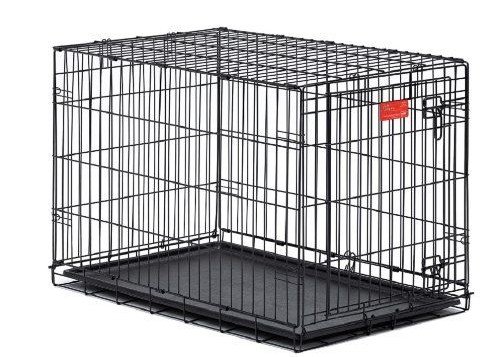
Clear the crate first. Take out bedding, toys, bowls, and the plastic floor pan (the tray slides out the front or bottom, depending on the model). Collapsing a crate with the pan still inside is the #1 reason it won’t fold flat — the pan holds the walls apart. Set it aside; it stores flat separately in the same spot.
Work on a clear surface. A rug or a patch of floor where a 36–48-inch wire box can swing. Wire crates are awkward, not heavy — most fold-down fights are about angles, not muscle.
Know your crate type. This guide is for wire crates (the folding kind). Soft-sided fabric crates collapse differently (see the FAQ), and plastic airline crates don’t fold at all — they split into top and bottom halves instead.
The 5 Steps to Collapse a Wire Dog Crate
Step 1: Release the top panel locks where the ends meet the top
Run your hands along the top edges where the front and back panels meet the roof panel. On most wire crates, the top panel hooks over or clips onto the end panels — you’ll feel small wire hooks, tabs, or loops at each corner. Unclip and lift the hooks free so the top panel is no longer anchored to either end. If you can’t find hooks, look for the panel that’s visibly hinged — that’s the order of operations working backwards.
Step 2: Fold the end panels (with the doors) inward or down
With the top released, the front and back panels — the ones containing the doors — fold down. On the classic design, the ends fold inward toward the middle of the crate (down against the floor panel), one at a time. Some designs fold one end over the other. Gently swing each end panel down flat; if it resists, go back to Step 1 — something up top is still latched.
Step 3: Now fold the side/top panel down over the ends
The long side panel (often the piece that covers the top and one side in one continuous wire sheet) now folds down over the folded ends, sandwiching them. This is the motion that turns the 3D box into a flat slab — walls, ends, and roof all lying in one stack.
Step 4: Engage the carry handle or panel clip to lock it flat
Most wire crates have a plastic or wire carry handle that doubles as the flat-lock: it clips across the folded panels and holds them closed for carrying and storage. If your crate has a storage latch or clip, snap it shut now. If there’s no lock, a bungee cord or a luggage strap through the wire keeps it from springing open in the closet.
Step 5: Store flat — and keep the pan with it
Slide the folded crate under a bed, behind a couch, or upright in a closet. Rest the floor pan on top of it so both pieces live in the same place. Done this way, the whole package is about 3–4 inches thick.
Why Won’t My Crate Collapse? Troubleshooting
The floor pan is still in. The most common cause, full stop. Remove it first.
A top clip is still latched. Even one hooked tab at a corner keeps the whole frame rigid. Run all four top corners before pushing anything.
You’re folding out of order. Wire crates fold in one sequence only: release top → ends down → side/top down → lock. Folding the side before the ends puts the panels in a bind — straighten it back up and start over.
Bent wire is catching. A crate that’s been sat on or dropped can have a bent hook that snags on the frame. Inspect the hooks and gently straighten any that are visibly deformed with pliers — they’re mild steel and bend back easily.
It’s stiff because it’s new (or dirty). New crates sometimes need a firm, slow push at the panel hinges — steady pressure, no yanking. Crusty hinges from outdoor use free up after a wash and a drop of household oil.
The Crate in the Examples: MidWest iCrate
Nearly every wire crate on the market copies the fold-flat design popularized by MidWest’s iCrate line, so the steps above are written around it. The iCrate is the #1 best-selling dog crate on Amazon, with Amazon listing roughly 4.8 stars across some 100,000+ ratings (figures from Amazon listings in search results; treat as approximate). It’s available in seven sizes from 18″ to 48″, in single-door and double-door versions, with a divider panel, leak-proof pan, roller feet, and the fold-and-carry design that needs no tools to set up or break down. If your crate is a different brand, the mechanism is almost certainly the same — the iCrate’s design is the industry template.
Check the MidWest iCrate on Amazon
Frequently Asked Questions
Do I need tools to collapse a wire dog crate?
No. Wire crates are designed to fold and unfold by hand — release the top clips, fold the ends, fold the side/top down, and lock it with the carry handle. The only tool that ever comes up is a pair of pliers to straighten a bent wire hook, which is a repair, not part of normal collapsing.
How long does it take to collapse a dog crate?
Once you know the sequence, under a minute — owners consistently describe it as a 30-to-60-second job. The first time takes longer mostly because finding the top clips is a treasure hunt. After two or three collapses, it’s muscle memory.
Can I collapse the crate with the dog’s bedding still inside?
You can fold it with soft bedding inside only if the bedding compresses fully flat — but the floor pan must come out regardless, and honestly, removing everything takes 20 seconds and guarantees a flat fold. Bedding stored long-term in a closed crate also traps odor and moisture, so pull it out anyway.
How do I collapse a soft-sided dog crate?
Differently: soft-sided crates have a spring-steel or folding frame inside the fabric. Typically you unzip the top, press the frame’s locking bars or twist-fold the frame (some fold like a car sunshade — push two opposite corners toward each other and it collapses into a flat oval), then secure it with the built-in straps. Check your brand’s tag inside the crate — the folding method varies by manufacturer more than it does for wire crates.
Why does my collapsed crate keep springing open?
Because the flat-lock isn’t engaged. Most wire crates use the carry handle or a small wire clip to hold the folded stack closed — if that clip is missing or bent, the panels’ spring tension pops them open. A bungee cord, luggage strap, or even a zip tie through the folded wire solves it permanently.
Does collapsing and unfolding weaken the crate?
Not meaningfully. The hinges and hooks are designed for repeated folding — travel crates get collapsed and rebuilt constantly. What wears them out is forcing panels against the fold order (bending hooks) and rust from storing them damp. Fold in sequence, store dry, and a wire crate lasts for years of trips.
