

Here’s the scenario every multi-pet household knows too well: you load the car for a weekend trip, cat and dog both coming along, and within an hour of arriving, the dog has found the cat’s litter box and is treating it like a snack bar. It’s gross, it’s a vet-bill risk (litter ingestion, parasites), and it’s the reason “dog proof cat litter box” is one of the most-searched phrases in the litter category.
The honest note most roundups skip: no litter box is truly dog-proof against a determined large dog. What these designs actually do is deter — a top entry a dog can’t comfortably reach into, a hood that blocks casual snooping, a furniture enclosure that hides the whole setup. This guide covers six designs that genuinely keep most dogs out, with the complaints owners actually report: cats that refuse top entries, boxes that are too small for big cats, and lids a clever dog learns to defeat. One more honest note for travelers: top-entry and enclosed boxes also contain litter scatter in a car or RV, which is a real bonus on the road.
Pet Travel Items is reader-supported. When you buy through links on this page, we may earn a commission at no extra cost to you. Our picks are driven by documented owner feedback, never by commission rates.
Best Dog Proof Cat Litter Boxes at a Glance
| # | Product | Size / Style | Best For | |
|---|---|---|---|---|
| 1 | IRIS USA Top Entry Litter Box | 20.75″ x 16.13″ x 14.63″ · top entry | Best overall | Check Price |
| 2 | Modkat Top-Entry Litter Box | 16″ x 16″ x 15″ · top entry | Best design | Check Price |
| 3 | Modkat XL Litter Box | Top or front entry · seamless base | Best for large cats | Check Price |
| 4 | Purina Tidy Cats Breeze Hooded System | Hooded · pellets + pads | Best odor control | Check Price |
| 5 | Petmate Top Entry Litter Pan | Hinged top-entry lid | Budget pick | Check Price |
| 6 | Good Pet Stuff Hidden Litter Box | 19.6″ x 19.6″ x 21.9″ · planter furniture | Best hidden/furniture | Check Price |
Prices shift constantly — check before you buy. Sizes are manufacturer figures.
1. IRIS USA Top Entry Litter Box — Best Overall
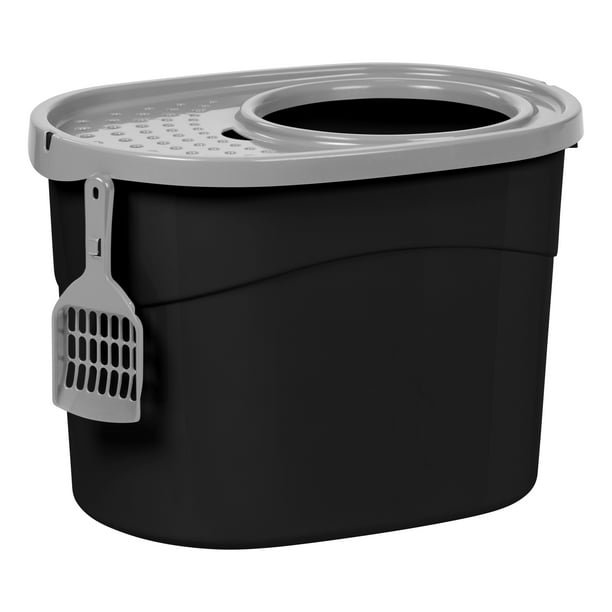
This is the default recommendation for a reason: the entry hole is sized for a cat but not for a dog’s snout, the 14.6-inch walls are tall enough that most medium dogs can’t reach in, and the grooved lid doubles as a litter-catching mat. IRIS explicitly markets it with “no dogs allowed” copy, and it’s the box most roundups land on for this exact keyword. The included scoop hooks onto the body, and it holds up to 25 lbs of litter.
The complaints are worth knowing before you buy. The rounded interior corners are harder to scoop cleanly than a square pan, per multiple roundup reviewers. And the fundamental top-entry trade-off: kittens, senior cats, and cats with limited mobility can struggle with the jump in and out — this is not the box for an arthritic cat. Very large, determined dogs can still get a nose into the opening, though few bother.
Specs: 20.75″L x 16.13″W x 14.63″H · entry 9″W x 10.5″H · holds up to 25 lbs of litter · grooved litter-catching lid · scoop included · made in USA.
Pros: the proven dog-deterrent design; tall walls contain spray and scatter; litter-catching lid; made in the USA.
Cons: rounded corners make scooping fiddly; not suitable for kittens, seniors, or limited-mobility cats; a very determined large dog can still reach the opening.
Verdict: The safest default — buy it if your cat can jump. Check the price on Amazon.
2. Modkat Top-Entry Litter Box — Best Design
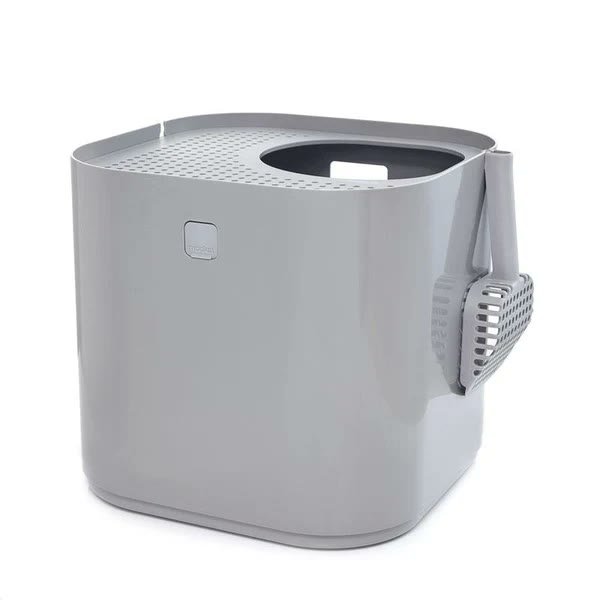
Modkat is the design-forward answer to the same problem: a seamless, leak-proof base (great for side-peers), a lid that swivels open one-handed for scooping instead of requiring you to wrestle a hood off, and a 9-inch top entry that keeps dogs out. The lid acts as a walk-off mat to cut tracking, and it comes with a reusable liner, a sifting scoop, and charcoal filters.
The honest part is the price of admission — and the ongoing costs. The box itself is premium-priced, and the fitted reusable liners are proprietary, so replacements come from Modkat. At 16″ x 16″, the standard size is also tight for genuinely large cats (Modkat sells the XL for that). And like every top-entry box, it only works if your cat accepts jumping in and out.
Specs: 16″ x 16″ x 15″ · ~9″ diameter top entry · seamless leak-proof base · swivel lid · reusable liner (up to ~3 months) · sifting scoop and charcoal filters included.
Pros: one-handed swivel lid — easiest scooping here; seamless base stops leaks; lid doubles as a litter mat.
Cons: premium price plus proprietary liner refills; standard size is small for large cats; cats that won’t jump are out of luck.
Verdict: The best-engineered top entry — worth it if the price doesn’t scare you. Check the price on Amazon.
3. Modkat XL Litter Box — Best for Large Cats
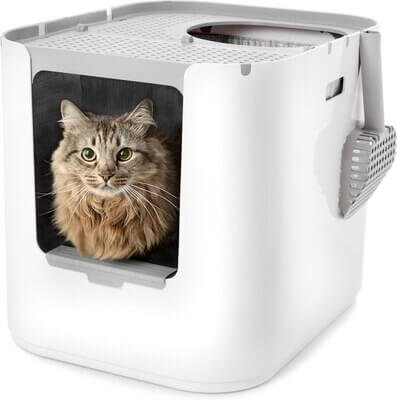
The XL answers the standard Modkat’s biggest complaint: it’s the bigger sibling, and it ships with parts to configure it as either a top-entry or front-entry box. In top-entry mode you get the same dog deterrence as the standard, with room for large cats and multi-cat households. The seamless full-height base prevents leaks, and it includes both top-entry and front-entry reusable liners plus the sifting scoop.
The catch is in the configurability. In front-entry mode, a dog can walk right in — the dog-proofing only exists in top-entry mode. And the ongoing-cost story is the same as the standard: proprietary liners and a premium price. If your cat needs the front entry for mobility reasons, this box won’t keep the dog out, and you should look at the furniture-enclosure option (#6) instead.
Specs: larger than the standard 16″ x 16″ · configurable top or front entry · seamless full-height base · Type C (top) and Type D (front) reusable liners included · sifting scoop included.
Pros: room for large cats and multi-cat homes; top-entry mode is genuinely dog-deterrent; same easy swivel-lid cleaning.
Cons: front-entry mode defeats the dog-proofing; premium price with proprietary liner refills; overkill for a single small cat.
Verdict: The large-cat answer — just keep it in top-entry mode. Check the price on Amazon.
4. Purina Tidy Cats Breeze Hooded System — Best Odor Control
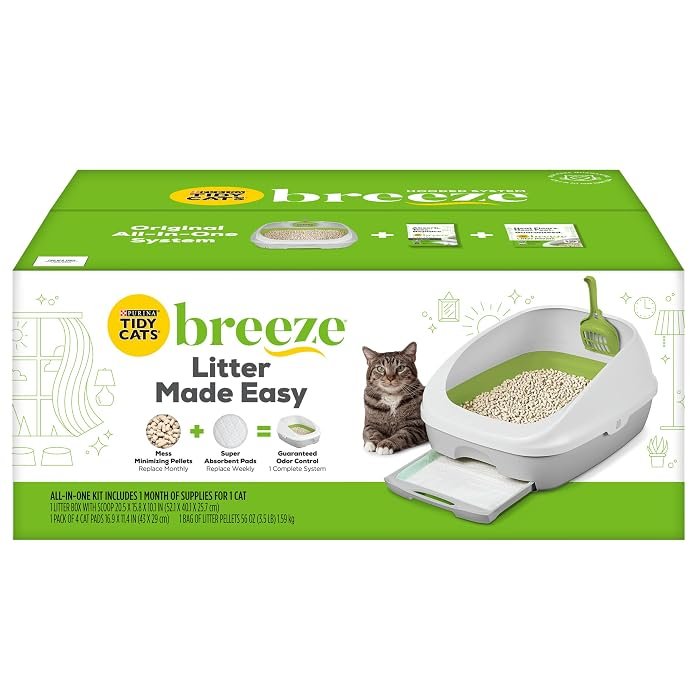
The Breeze takes a completely different approach: instead of clumping clay, it uses zeolite pellets that let urine pass through to an absorbent pad in a pull-out drawer, while solids are scooped off the pellets. The hooded version adds a cover that blocks a casual canine snooper, and the system is 99.9% dust-free with strong ammonia-odor control (one pad handles about 7 days for one cat). For travel, the near-zero dust is a genuine plus in a car or RV.
The complaints cluster around the system lock-in and cat acceptance. The pads and pellets are ongoing costs — you’re buying into Purina’s refills indefinitely. And the big one: a meaningful share of cats refuse pellet texture outright, preferring to dig in fine clay. Some owners also report pellets escaping the box and scattering. The hood deters opportunistic dogs, but it’s lightweight — don’t expect it to stop a determined one.
Specs: hooded box + zeolite pellets + absorbent pads + scoop · 99.9% dust-free per manufacturer · one pad ≈ 7 days for one cat · pads in a protective drawer.
Pros: excellent odor control with minimal dust — great for travel; no clay clumps to scrape; pads make urine cleanup trivial.
Cons: locked into Purina pad/pellet refills; many cats reject pellet texture; pellets can scatter; the hood won’t stop a determined dog.
Verdict: The low-dust, low-odor system — if your cat accepts pellets. Check the price on Amazon.
5. Petmate Top Entry Litter Pan — Budget Pick
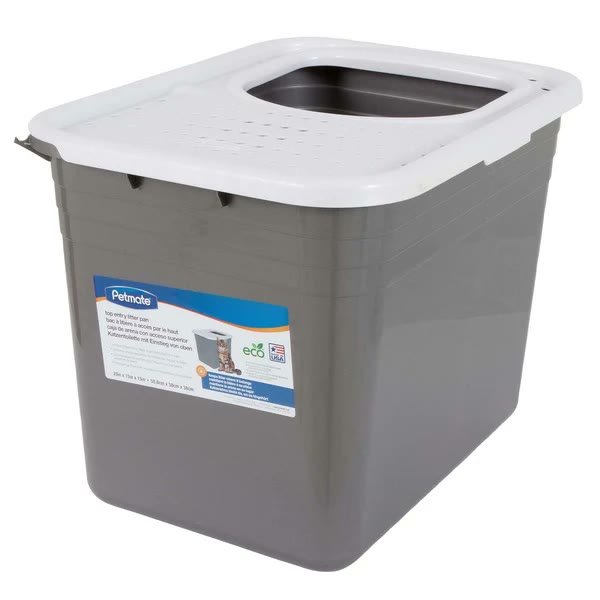
Petmate’s top-entry pan does the core job — wide top opening for the cat, walls the dog can’t easily defeat — at a fraction of the Modkat’s price. It’s made in the USA from recycled materials, has a hinged lid with a filter, and the listing itself advertises “keep litter in and dogs out.” For a second box (say, the travel setup), the price is right.
The compromises are visible. The scoop is not included, the warranty is only 30 days, and owners commonly describe the plastic as thinner and less premium-feeling than the IRIS or Modkat. The entry is generous, which is good for cats but marginally easier for a medium dog to investigate than the tighter IRIS opening. It’s the value play, not the best play.
Specs: enclosed top-entry pan · hinged lid with filter · wide top entry · made in USA from recycled materials · scoop not included · 30-day warranty.
Pros: cheapest real dog-deterrent design; hinged lid with filter; made in the USA.
Cons: scoop not included; thin-feeling plastic; short warranty; the wide entry is slightly less dog-deterrent than tighter designs.
Verdict: The budget top entry — fine as a second or travel box. Check the price on Amazon.
6. Good Pet Stuff Hidden Litter Box — Best Furniture Enclosure
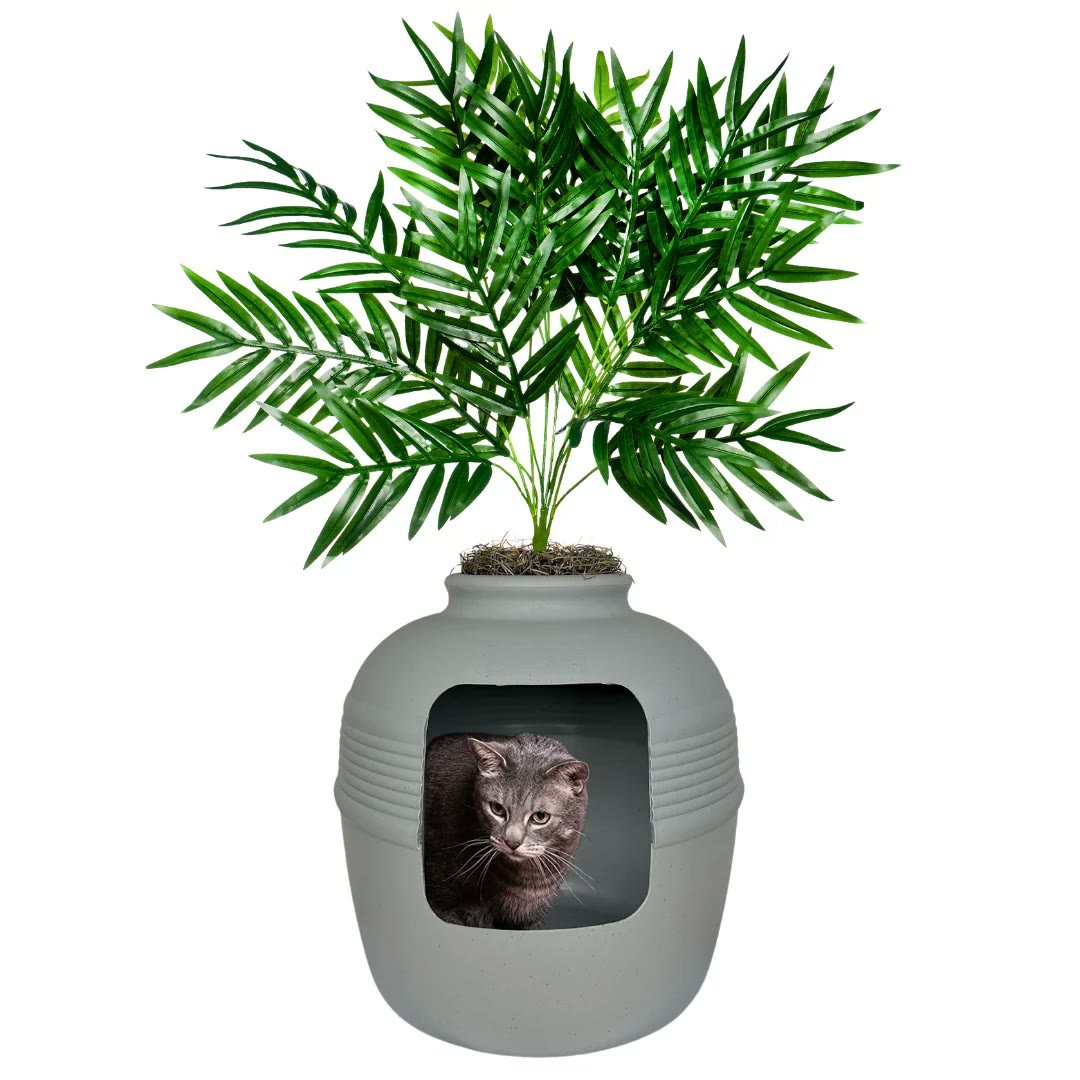
If the problem is partly aesthetic — a litter box in the living room of a vacation rental — the Good Pet Stuff planter hides the entire box inside what looks like a potted palm. The cat enters through a 9.1″ x 9.1″ opening; the dog sees furniture. A vented carbon filter and the enclosed design handle odor, and the interlocking V-groove base is genuinely leak-proof for high-spraying cats. Over a million sold and made in the USA.
Complaints to weigh: the 9.1-inch square entrance is tight for large cats — measure your cat, not just the box. The faux plant and decorative moss are chewable and scatterable, which some owners (and some cats) turn into a second mess. And it’s priced like furniture, not like a litter box. Cleaning means lifting the whole planter top off, which is more effort than flipping a lid.
Specs: 19.6″L x 19.6″W x 21.9″H (44.5″H with plant) · interior 19″ x 19″ x 19″ · entrance 9.1″ x 9.1″ · vented carbon filter · leak-proof V-groove base · faux palm and moss included · made in USA.
Pros: completely hides the box — best for living spaces and rentals; carbon filter plus enclosed design for odor; leak-proof base.
Cons: entrance is tight for large cats; plant and moss can become a mess; furniture pricing; cleaning requires removing the top.
Verdict: The disguise option — best looks, highest price, measure your cat first. Check the price on Amazon.
How to Choose a Dog Proof Cat Litter Box
Match the entry to your cat’s mobility first, the dog second. Top-entry boxes are the best dog deterrent, but they’re unusable for kittens, arthritic seniors, and cats with limited mobility. If your cat can’t jump, skip straight to furniture enclosures or hooded boxes with cat-sized doors.
Size the deterrent to your dog. A top entry with a 9-inch opening defeats most medium dogs completely; a large, determined dog can still get a nose in. For big, persistent dogs, a furniture enclosure (the whole box hidden) beats any open-top design.
Size the box to the cat, not the room. Large cats need turning room — the IRIS and the Modkat XL work; the standard Modkat and the Good Pet Stuff planter are tight for big cats. A box the cat finds cramped gets rejected, and a rejected box helps nobody.
Weigh cleaning access. You’ll scoop this box daily. Swivel and hinged lids (Modkat, Petmate) beat lift-off hoods, and lift-off hoods beat disassembling a planter. The best dog-proof box is the one you’ll actually maintain.
Count the ongoing costs. Pellet-and-pad systems (Breeze) and proprietary liners (Modkat) add refill costs forever; plain top-entry pans cost nothing beyond litter. Factor a year of refills into the real price.
Don’t forget the travel scenario. Top-entry boxes contain scatter in a car or RV far better than open pans, and low-dust systems (Breeze) keep the air breathable in a small space. If the box travels, prioritize contained designs and low dust.
Bottom line: the IRIS USA Top Entry is the best all-rounder for most dog-and-cat households — proven deterrent, sensible price, easy to clean. Step up to the Modkat XL for large cats, the Tidy Cats Breeze if odor and dust matter most (and your cat accepts pellets), or the Good Pet Stuff planter when the box has to disappear into your décor. On a budget, the Petmate Top Entry covers the basics.
Frequently Asked Questions
Why does my dog eat cat poop?
Dogs are drawn to cat feces by scent and taste — cat food is higher in protein and fat than dog food, so the waste smells like food to them. It’s also an instinctive scavenging behavior. Beyond the gross factor, it risks parasite transmission and litter ingestion, which is why physically blocking access beats scolding.
Will a top-entry box stop a large dog?
It deters most dogs, but a large, determined dog can sometimes reach a nose or paw into a 9-inch opening. For persistent big dogs, a furniture enclosure that hides the entire box is the more reliable barrier — there’s nothing visible to investigate.
Can kittens or senior cats use a top-entry litter box?
Usually not well. Kittens under about 6 months and seniors with arthritis or limited mobility often can’t manage the jump in and out, and forcing it can cause box avoidance. For these cats, use a hooded box with a low, cat-sized entry or a furniture enclosure, and manage the dog with placement (a baby gate with a cat door, or a room the dog can’t enter).
Do covered litter boxes make odor worse?
They can concentrate odor inside the box, which is why the picks here include ventilation or filters (Modkat’s charcoal filters, Breeze’s pad system, Good Pet Stuff’s vented carbon filter). The fix is the same regardless: scoop daily. An enclosed box that’s scooped daily smells less than an open box that’s neglected.
Top-entry or hooded — which is better for travel?
Top-entry wins for travel. The tall walls and lid contain litter scatter on bumpy roads far better than a hooded box with a side door, and there’s no door flap for litter to pour out of. Pair it with a low-dust litter to keep the car’s air breathable.
My cat refuses to use the new box. What now?
Don’t remove the old box immediately — run both side by side, and let the cat choose. For top-entry boxes specifically, some owners have success leaving the lid off for the first few days so the cat learns the pan, then adding the lid. If the cat still refuses after a week or two, the box style may just not suit that cat, and no amount of dog-proofing matters if the cat won’t use it.
