

Picture the road trip: you’ve stopped at a scenic overlook, your 70-lb Shepherd mix spots a squirrel, and suddenly your shoulder is doing all the work. That’s the exact moment a front-clip harness earns its keep. Clip the leash to the ring on the chest — sometimes called the front D-ring — and when your dog lunges, physics turns them sideways instead of letting them drag you forward.
The honest note most roundups skip: a front clip is a steering wheel, not a training program. It redirects pulling; it doesn’t teach loose-leash walking by itself. And when a determined puller keeps hauling on a front-clip harness, the harness can rotate out of position, which is where chafing, twisting, and armpit rub come from. This guide compares six front-clip harnesses with the complaints owners actually report — the sizing quirks, the chafing, the straps that loosen — so you can pick the right one instead of the most photogenic one.
Pet Travel Items is reader-supported. When you buy through links on this page, we may earn a commission at no extra cost to you. Our picks are driven by documented owner feedback, never by commission rates.
Best Dog Harness Front Clip at a Glance
| # | Product | Key spec | Best For | |
|---|---|---|---|---|
| 1 | Blue-9 Balance Harness | 6-point adjustment · front + back D-rings | Best overall | Check Price |
| 2 | 2 Hounds Design Freedom No-Pull | Martingale control loop · front ring · 14–250+ lbs | Best for strong pullers | Check Price |
| 3 | PetSafe Easy Walk | Martingale chest loop · 8 sizes · vet behaviorist design | Best budget / travel pick | Check Price |
| 4 | rabbitgoo No-Pull | Front + back metal clips · padded · XS–XL | Best value padded vest | Check Price |
| 5 | PoyPet No-Pull | Neck-release buckle (no over-head) · front clip | Best for head-shy dogs | Check Price |
| 6 | Halti No-Pull | Front steering + lifting action · padded chest panel | Best for escape-prone pullers | Check Price |
Prices shift constantly — check before you buy. Sizes are manufacturer figures.
1. Blue-9 Balance Harness — Best Overall
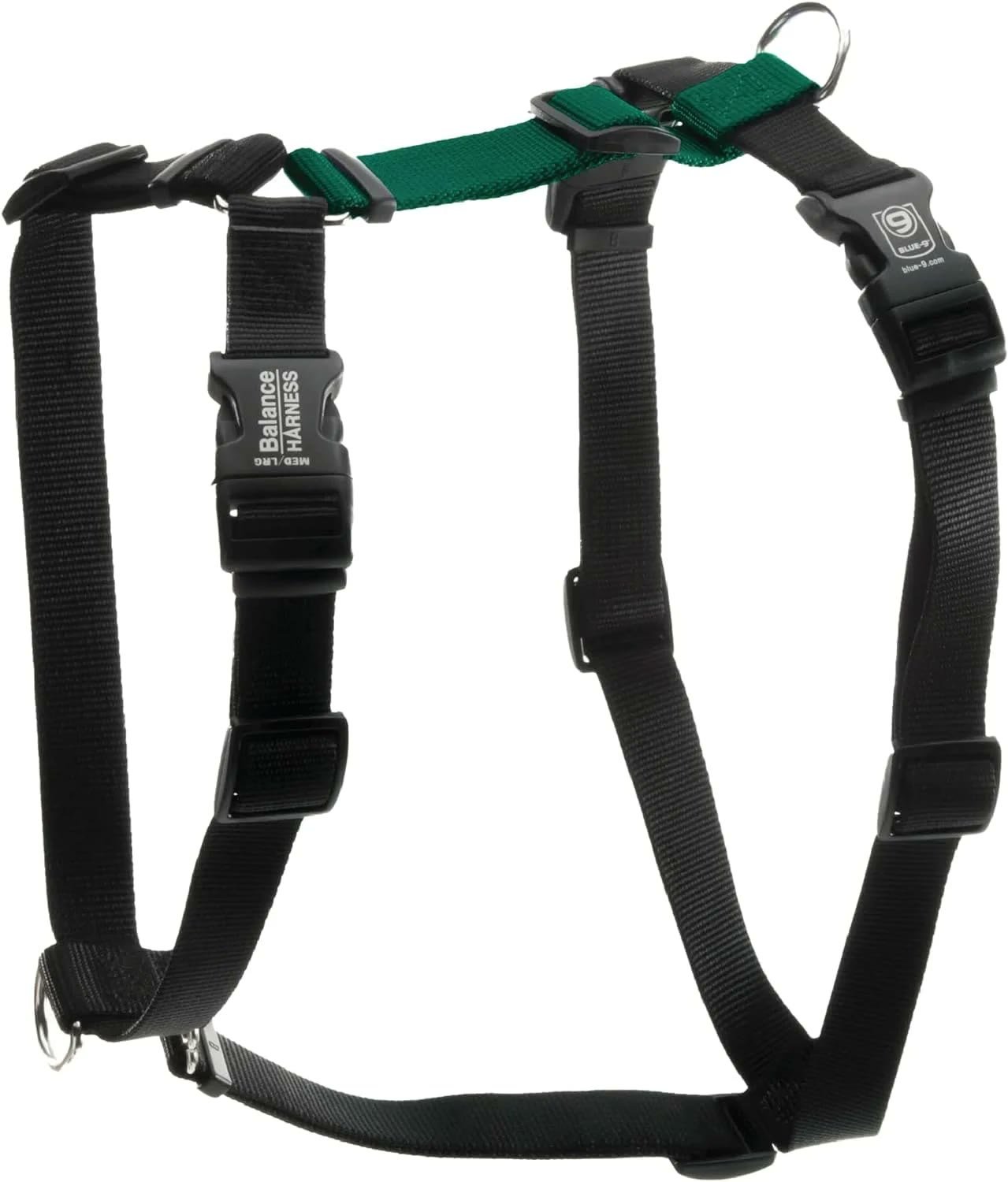
The Balance is the trainer favorite for a reason: six points of adjustment, a Y-shaped front that clears the shoulders, and D-rings on both chest and back, so you can clip front-only for no-pull steering or run a double-ended leash to both rings. The buckle-neck design means nothing goes over the head — a genuine advantage for head-shy or fearful dogs. Made in the USA, minimal coverage so dogs don’t overheat, and the nylon is soft enough to wear all day.
The honest part: fitting it is a project the first time. The straps are fully customizable, which means six straps to learn, and the harness can slide around on the body because there’s no fixed structure — one owner described the chest strap gaping in certain positions. It also runs large; multiple owners recommend sizing down from the chart. And the soft nylon is a liability with chewers: one owner reported their dog chewing through it within minutes of first wear. Supervise, fit carefully, and size down if between sizes.
Specs: 6-point adjustment · front + back D-rings · Y-front (shoulder-clearing) · buckle neck, no over-head · sizes XS–M/L by ribcage (M: 21″–32″) · made in USA · hand wash.
Pros: best adjustability in the category; true shoulder clearance; no over-head donning; minimal coverage for hot weather.
Cons: runs large — size down; confusing first fitting; straps can shift position on the body; soft webbing is chewable.
Verdict: The pick for oddly shaped dogs and anyone who wants the fit dialed in — measure twice, size down. Check the price on Amazon.
2. 2 Hounds Design Freedom No-Pull Harness — Best for Strong Pullers
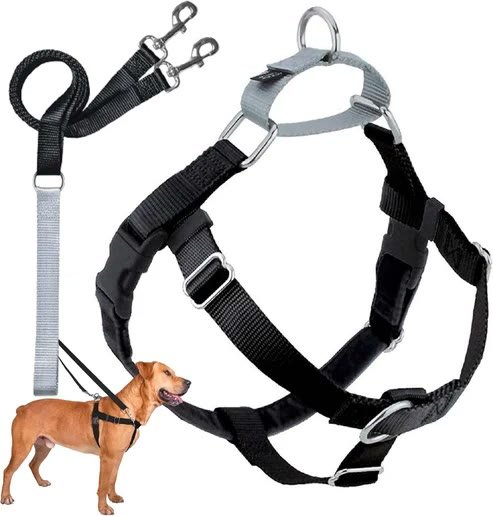
The Freedom is the heavy-duty answer: a patented martingale control loop on the back that tightens gently around the chest when the dog pulls, plus a structural front ring for steering. The chest strap is lined with Swiss velvet specifically to prevent the armpit chafing that plagues front-clip designs, the webbing edges are turned outward so seams can’t irritate skin, and the stainless steel hardware holds dogs from 14 lbs up to 250+. Made in the USA, and the manufacturer replaces up to two chewed straps free (shipping only) under a lifetime chewing warranty. The set version includes the double-ended leash that clips to front and back simultaneously — the “power steering” configuration.
Complaints are about the extras, not the core: the included double leash is short for some owners’ taste, the harness isn’t padded so it’s a poor choice for seatbelt-car travel, and it’s the priciest pick here. Some dogs also find the martingale tightening sensation aversive at first — introduce it gradually with treats.
Specs: Martingale control loop (back) + structural front ring · Swiss velvet chest lining · stainless steel hardware · 4 adjustment points · 14–250+ lbs (5/8″ and 1″ widths, XS–XXL) · made in USA · lifetime chew warranty.
Pros: most control for serious pullers; velvet lining targets chafing; bombproof hardware; real warranty.
Cons: premium price; not padded — poor for car rides; included leash too short for some; martingale sensation needs introduction.
Verdict: The strong-puller specialist — worth the money if your dog has outmuscled lighter harnesses. Check the price on Amazon.
3. PetSafe Easy Walk Harness — Best Budget / Travel Pick
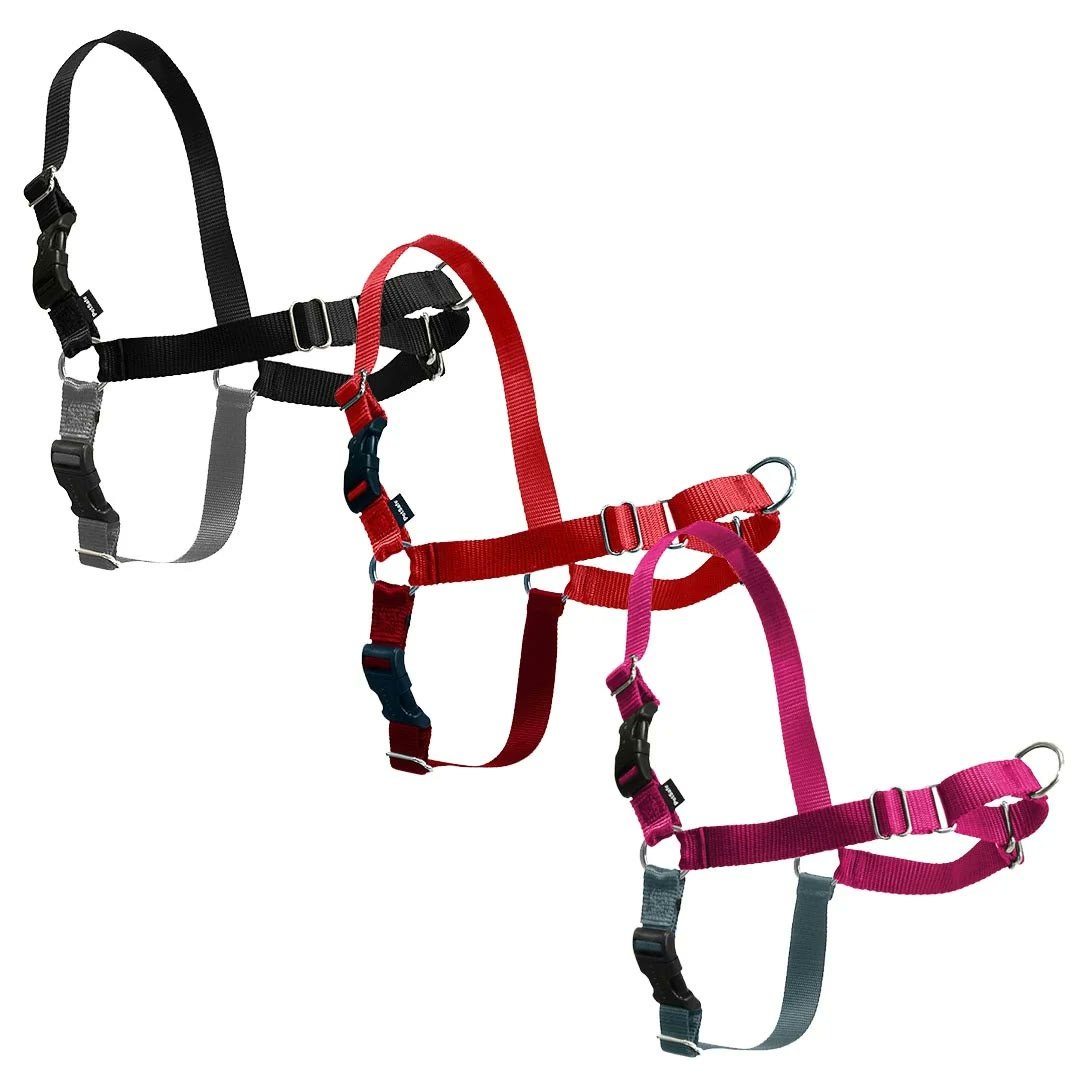
The original front-clip harness, designed by a veterinary behaviorist in 2004 and still the cheapest way into the category. A martingale loop across the chest applies gentle pressure to the shoulders when the dog pulls; the front chest ring steers; the belly strap is color-coded so you always know which side is up. It packs down to almost nothing — genuinely useful for a travel bag — and comes in eight sizes.
The complaints are well documented because this harness is so widely used. Fit is finicky: reviewers describe a “mythical T-shape” that’s hard to achieve, with the front strap either sagging or pulling the harness into a Y. Mis-fitted, it chafes behind the front legs — the #1 owner complaint. Determined chewers can destroy the straps fast, and some dogs can back out of it if it’s left loose. It’s a great starter harness, but it’s not the most secure and not the most durable.
Specs: Patented front martingale loop · front chest leash attachment · 8 sizes · color-coded belly strap · lightweight nylon · quick-snap buckle.
Pros: lowest price from a proven design; ultra-packable for travel; simple construction with few failure points; huge size range.
Cons: armpit chafing when misfitted; fussy fitting; dogs can back out if loose; chewable straps — keep out of reach off-walk.
Verdict: The travel-bag pick — cheap, light, and effective if you nail the fit. Check the price on Amazon.
4. rabbitgoo No-Pull Dog Harness — Best Value Padded Vest
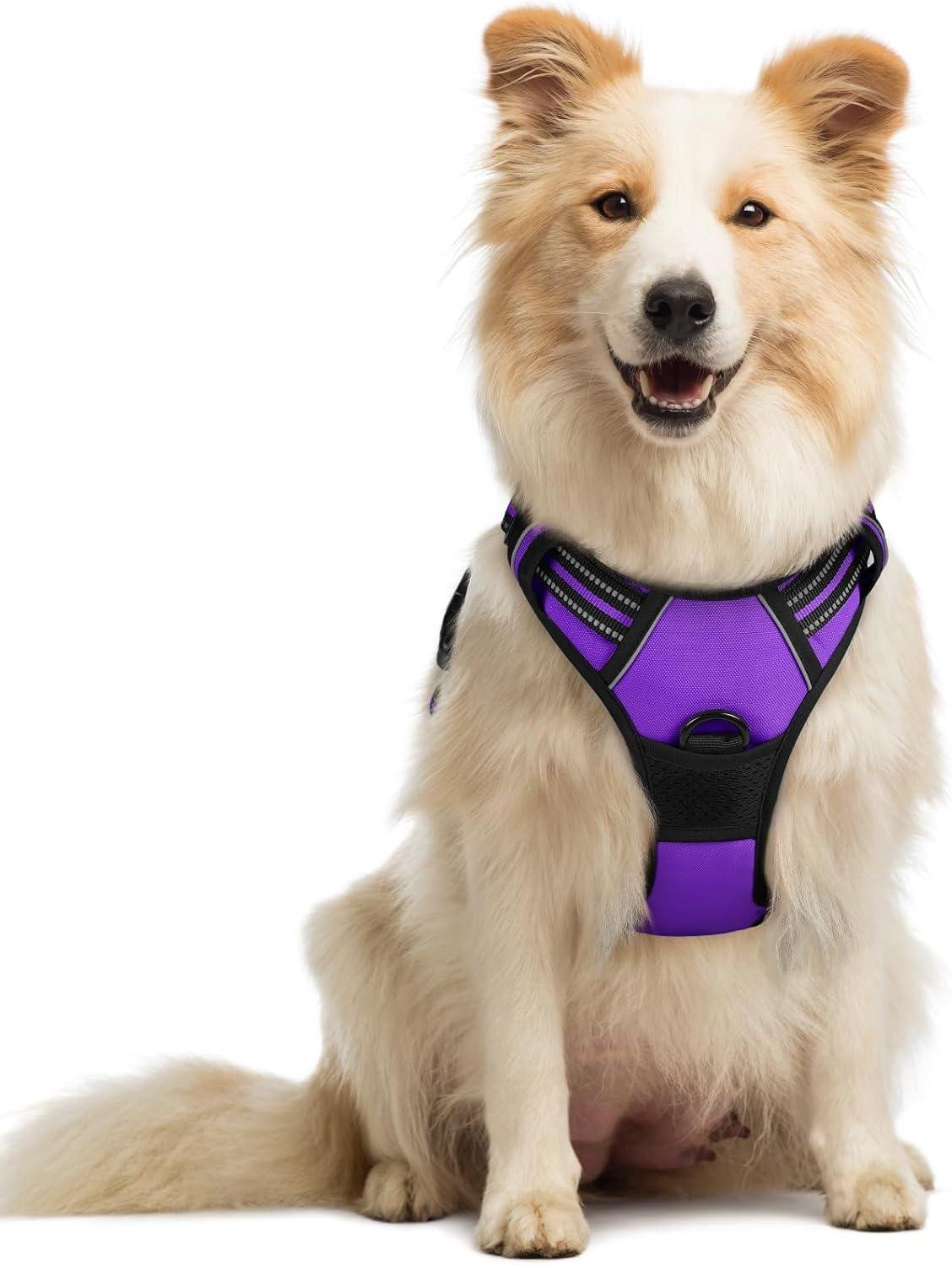
rabbitgoo’s classic no-pull vest gives you both metal leash rings — front clip for no-pull training, back clip for casual walks — plus a padded top handle, breathable air-mesh padding, reflective strips, and four adjustment straps at a budget price. Five sizes (XS–XL), over-the-head with two quick-release buckles, machine-washable on gentle. For a mild puller or a puppy in training, it’s the feature-per-dollar leader.
Where owners push back: the fit runs tight behind the front legs on deep-chested dogs — measure carefully and size up if in doubt. A few long-term owners report the buckles loosening with wear (one dog’s harness started unclipping on its own around month ten), and one owner reported the back-clip D-ring’s slotted section snapping when a 95-lb dog lunged hard on a tie-out. Use it as a walking/training harness, not a tie-out, and re-check the fit monthly.
Specs: Front + back metal leash rings · padded top handle · 4 adjustment straps · breathable mesh padding · reflective strips · sizes XS–XL (M: neck 14.8″–19.7″, chest 19.1″–29.3″) · machine washable (gentle).
Pros: best features for the price; padded and breathable; reflective; huge review history to learn from.
Cons: tight behind the legs on deep-chested dogs — size up; buckles can loosen with long-term wear; back clip not built for hard lunges or tie-outs.
Verdict: The value vest — great for puppies and mild pullers, re-check the fit as it wears. Check the price on Amazon.
5. PoyPet No-Pull Harness — Best for Head-Shy Dogs
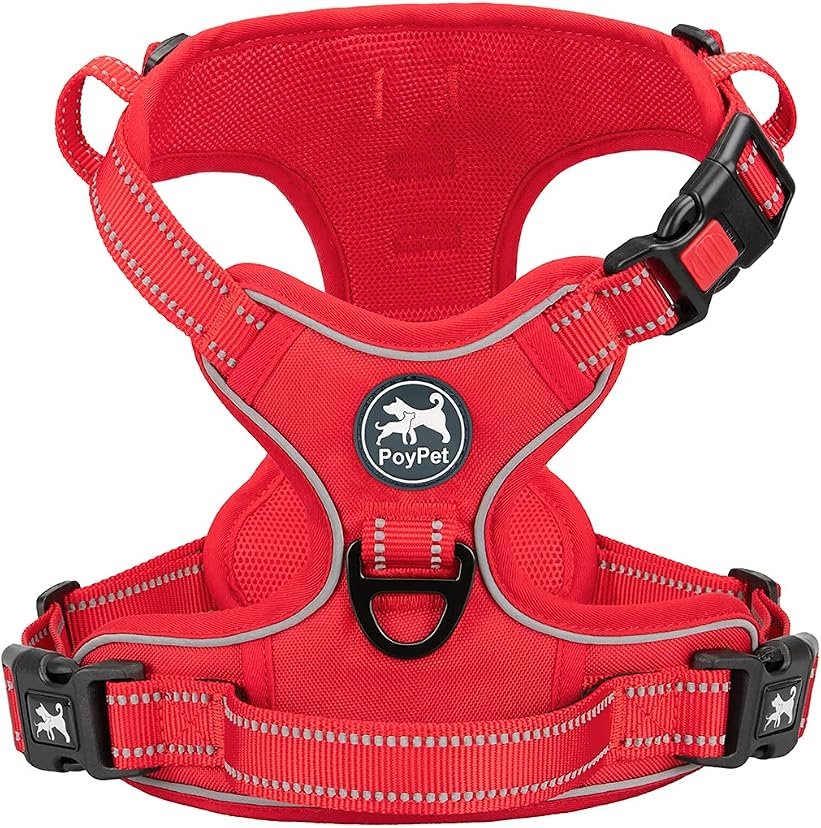
PoyPet’s standout feature is the neck-release buckle: instead of sliding the harness over the head, you buckle it around the neck like a collar, then fasten the two belly straps — under five seconds once practiced. For dogs that duck, freeze, or panic at over-head donning, that’s a genuine quality-of-life upgrade. It also has front and back metal clips, dual elastic belly straps that absorb jerks, a padded handle that doubles as a seatbelt loop, and reflective stitching.
The trade-offs: the straps are stiff and fiddly to adjust the first few times, and sizing demands careful measuring — one owner’s beagle got a leg out of a loosely fitted one, so fit it snug. It’s bulkier than minimal strap harnesses, and reviewers note it runs bulky on very small dogs. The neck piece can also be hard to center on the updated version.
Specs: Neck-release buckle (no over-head) · 3 snap buckles · front + back metal clips · dual elastic belly straps · padded handle (doubles as seatbelt loop) · reflective stitching · 4-way adjustable.
Pros: no over-head donning — great for head-shy dogs; elastic straps absorb jerks; handle doubles as seatbelt loop; easy on/off.
Cons: stiff, fiddly strap adjustment at first; must be fitted snug or dogs can slip a leg; bulky on small dogs.
Verdict: The head-shy dog pick — if donning is the battle, this ends it. Check the price on Amazon.
6. Halti No-Pull Harness — Best for Escape-Prone Pullers
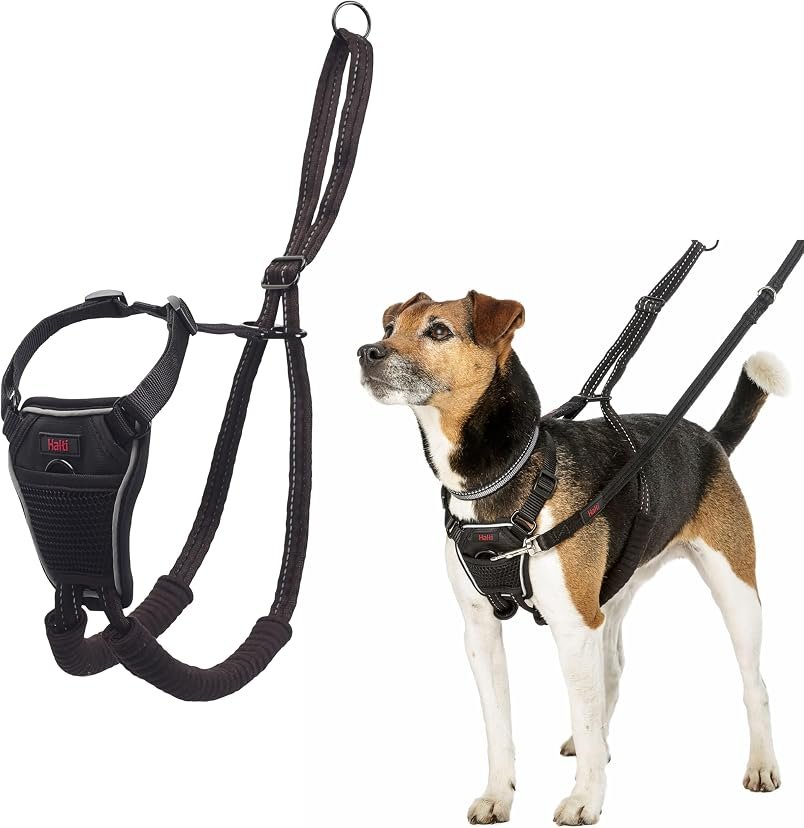
Halti’s design combines a front-control steering clip with a “squeeze and lift” action that discourages pulling without a headcollar — useful for flat-faced breeds that can’t wear one. The chest and leg straps are padded, there’s reflective trim for low light, and a sliding safety lock prevents over-tightening. It’s the pick when the dog is both strong and clever.
The caveats come from the lifting mechanism itself. When a dog pulls hard from the front clip, the harness can twist around the body, loosening the straps — and loose straps plus armpit straps equals rubbing, exactly the failure owners report. One reviewer found their dog learned to pull in reverse and nearly backed out of it entirely. With only three sizes, between-size dogs may struggle to get a secure fit. Fit it snug and re-check during the walk.
Specs: Front-control clip + no-pull lifting action · padded chest and leg straps · reflective trim · sliding safety lock · 3 sizes · 1-year manufacturer warranty · Company of Animals.
Pros: strong pullers without a headcollar; padded where it contacts; reflective; safety lock against over-tightening.
Cons: can twist and loosen when dogs pull hard from the front; armpit rub if it loosens; reverse-pullers can back out; only 3 sizes.
Verdict: The strong-and-clever pick — powerful steering, but fit it tight and keep checking it. Check the price on Amazon.
How to Choose a Front-Clip Harness
Measure the chest, not the weight. Every one of these harnesses sizes by chest/neck girth, and weight-based guessing is the #1 cause of returns. Wrap a soft tape behind the front legs, compare to the chart — and for the Blue-9 and Auroth-style brands, size down (or up) per the documented quirks above.
Decide how much structure you want. Minimal strap harnesses (Blue-9, Easy Walk) are cooler and more adjustable but can shift on the body. Padded vests (rabbitgoo, PoyPet) stay put better but run warmer and bulkier. Deep-chested or barrel-chested dogs usually do better with more adjustment points, not less.
Treat chafing as a fit problem first. Front-clip harnesses rub behind the front legs when they’re loose, twisted, or sized wrong — the harness rotating is usually the mechanism. Fit snug (two fingers under straps), re-check after 10 minutes of walking, and look for velvet/padded linings (Freedom) or shoulder-clearing Y-fronts (Blue-9) if your dog has sensitive skin.
Match the control level to the dog. Mild puller or puppy in training: Easy Walk, rabbitgoo, PoyPet. Serious freight-train puller: Freedom’s martingale loop or Halti’s lift action. Escape artist: Blue-9’s snug 6-point fit or the Freedom’s four adjustment points — and always use a backup collar the first few outings.
Plan for the car. If the harness doubles as car gear, the Freedom’s unpadded straps are a poor seatbelt interface; the PoyPet’s handle doubles as a seatbelt loop, and the rabbitgoo’s handle gives you grab control at rest stops. No front-clip harness is crash-tested — that’s a separate category.
Don’t skip the training. A front D-ring steers the dog sideways when they pull, which buys you control while you teach loose-leash walking. Pair any of these with reward-based training — the harness is the tool, not the teacher.
Bottom line: the Blue-9 Balance is the best overall front-clip harness for its unmatched adjustability and shoulder clearance, with the 2 Hounds Freedom right behind it for serious pullers who need the martingale loop and chew warranty. On a budget, the PetSafe Easy Walk still works if you nail the fit; the rabbitgoo is the best padded value vest; the PoyPet wins for head-shy dogs; and the Halti is the pick for strong, clever pullers — fitted snug.
Frequently Asked Questions
What is a front-clip harness, and is it the same as a front D-ring harness?
Yes — same thing. The leash attaches to a metal ring (usually a D-ring) on the dog’s chest instead of on the back. When the dog pulls forward, the front attachment turns them sideways, which discourages pulling without any pressure on the neck.
Will a front-clip harness stop my dog pulling?
It reduces and redirects pulling, but it doesn’t teach loose-leash walking on its own — trainers consistently note that determined dogs will keep pulling through a front clip, which is when the harness can rotate and cause chafing. Use it alongside reward-based training for lasting results.
Why does my dog’s front-clip harness chafe under the arms?
Almost always a fit or rotation problem: the harness is loose, the dog keeps pulling through the front clip so it rotates, and the leg straps end up rubbing the armpits. Fix it by fitting snug (two fingers under every strap), re-checking mid-walk, and sizing up or down per the product’s known quirks. Velvet-lined or padded chest straps help sensitive dogs.
Front clip vs. back clip — which is better?
Front clip for training and pullers (more steering control); back clip for calm, trained dogs on relaxed walks (more comfortable, no steering). Several picks here (Blue-9, Freedom, rabbitgoo, PoyPet) offer both, and a double-ended leash clipped to both rings gives the most control of all.
Can I leave a front-clip harness on all day?
Only the soft, minimal ones (Blue-9 is designed for it) — and even then, check for rubbing daily. Padded vests can cause hot spots and matting with all-day wear, and any harness on an unsupervised chewer is a risk. Off at home, on for walks is the safe default.
Are front-clip harnesses safe for puppies?
Yes, with two caveats: fit them to the growing body and re-check weekly (puppies outgrow harnesses fast), and avoid designs that restrict shoulder movement or apply strong martingale pressure on young, growing large-breed puppies — a simple front-clip vest is the safer starting point.
