

Pet Travel Items is reader-supported. When you buy through links on our site, we may earn an affiliate commission at no extra cost to you. Read our affiliate disclosure.
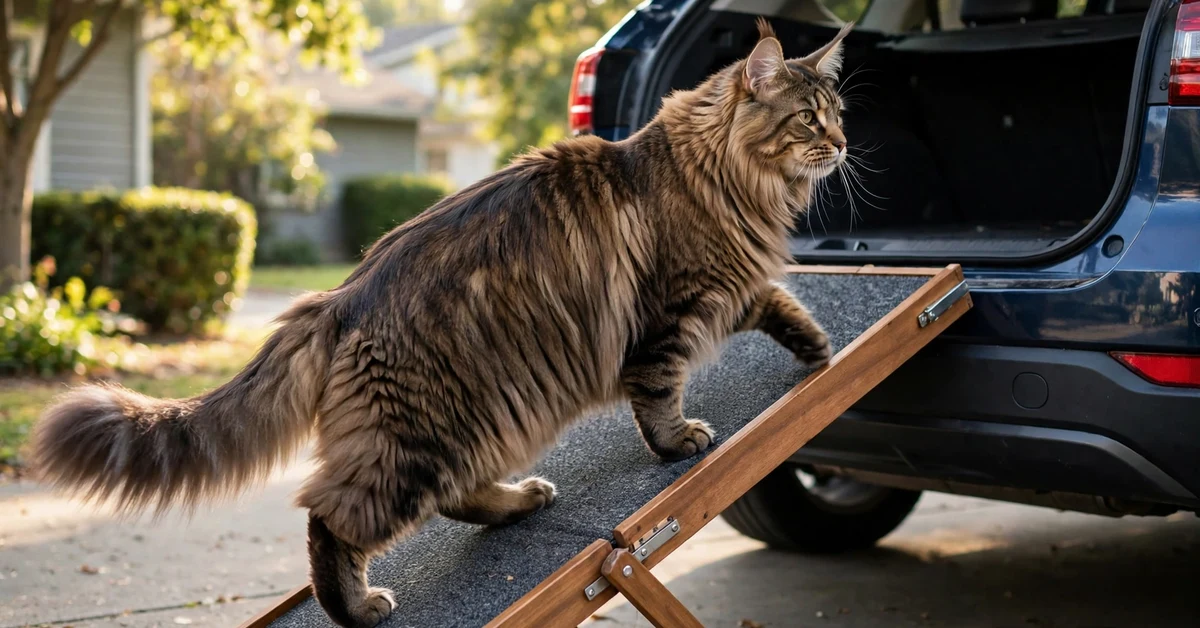
Shopping for a car ramp for a large cat is a strange exercise. Nearly every ramp sold on Amazon is built, marketed, and photographed for dogs. Search for one and you will wade through listings aimed at Labradors and German Shepherds before you find a single mention of cats. That does not mean the products are useless for felines. A Maine Coon pushing 20 pounds, a Ragdoll, or a Norwegian Forest Cat has more in common with a small dog, mechanically speaking, than with a five-pound kitten. The ramp does not care what species walks up it. What matters is width, traction, slope, and whether the thing folds down small enough to live in your trunk.
Here is the honest part most roundups skip: no major ramp brand designs for cats. Of the six folding ramps and steps below, only two listings even mention cats by name. The rest are dog products that happen to suit large cats because they are wide, carpeted, and rated far above a cat’s weight. That framing is fine as long as nobody pretends otherwise. A 20-pound cat on a ramp rated for 200 pounds is not a safety concern. The real question is whether a particular ramp’s surface and slope work for the way cats move. Cats walk in a straight line, placing back paws almost where the front paws were, and they hate surfaces that shift or feel unstable underfoot. A narrow, slick plastic ramp that a Beagle tolerates can be a non-starter for a cautious cat.
For a large cat, three things decide whether a ramp gets used or becomes garage clutter. First, width. Sixteen inches is the practical minimum, and 18 to 20 inches is noticeably better for a broad-chested breed. Second, traction. Carpet or textured fabric beats hard ridged plastic for claws, and it is quieter, which matters for noise-sensitive cats. Third, slope. A longer ramp makes a gentler angle against the same bumper height, and a gentler angle is the difference between a cat that walks up confidently and one that backs away. Weight capacity is rarely the constraint. Even the biggest domestic cats top out around 25 pounds, and every pick below is rated for at least 120.
One more decision before the list: ramps versus steps. Many large cats actually prefer steps, because each step is a discrete, stable surface and the overall structure feels less exposed. That is why two of the six picks below are folding steps rather than ramps. Both types fold for travel, both work at the car, and the steps double as furniture aids at home. I have ordered the list starting with the most cat-appropriate design and flagged, for each product, what real owners complain about. Nothing here was lab-tested by us; the specs come from the listings and the complaints come from owner reviews where I could find them.
Here are six folding ramps and steps that work for large cats, starting with the most cat-friendly design on the list.
| # | Product | Why it made the list | Check Price |
|---|---|---|---|
| 1 | SweetBin Wooden Adjustable Pet Ramp (40″) | The only pick explicitly marketed for cats; carpeted pine, five heights, 200-lb capacity. | Check Price |
| 2 | NUOBESTY 71″ x 20″ Extra Wide Ramp | A full 20 inches wide with the gentlest slope of the bunch at 71 inches long. | Check Price |
| 3 | PetSafe CozyUp Folding Pet Steps (25″) | Folds flat and rated to 200 lbs; many large cats prefer steps over ramps. | Check Price |
| 4 | SweetBin Adjustable Dog Ramp (51″) | Reaches 28 inches high, so it suits tall SUVs and trucks that shorter ramps cannot. | Check Price |
| 5 | Vodipetko Foldable Dog Stairs for Cars (4-Step) | Weighs just 8.28 lbs with a 200-lb rating; the easiest to toss in the trunk. | Check Price |
| 6 | QUCHRYO 5-Level Wooden Ramp | Simple solid-pine folding design with five height settings; note its capacity is unstated. | Check Price |
1. SweetBin Wooden Adjustable Pet Ramp — Best overall for large cats
This is the one pick on the list whose listing actually says the words “for all dogs and cats,” and it earns the top spot for more than the marketing. The ramp is 40 inches of solid pine with a grooved carpet surface, and it adjusts to five heights from 12 to 24 inches. That adjustability is the feature that matters most for cat owners, because a ramp set to match a low sedan trunk is a very different proposition from one leaning against a tall SUV bumper. You can start low while your cat learns the thing, then raise it. The listing even notes, bluntly, that at the full 24-inch setting the slope is steep enough that it suits large dogs and cats only, not puppies. Rare candor from a product page.
The 200-pound capacity is overkill for any cat, and that is exactly the point. A Maine Coon at 22 pounds is using roughly a tenth of the rated load, which means zero flex and zero creak underfoot. Cats notice flex. A surface that gives slightly as they step is often enough to end the experiment. Pine does not give. The carpet has grooves cut into it for grip, the feet are non-slip pads, and the whole unit folds flat to about four inches thick with a carry handle. At around 12.8 pounds it is not featherweight, but it is manageable for one person to set up at the car.
Owner feedback on this ramp line is mostly positive, with a few recurring complaints worth knowing. A handful of buyers report the ramp arriving with minor damage, typically a small split in the wood on one side that did not affect use. Several owners warn that settings above 16 inches get steep fast, which limits it for tall beds and high vehicles. And the carpet, while grippy, is rough and genuinely hard to vacuum; one reviewer compared cleaning it to vacuuming car floor mats. For cat owners, add a practical note: the carpet will collect fur, and a lint roller becomes part of the routine.
- Open size: 40″L x 15.7″W
- Five adjustable heights: 12, 16, 20, 22, and 24 inches
- Weight capacity: 200 lbs
- Unit weight: about 12.8 lbs
- Material: natural pine wood with grooved non-slip carpet, non-slip foot pads
- Fold: folds flat to ~4″ thick; carry handle; no assembly
What it does well:
- Explicitly marketed for cats, not just dogs, which is rare in this category
- Adjustable height lets you train at a low, gentle setting first
- 200-lb rating means a large cat will never feel flex or wobble
- Carpet with grooves gives claws real purchase; quieter than plastic
- Folds to four inches flat for trunk or closet storage
Where it falls short:
- Above 16 inches of height the slope gets steep; tall vehicles are a stretch
- 15.7″ width is adequate, not generous, for the broadest cats
- Rough carpet traps fur and is hard to vacuum
- Occasional shipping damage reported (split wood on arrival)
Verdict: The most cat-appropriate folding ramp here. If your car has a low to mid-height cargo area and your cat is new to ramps, the adjustable heights make this the easiest one to introduce. Just keep it at the lower settings and accept the fur-covered carpet as the price of traction.
2. NUOBESTY 71″ x 20″ Extra Wide Ramp — Widest surface, gentlest slope
Width is the spec that matters most for a big cat, and this ramp has more of it than anything else on the list: a full 20 inches across. Most folding ramps stop at 16 or 17 inches. Those extra inches sound trivial until you watch a broad-chested cat walk a straight line and realize how little margin a 16-inch surface leaves. The length matters just as much. At 71 inches, this is the longest ramp here, which means the gentlest angle against any given bumper height. For a senior large cat with stiff joints, slope angle is the whole game, and length is how you buy a gentler one.
The construction is reinforced aluminum alloy with double-layer hinges and support tubes underneath, rated to 250 pounds. The walking surface is a terry-fabric rug with a loofah-like texture rather than hard plastic or grip tape. That is a meaningful choice for cats. Terry fabric is soft on paws, quiet, and gives claws something to catch without the cheese-grater feel of abrasive tread. Safety tethers with buckles and rubber feet keep it planted. It folds down for storage, though with a 71-inch open length it will never be a small package.
The trade-offs are the kind that come with going big. A 71-inch aluminum ramp with internal bracing is not light, and the listing does not publish the unit’s own weight, which is an annoying omission. Terry fabric is comfortable, but it will trap fur and need regular cleaning, and it is slower to dry than a hard surface if it gets wet. More hinge points on a long folding ramp also mean more places for slight play to develop over time, so check the hinges and tether before each trip. None of that disqualifies it. For a nervous or arthritic large cat, width plus a gentle slope outweighs the bulk.
- Open size: 71″L x 20″W
- Weight capacity: 250 lbs
- Unit weight: not published on the listing
- Material: reinforced aluminum alloy, double-layer hinges, support tubes; terry-fabric non-slip rug surface
- Fold: multi-fold portable design; safety tethers with buckles; anti-slip rubber feet
What it does well:
- 20-inch width is the roomiest surface on this list for a large cat’s gait
- 71-inch length gives the gentlest slope against tall bumpers
- 250-lb rating with braced aluminum frame; no flex under a cat
- Terry-fabric surface is soft, quiet, and claw-friendly
- Safety tethers and rubber feet address the sliding problem
Where it falls short:
- Listing does not state the ramp’s own weight; expect it to be hefty
- Terry fabric traps fur and dries slowly when wet
- Long folded package needs real trunk space
- More hinge points than a simple bi-fold; inspect them periodically
Verdict: Buy the width and the slope. If your large cat is cautious, senior, or recovering, the extra inches in both directions are worth the bulk and the fur-covered fabric. This is the ramp for cats that refused narrower ones.
3. PetSafe CozyUp Folding Pet Steps — Best folding steps instead of a ramp
Some large cats simply will not walk up a ramp and will happily climb steps. If yours is one of them, these folding steps from PetSafe are the best-known option. The 25-inch model stands 28 inches long, 18 wide, and 25 tall, with four steps and a 200-pound rating. It folds flat for storage, which is rarer in pet stairs than it should be, and the fabric tread covers are replaceable. PetSafe’s own line is sold for both cats and dogs, and the side rails plus non-skid feet are genuinely useful for a cat that likes a defined edge to walk against.
The step dimensions deserve attention. Each tread is a discrete, stable platform, and for many cats that reads as safer than one long slope. The 18-inch width gives a large cat room to place all four paws on a single step. At 25 inches tall it suits beds, couches, and the lower cargo entries of cars and small SUVs; it will not reach the bumper of a tall truck. Training is the same as with a ramp: treats on each step, let the cat explore it flat first if possible, and never force the issue.
Now the complaints, because this product has a well-documented one. Across owner reviews, the adhesive holding the fabric tread pads to the plastic steps is weak. Multiple owners report the pads peeling or sliding off within hours of setup, and several resorted to double-sided carpet tape to keep them in place. Without the pads, the bare plastic is slippery, which defeats the purpose. A smaller but real thread of reviews mentions wobble or sliding on hard floors, though plenty of other owners report no movement at all, which suggests setup and flooring matter. One reviewer noted the tread fabric sheds black lint, and wished for rubber instead. A 12-year-old arthritic cat’s owner gave it one star after a pad shifted under the cat mid-step. None of this makes it a bad product, but go in knowing the pads may need reinforcing on day one.
- Assembled size: 28″L x 18″W x 25″H; 4 steps
- Weight capacity: 200 lbs (25-inch model)
- Material: lightweight plastic; replaceable fabric tread covers; side rails; non-skid feet
- Fold: folds down flat for compact storage
- Unit weight: not published on the listing
What it does well:
- Four wide, discrete steps suit cats that distrust ramps
- 18-inch width fits a large cat’s full stance on each step
- Folds flat, unlike most pet stairs
- Side rails give cautious cats a defined edge
- Tread covers are replaceable when they wear out
Where it falls short:
- Tread pad adhesive is weak; pads peel and may need carpet tape (widely reported)
- Some owners report wobble or sliding on hard floors
- Tread fabric sheds black lint
- 25-inch height will not reach tall truck or SUV bumpers
Verdict: The right pick if your cat prefers steps, with one mandatory fix: plan to reinforce the tread pads with double-sided carpet tape on arrival. Once the pads stay put, this is a sturdy, cat-sensible set of stairs.
4. SweetBin Adjustable Dog Ramp (51″) — Best for tall SUVs and trucks
Tall vehicles break most pet ramps. A 40-inch ramp against a 30-inch bumper makes a staircase, not a slope, and cats vote with their feet. This 51-inch SweetBin is the answer for high cargo floors: six height settings from 13 up to 28 inches, so it can actually meet a tall SUV or truck bumper at a walkable angle. The width is 18 inches, the capacity is 200 pounds, and like its shorter sibling it is knotless pine with a non-slip fabric carpet, this time with nine anti-slip crossbars for extra grip. It folds flat to just 2.2 inches and has a carry handle.
The extra length changes the slope math in your favor. Against a 28-inch bumper, a 51-inch ramp sits at roughly 33 degrees. Against the same bumper, a 40-inch ramp would be closer to 44 degrees, which most cats will simply refuse. That is the entire argument for this product: if your vehicle is tall, length is not a luxury, it is the requirement. The six height settings also let you dial it down for lower cars, so it is not a one-truck pony. Setup is tool-free, and the bottom has a non-slip mat to protect floors and stop sliding.
The cost of all that reach is bulk. Pine is heavy, and a 51-inch pine ramp is the heaviest thing on this list to carry, even though the listing does not publish its weight. You will feel it loading and unloading. It also needs genuine trunk space when folded; measure before you buy. The same product-line caveats apply as with the 40-inch version: at the highest settings the slope is steep and best left to confident animals, and the carpet will collect fur and resist the vacuum. Treat the top two height settings as emergency options, not daily ones, and this is a strong tall-vehicle pick.
- Open size: 51″L x 18″W (a 39″ variant also exists)
- Six adjustable heights: 13, 16, 19, 22, 25, and 28 inches
- Weight capacity: 200 lbs
- Unit weight: not published on the listing
- Material: natural knotless pine; non-slip fabric carpet with 9 anti-slip crossbars; bottom non-slip mat
- Fold: folds flat to 2.2″; carry handle; no tools required
What it does well:
- 51-inch length plus 28-inch max height actually reaches tall bumpers at a sane angle
- Six height settings cover everything from sedans to trucks
- 18-inch width and 200-lb rating suit large cats with margin to spare
- Crossbars plus carpet give strong traction
- Folds to 2.2 inches flat despite its size
Where it falls short:
- Heavy to carry; pine at this length is a real load and the weight is unstated
- Needs serious trunk space even folded
- Top height settings are steep; reserve them for confident cats
- Carpet traps fur and is hard to clean
Verdict: If your vehicle is tall, this is the pick. Nothing else on the list reaches 28 inches. Just be honest with yourself about the weight and the trunk space before ordering.
5. Vodipetko Foldable Dog Stairs for Cars — Lightest option for travel
Everything else on this list asks you to lug wood or long aluminum. This one weighs 8.28 pounds. The Vodipetko is a four-step folding stair built on an aluminum frame with 1680D PVC Oxford cloth steps coated in non-slip rubber, rated to 200 pounds. It folds up, has a foam comfort handle for carrying, and includes a carabiner safety tether to anchor it to the vehicle. For frequent travelers, road-trippers, and anyone whose back objects to hauling pine, the weight difference is the whole pitch.
The design is clever in a travel context. Aluminum keeps the frame rigid while the cloth steps keep the packed size and weight down. The rubber coating on the cloth is the traction story, and a tether is a thoughtful inclusion at this price tier; stairs that creep away from the bumper mid-climb are a common failure mode for lightweight designs. Four steps keep the rise per step manageable, and setup is essentially unfold-and-go.
The compromises are visible in the spec sheet. The steps are 15.6 inches wide, the narrowest on this list, and a broad large cat will notice. Cloth steps also flex more than wood or rigid plastic, and some cats read flex as instability. The listing’s stated dimensions look like the folded package rather than the open stairs, which is sloppy and makes it hard to plan trunk space precisely. And Vodipetko is an obscure brand with no meaningful warranty or support footprint, so buy it for what it is: a light, cheap, functional travel stair, not an heirloom. If your cat is already comfortable with steps and you travel often, the weight savings are real. If your cat is nervous or very broad, the wider picks above serve better.
- Steps: 4, with 15.6″ wide treads
- Weight capacity: 200 lbs
- Unit weight: 8.28 lbs
- Material: aluminum frame; 1680D PVC Oxford cloth with non-slip rubber coating
- Fold: foldable; foam comfort handle; carabiner safety tether
- Stated dimensions: 18.33″L x 15.6″W x 5.7″H (appears to describe the folded unit)
What it does well:
- 8.28 lbs is dramatically lighter than the wood options
- 200-lb rating on an aluminum frame is plenty for any cat
- Safety tether included, which cheap stairs often skip
- Folds small; genuinely trunk-friendly
Where it falls short:
- 15.6″ tread width is the narrowest here; broad cats may feel cramped
- Cloth steps flex, which can unsettle cautious cats
- Listing dimensions are ambiguous; open footprint is unclear
- Obscure brand with no real support footprint
Verdict: The travel pick. If weight and packed size decide for you, nothing else here comes close. Just make sure your cat tolerates narrower, slightly flexible steps before committing.
6. QUCHRYO 5-Level Wooden Ramp — Simple pine ramp for home and car
Sometimes the right product is the simple one. The QUCHRYO is a solid pine folding ramp with a soft grey carpet surface, five adjustable height stages, and a collapsible design that drops to 3.9 inches tall for storage. A carry handle is built into the side. The listing explicitly names dogs and cats, and describes indoor and outdoor use, beds, couches, cars, trucks, and SUVs. There is no app, no gimmick, no 47-piece assembly. It is a wooden ramp that folds.
The pine-and-carpet combination is the same formula that makes the SweetBin picks cat-friendly: rigid underfoot, quiet, and grippy for claws. The double non-slip structure with a cross brace addresses stability, and anti-slip stickers are included for the feet. At a bit over 12 pounds it is portable without being flimsy. For a large cat that already uses a ramp at home, this is a straightforward second ramp for the car, or a first ramp if you prefer the simplest possible design.
The honest problem with this listing is what it does not say. No weight capacity is published anywhere in the product text I could retrieve. For a large cat this is probably fine; a solid pine ramp in this style will hold a 25-pound animal without drama. But “probably fine” is not a spec, and I will not invent one. If your cat is exceptionally large or you want a published number for peace of mind, pick one of the rated options above. The specific heights of the five stages are also unstated, so you cannot plan the slope angle precisely before it arrives. Treat this as the simple, affordable pine option with one documentation gap you should know about.
- Material: natural solid pine wood with soft grey carpet surface
- Five adjustable height stages (specific heights not published)
- Weight capacity: not published on the listing
- Unit weight: a bit more than 12 lbs
- Fold: collapsible; 3.9″ tall when collapsed; side carry handle
- Extras: double non-slip structure with cross brace; anti-slip stickers included
What it does well:
- Simple, rigid pine-and-carpet design cats tend to accept
- Five height stages for beds, couches, and cars
- Collapses to 3.9 inches for storage
- Listing explicitly mentions cats and indoor/outdoor use
Where it falls short:
- No published weight capacity; a documentation gap, not a known failure
- Height stage measurements are unstated, so slope planning is guesswork
- Over 12 lbs is heavy for frequent travel
Verdict: A fine, simple pine ramp if you want the basics and your cat is within normal large-breed weight. If you need a published capacity number, choose one of the rated picks instead.
Measure your car before you order
The number-one mistake with pet ramps is buying for the pet and forgetting the vehicle. Measure the height from the ground to the surface your cat will step onto: the cargo floor, the back seat, the bumper lip. Then apply the rough rule that ramp length should be three to four times that height for a slope a cat will actually use. A 24-inch bumper wants a ramp in the 72- to 96-inch range for a truly gentle angle, which is why even the longest pick here (71 inches) is a compromise you accept by choosing a lower entry point, like the back seat instead of the cargo floor of a tall SUV.
Measure your trunk, too. Folded dimensions are published for most of these, and a 71-inch ramp does not fold into a sedan trunk gracefully. Check the folded length against your cargo area with the seats up, because that is how you will actually carry it. Finally, note where the ramp’s top will rest. A lip or sill that the ramp can hook over is ideal; a rounded bumper that it slides against needs the tether and rubber feet to do their job. Five minutes with a tape measure prevents the most common bad review in this category: “doesn’t fit my car.”
Ramp or steps: which one suits a large cat?
Watch how your cat moves around the house and the answer usually appears. Cats that hop confidently from furniture to furniture often take to ramps quickly, because a ramp is just a slope and slopes are familiar. Cats that place each paw deliberately, test surfaces before committing weight, or freeze on unfamiliar textures tend to do better with steps. Each step is a complete, stable platform, and the rhythm of step-pause-step matches how cautious cats already move. Senior cats with arthritis sometimes prefer ramps because stepping up repeatedly can bother stiff joints, while other seniors prefer steps because a ramp’s continuous slope asks their hind legs to push the whole way.
There is no universal winner, which is why this list includes both. If you are unsure, steps are the safer first guess for a nervous cat, and a ramp is the safer first guess for a cat with mobility issues that still walks confidently. Either way, introduction matters more than the product. Set it flat on the floor first and let the cat walk across it for treats over several days. Then raise one end slightly. Then move it to the car with the engine off. Rushing this process is how ramps become expensive garage decorations. Most cats that reject a ramp on day one will use it by day ten if nobody forces the issue.
What to check on the listing before you buy
Listings in this category are uneven, so read them like a skeptic. First, look for a published weight capacity and make sure it gives you at least five times your cat’s weight in headroom; that margin is what guarantees no flex. Second, confirm the width. Anything under 16 inches is a gamble for a large breed. Third, look at the surface: carpet or textured fabric for cats, with suspicion toward bare hard plastic unless the tread pattern is aggressive. Fourth, find the folded dimensions and the unit’s own weight. Sellers love to publish capacity and hide weight, and a ramp you dread carrying is a ramp you stop bringing.
Treat missing specs as information. When a listing does not state its own weight, assume it is heavy. When it does not state a capacity, as with the QUCHRYO above, decide whether you are comfortable without one. Check whether the listing mentions a safety tether or strap; ramps that anchor to the vehicle slide less, and sliding is what scares cats off permanently. And glance at the most recent reviews, not just the average, since sellers quietly change materials and suppliers. A ramp that earned its reputation two years ago may not be the same ramp shipping today.
Frequently asked questions
Do cats actually use car ramps?
Many do, with training. The cats that take to ramps fastest are confident, food-motivated, and already comfortable in the car. Nervous cats need a slower introduction: flat on the floor first, then slightly raised, then at the car over a week or more. A meaningful minority of cats will never accept a ramp and do better with steps, which is a preference, not a failure. If your cat has ignored a ramp for two weeks of patient training, try steps before giving up on assisted entry entirely.
What width does a large cat need in a ramp?
Sixteen inches is the practical minimum for a Maine Coon, Ragdoll, or Norwegian Forest Cat. Eighteen to 20 inches is meaningfully better because cats walk with a straight-line gait and like margin on both sides. Narrower ramps are not unsafe at these weights, but they get refused more often, and a refused ramp is the same as no ramp. When choosing between two otherwise equal ramps, take the wider one.
Are dog ramps safe for cats?
Mechanically, yes. A ramp rated for 150 to 250 pounds is massively overbuilt for a 15- to 25-pound cat, so structural safety is not the concern. The cat-specific concerns are surface traction, width, and stability: carpet or fabric beats slick plastic, wider beats narrower, and anything that wobbles will end the experiment. The one real caution is supervision. Never leave a cat unattended on a ramp at the car, and always use the tether or strap if one is included.
Should I get a ramp or just keep using a carrier for vet trips?
These solve different problems. A carrier contains the cat; a ramp helps the cat enter the vehicle. Many owners use both: the ramp gets the cat into the car without being lifted, and the carrier keeps the cat secure during the drive. For senior or arthritic cats, eliminating the lift into a tall vehicle is genuinely valuable even if the cat rides in a carrier once inside. A ramp does not replace a carrier, and a carrier does not replace a ramp.
How do I train my cat to use a ramp?
Start with the ramp flat on the floor and put treats along its length for several days until the cat walks it casually. Then raise one end a few inches on a sturdy box and repeat. Then move it to the car with the engine off and the doors open, and lure the cat up with something high-value. Keep sessions short and end on a success. Do not place the cat on the ramp or push from behind; a single scary experience can undo a week of progress. Most cats need one to two weeks.
Why are there no telescoping ramps on this list?
Telescoping ramps slide to adjust length, which is convenient, but every telescoping model we could verify was either already used in an earlier article or unavailable, so this list covers folding designs only. Folding ramps also have a practical advantage for cats: fewer sliding sections means fewer pinch points and less mechanical play, which means less wobble underfoot. For a species that notices instability, that is a feature, not a compromise.
A car ramp for a large cat is one of those purchases where the boring specs decide everything. Width, surface, slope, and folded size matter more than brand names or marketing copy, and the honest truth is that you are buying a dog product for a cat in five cases out of six. Pick the design that matches how your particular cat moves: the adjustable wooden ramp for most cats, the extra-wide aluminum one for the cautious or arthritic, steps for the deliberate paw-placer, and the long 51-inch version if your vehicle is tall.
Whatever you choose, measure the car first, introduce the ramp slowly, and reinforce those tread pads on day one if you go with steps. The best ramp is the one your cat actually walks up, and that outcome is decided as much by your patience during the first two weeks as by anything in the spec sheet.
