

Pet Travel Items is reader-supported. When you buy through links on this page, we may earn an affiliate commission at no extra cost to you. This keeps our reviews honest: we never let commissions decide what makes the cut, and every carrier below carries its real drawbacks as well as its strengths.
Shopping for a budget cat carrier has one landmine you will not see coming. Half of the “affordable” carriers on Amazon are rated for dogs of the same weight, and a 12-pound cat does not ride like a 12-pound dog. Cats brace, twist, and hunt for the exit. A flimsy carrier that holds a sleepy Chihuahua fine will show its weaknesses within five minutes of a cat that objects to travel.
Three honest caveats before the picks. First, a carrier is containment, not crash protection. None of the carriers below claims crash-test certification, and fabric alone does nothing in a collision. Second, “airline approved” is a brand claim, not a promise. Every airline sets its own under-seat dimensions, and some (Southwest, Alaska) cap height at 8.5 inches. Check YOUR airline’s rules before you fly. Third, measure your cat. A carrier rated for 15 pounds is useless for a 13-pound cat that cannot turn around inside it. Measure length (nose to base of tail) and height (floor to top of shoulder), then buy to the measurements, not the weight number.
| # | Product | Key Spec | Best For | Check Price |
|---|---|---|---|---|
| 1 | Mr. Peanut’s Gold Series Standard Size Expandable Pet Carrier V3.0 | 18.5 x 11.75 x 11.5 in; up to 30 lb; expandable side | Flyers who want extra room at the gate | Check Price |
| 2 | Sherpa Original Deluxe Pet Carrier, Medium | 17 x 11 x 10.5 in; up to 16 lb; spring-wire frame | The established airline-travel standard | Check Price |
| 3 | Henkelion Soft-Sided Pet Carrier, Medium | 17 x 11 x 11 in; up to 15 lb; 2 lb | The lightest budget pick | Check Price |
| 4 | PetAmi Airline Approved Pet Carrier for Cats, Small | 17 x 10.2 x 11.2 in; up to 18 lb; 600D polyester | Feature-packed for the money | Check Price |
| 5 | Petmate Two Door Top Load Pet Kennel, 19 in | 19 x 13 x 10 in; up to 10 lb; hard plastic | Escape artists and hard-sided purists | Check Price |
| 6 | Amazon Basics Soft Cat & Dog Carrier | Under-seat footprint; top + side entry | The cheapest way in | Check Price |
1. Mr. Peanut’s Gold Series Standard Size Expandable Pet Carrier V3.0
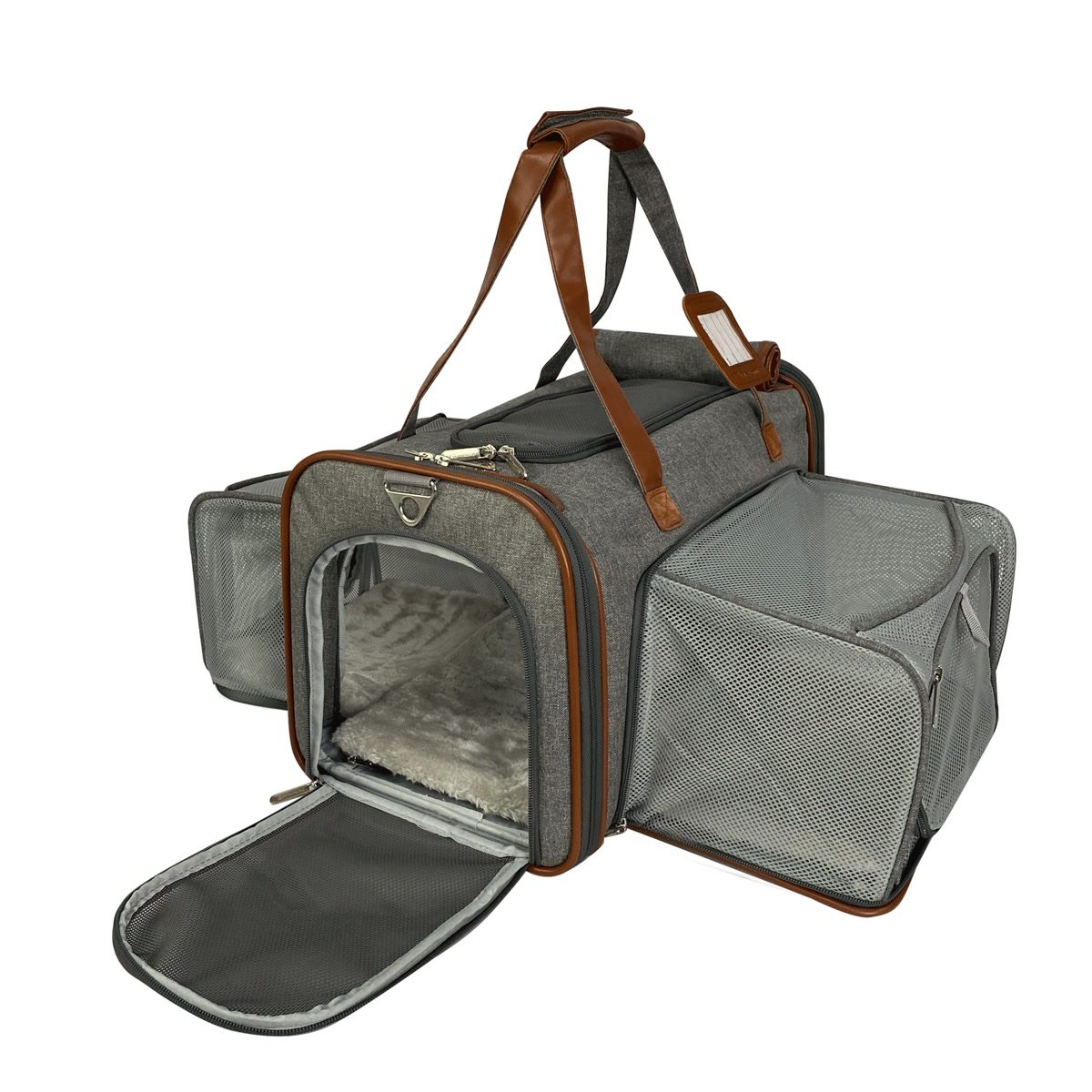
This is the carrier that answers the number-one cat-travel problem: a cat that cannot stand the trip does not need a bigger permanent footprint, it needs somewhere to stretch once you are through security. The expandable side panel does exactly that. At the gate it collapses back to a regulation-ish 18.5-inch length; at the airport bench it opens up. Mr. Peanut’s claims it meets FAA requirements and fits under most major airline seats, with the standard rider to verify with your airline.
What separates this from the budget pack is the zipper story. Self-locking zippers that cannot be pushed open from the inside address the classic cat failure mode: the paw-under-the-zipper pull that turns a soft carrier into a surprise. There is also a strap that converts to a leash, which is a small thing until your cat bolts across a parking lot. The weight is honest at 4 pounds, and the up-to-30-pound rating is generous for a small cat. Just remember interior space runs smaller than exterior. A cat at 17 inches nose-to-tail lying down fits; beyond that, step up in size.
- Specs: 18.5 in L x 11.75 in W x 11.5 in flex height (exterior); 4 lb; pets up to 30 lb; mesh on top and all four sides; auto self-locking zippers; faux fleece padding with composite base; privacy covers roll away; luggage strap; zippered mesh pocket; antimicrobial-treated padding.
- Pros: Expandable panel adds real floor space when it counts; self-locking zippers fight the cat escape playbook; shoulder strap converts to leash; roomy rating for small cats; fabric keeps shape thanks to the composite base.
- Cons: Heavier than bare-bones budget carriers; expandable panel adds bulk some owners find fiddly to repack quickly; the 30-pound rating overstates usable interior room; priced above the cheapest options.
Verdict: The best-engineered pick here for flyers. Buy it for the self-locking zippers and the expandable side; measure your cat first, because the interior is tighter than the box suggests. Check Price on Amazon
2. Sherpa Original Deluxe Pet Carrier, Medium

Sherpa is the carrier your vet has seen a thousand times. The patented spring-wire frame is the reason: the rear of the carrier compresses a few inches to slide under airline seats, then springs back when you pull it out. The Guaranteed On Board program covers Small and Medium sizes, which is the closest thing to an airline blessing a carrier brand can offer. That said, it is still a brand program. Airlines write their own rules, and the program itself tells you to check.
The Medium is the size a small cat actually fits in: 17 by 11 by 10.5 inches, up to 16 pounds, and Sherpa’s own sizing guidance says to go by measurements before weight. Locking zippers, a seatbelt strap that doubles as a luggage strap, and a removable washable faux lambskin liner round it out. The honest tradeoff is rigidity. That wire frame keeps the same shape whether your cat wants it or not, and the carrier does not collapse flat the way cheaper shells do. For a dedicated flyer, that is a feature. For apartment storage, it is bulk.
- Specs: 17 in L x 11 in W x 10.5 in H; 3.55 lb; up to 16 lb; spring-wire frame; locking zippers; top and side entry; mesh panels; seatbelt/luggage strap; large side pocket; waterproof interior base; removable washable liner; 1-year warranty.
- Pros: The reference standard for in-cabin travel; wire frame gives structural confidence; locking zippers; generous pocket and storage details; liner is removable and washable; metal D-rings and padded strap for carrying.
- Cons: Does not fold flat; shell is spot-clean only (remove the liner first); wire frame feels bulky in storage; cat-specific colors and sizes still carry a premium over no-name shells.
Verdict: The default pick if you fly and want the most-traveled carrier in its class. Accept the fixed shape, gain the peace of mind. Check Price on Amazon
3. Henkelion Soft-Sided Pet Carrier, Medium
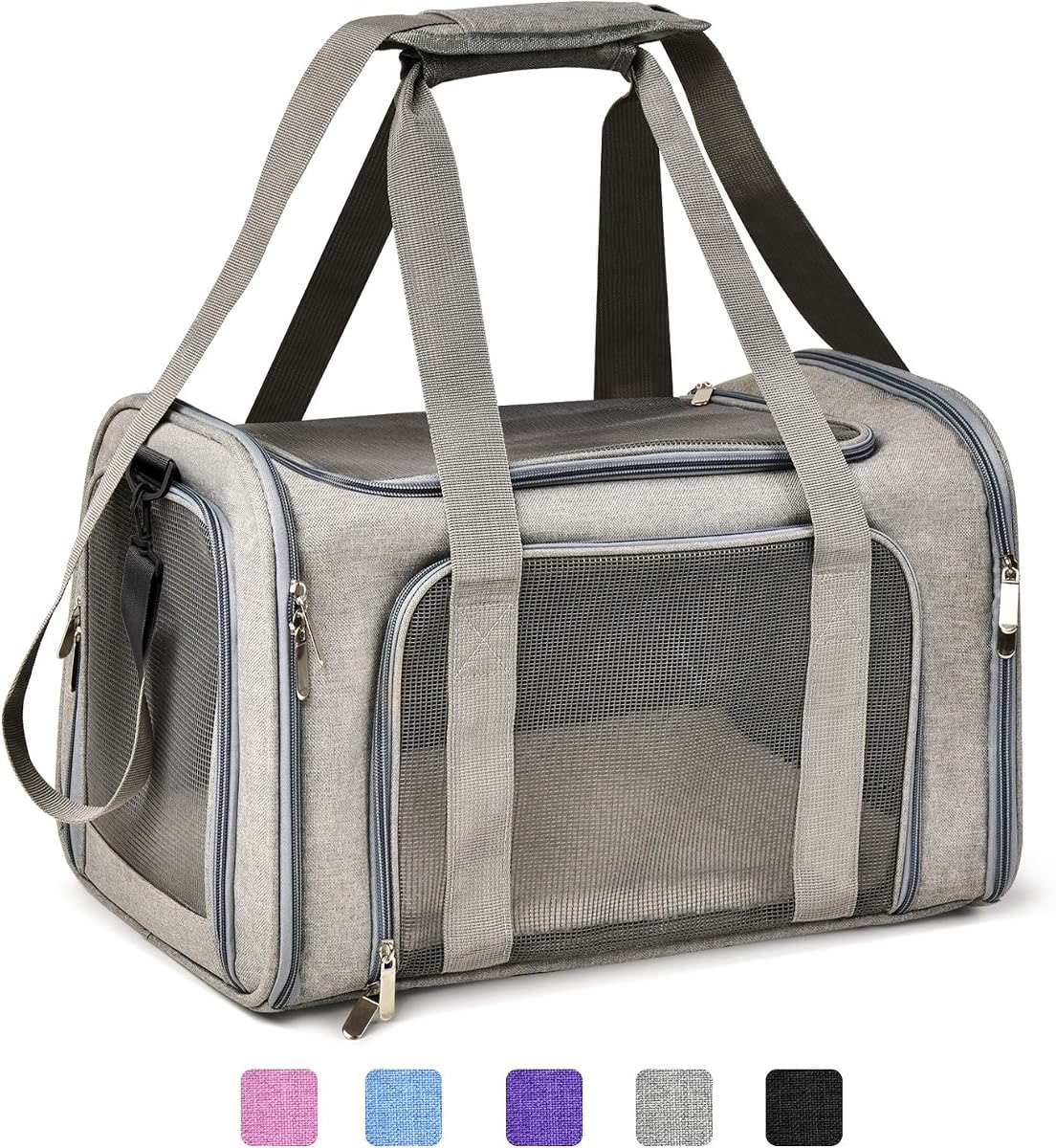
Two pounds. That is the headline number on the Henkelion Medium, and it matters more than it sounds. You will feel the difference between a 2-pound shell and a 4-pound one walking a terminal with an 11-pound cat inside. The three-side entrance design (sides, front, and top) gives you loading options, and the interior safety leash is a detail cheap carriers often skip.
Here is the honest catch, and it is the same catch every ultra-light budget carrier has. A 2-pound shell cannot have the same structural backbone as the heavier options. With a heavier cat, expect the shell to sag on the shoulder strap and the base to dip under a settled 13-pounder. The brand’s own listing warns the carrier may arrive with a smell that needs airing out, and it is wipe-clean only, never machine washable. The airline story also deserves a hard read: Henkelion labels the carrier TSA/airline approved, then its own listing tells you the Medium does not fit Southwest or Alaska’s 8.5-inch height cap. That honesty is actually a point in its favor. Just do not buy it for a Southwest flight.
- Specs: 17 in L x 11 in W x 11 in H (Medium); 2 lb; up to 15 lb; polyester shell; three-side mesh entrances; padded shoulder strap; interior safety leash; side pocket; loop handles double as seatbelt/luggage strap; 3-layer cozy mat; not machine washable.
- Pros: Extremely light; interior leash included; three entry points make loading easy; folds flat; typically the cheapest of the structured picks; several colors.
- Cons: Shell can sag under heavier cats; arrives with a chemical smell per the brand’s own warning; not machine washable; height rules it out for Southwest and Alaska regardless of the “airline approved” label.
Verdict: The best value if your cat is under 10 pounds and you are not flying Southwest. Above that weight, the shell starts working harder than it should. Check Price on Amazon
4. PetAmi Airline Approved Pet Carrier for Cats, Small
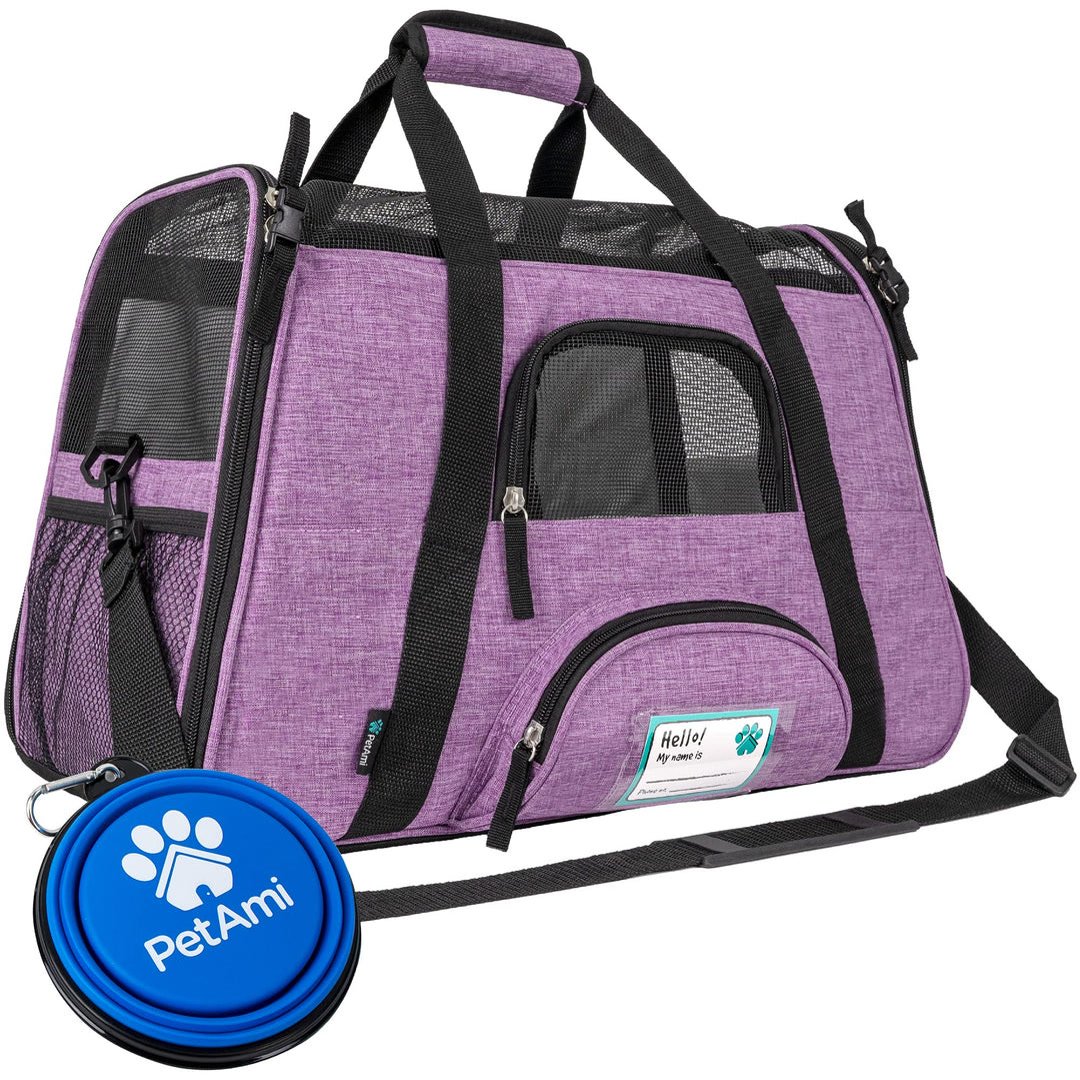
PetAmi packs more extras into a budget carrier than anyone else here. A collapsible silicone bowl, reflective trim for low-light walking, side buckles that loop a car seatbelt, an ID tag, and a front pocket. The 600D polyester shell is a step up in fabric weight from the cheapest shells, and the safety-buckle zippers resist the nose-and-paw push from inside.
The extras are real, but so are the limits. The base pad is thin, and for trips longer than a vet run you will want to slide a folded towel under the sherpa bed to keep the floor from hammocking under the cat. The up-to-18-pound rating deserves skepticism the way every budget weight rating does: an 18-pound cat in a 17-inch-long carrier is a tight ride no matter what the listing says. PetAmi at least tells you how to measure (length neck-to-tail, height floor-to-shoulder) before buying. Take them up on it. The small cat version here is the 17-inch Small, and it suits actual small cats better than the rating line suggests.
- Specs: Small 17 x 10.2 x 11.2 in (L x W x H); up to 18 lb; 600D high-grade polyester; ventilated mesh; two-sided zippered access; safety-buckle zippers; removable sherpa-lined bed; collapsible silicone bowl; reflective trim; seatbelt-loop buckles; harness safety strap; ID tag; front zipper pocket.
- Pros: Best extras-per-dollar here; sturdy 600D fabric; safety-buckle zippers; seatbelt loops for car use; collapsible bowl included; reflective trim.
- Cons: Thin base pad for longer trips; 18-pound rating overstates comfortable interior space; more zippers to manage at the security line; bulkier than the simplest budget shells.
Verdict: The loaded-budget pick. Buy it for the extras and the fabric; add a folded towel to the base and size by measurement, not by the weight rating. Check Price on Amazon
5. Petmate Two Door Top Load Pet Kennel, 19 in
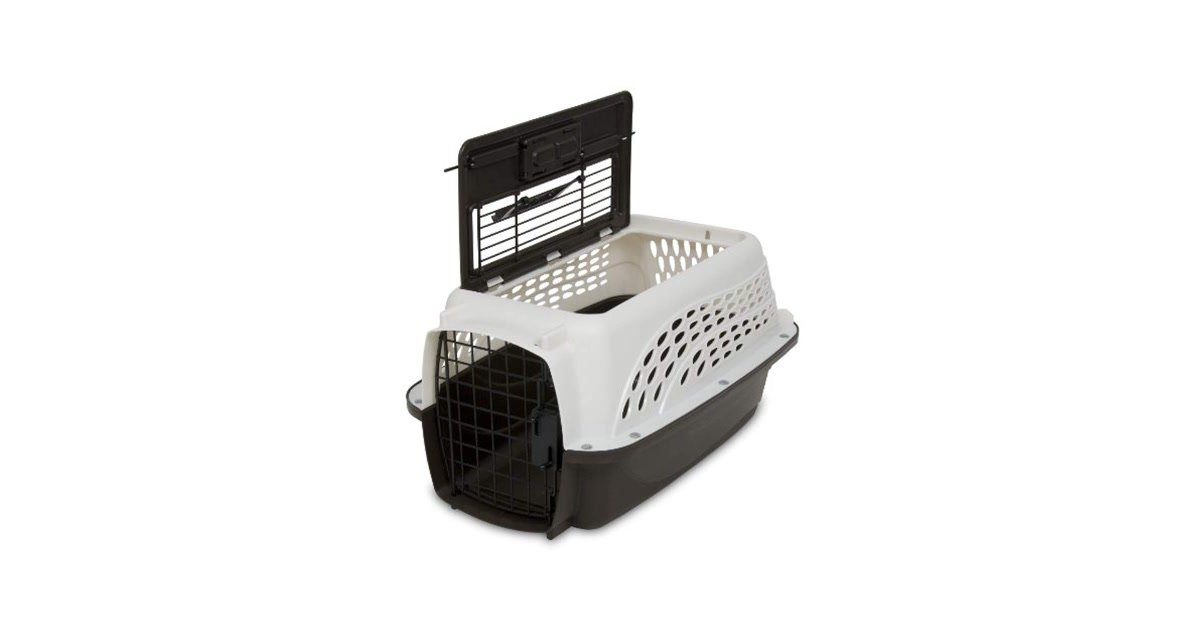
Sometimes the honest answer is plastic. A hard-sided kennel answers the two things soft carriers never fully solve: the cat that claws through mesh and the cat that figures out zippers. The Petmate’s steel top-load door drops your cat straight in from above, which is how most cat owners actually load a carrier, and the front door works for the ones who walk in. Made in the USA from recycled plastic, with vents on all sides and a stay-dry moat inside the floor.
The 10-pound maximum weight rating is the binding constraint, and it is refreshingly strict for a budget listing. Trust it. The 19-inch shell is also the biggest exterior here, which cuts both ways: roomy for the cat, bulky for you. It is not the quiet, cozy-looking pick, and the hard shell transmits more noise on a walk than fabric. Some owners drop a fleece over the moat floor because the plastic feels bare. But for a cat that treats soft carriers as a puzzle to solve, this is the most escape-resistant affordable option on the list.
- Specs: 19 in L x 13 in W x 10 in H; 3.8 lb; up to 10 lb; hard plastic shell (recycled materials); steel top-load door with easy-squeeze latch; front door; foldable handle; vents on all sides; stay-dry moat floor; assembly required; made in USA.
- Pros: Most escape-resistant pick; top-load plus front door; easy to clean hard shell; stay-dry floor; made in USA; strict honest weight rating.
- Cons: 10-pound cap rules out bigger cats; bulkiest exterior here; noisier and less cozy-feeling than soft carriers; plastic floor wants a fleece added; looks utilitarian.
Verdict: The escape-artist solution. If your cat has ever opened a carrier, this ends that story. Respect the 10-pound cap. Check Price on Amazon
6. Amazon Basics Soft Cat & Dog Carrier
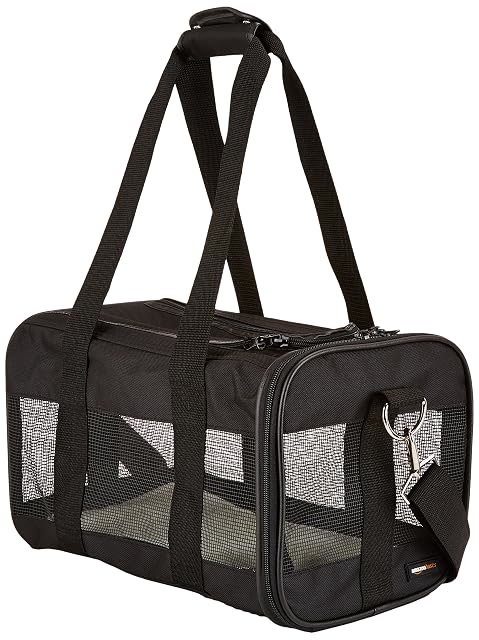
The cheapest way into this roundup, and it does not pretend to be anything else. A soft tote with top and side entry, mesh ventilation, a washable cushion cover, an adjustable shoulder strap, and handles that loop as a seatbelt or luggage strap. Amazon Basics prints the airline size tables right on the listing, which is more transparency than most budget sellers offer, and then tells you to check with your airline before travel. Good advice.
The honesty extends to the tradeoff. A no-brand shell at this price point is the one most likely to lose its shape over a year of use, and shoulder-strap comfort is a function of your cat’s weight. This is a carrier for the vet-run-and-back crowd, not a weekly flyer. It also has no interior leash, which costs a dollar to add yourself and is worth doing. For a small cat that travels a few times a year, it is adequate. For more than that, one of the structured picks above earns its keep.
- Specs: Under-seat footprint; top and side entry; mesh ventilation; washable cushion cover; adjustable shoulder strap; 2 loop handles double as seatbelt/luggage strap; collapsible, folds flat; polyester.
- Pros: Lowest cost of entry; airline size tables printed on the listing; washable cushion cover; folds flat; handles double as seatbelt strap.
- Cons: No interior leash included; shell likely to lose shape with heavy use; shoulder strap digs with heavier cats; fewest structural features of the six.
Verdict: Adequate for occasional vet trips on a tight budget. If you fly more than twice a year, spend a little more on one of the structured options above. Check Price on Amazon
Buying Guide: How to Choose an Affordable Travel Carrier for a Small Cat
Size by measurement, not by the weight rating
Budget carriers inflate weight ratings. An 18-pound rating on a 17-inch carrier is marketing, not physics. Measure your cat lying down, nose to base of tail, and standing, floor to top of shoulder. The carrier needs a couple of inches of clearance in both directions. A cat that cannot turn around inside the carrier will panic, and a panicking cat is how zippers fail and carriers break open.
Soft-sided vs. hard-sided for cats
Soft-sided carriers win on weight, storage, and airline fit. They fold flat, squeeze under seats, and do not rattle. Hard-sided kennels win on escape resistance and cleaning: a claw-proof shell and a hose-down interior. If your cat scratches mesh or has ever defeated a zipper, the soft-sided category is the wrong category. Pick the Petmate-style hard kennel and stop fighting the cat.
What “airline approved” actually means
It means the brand designed the carrier around common under-seat dimensions and, in Sherpa’s case, built a program with participating airlines. It does not mean every airline will accept it. Southwest and Alaska cap carrier height at 8.5 inches, which disqualifies most carriers listed here at 10.5 to 11.5 inches tall. Delta, United, and American generally allow up to 18 x 11 x 11 inches. Policies change by route and aircraft, so confirm with your airline for your specific flight before you buy anything.
The zipper is the whole safety system
On a budget soft carrier, the zipper is the load-bearing part of the design. Cats push zippers from inside with their paws and nose. Self-locking zippers (Mr. Peanut’s), safety-buckle zippers (PetAmi), and locking zippers (Sherpa) exist because this failure is common. At this price, prefer carriers with any locking mechanism over plain zippers, and always test the zipper track for fabric snags before trusting it with a cat.
Containment is not crash protection
Worth repeating plainly: fabric carriers are not crash-tested restraints. In a car, loop the seatbelt through the carrier’s handles or strap pass-through so the carrier itself cannot become a projectile. A seatbelt loop does not protect the cat inside the carrier; it protects everything else from a flying carrier. The only travel setups with meaningful crash claims are certified crash-tested crates and harness systems, a different category entirely.
Washing and lifespan realities
Almost no budget carrier is machine washable. The standard rule is wipe down the shell, wash the removable liner or pad. Budget shells lose structure faster than premium ones, especially when carried heavy on one shoulder strap. Expect one to three years of regular use from the cheapest options. If the carrier starts collapsing on the cat or the zippers wander open, replace it. A dead carrier is worse than none, because it looks safe.
Frequently Asked Questions
Can a small cat fly in an affordable carrier in the cabin?
Yes, if the carrier fits your airline’s under-seat dimensions and your cat is comfortable inside it. The airline’s rules are the only ones that count, and they vary by carrier and aircraft. Southwest and Alaska are the strictest on height (8.5 inches). Confirm your specific flight’s rules before you buy, and acclimate your cat to the carrier at home for a week before the trip.
What size carrier does a small cat need?
Measure first. A typical small cat needs roughly 17 inches of length and 10 to 11 inches of height, but “small cat” covers a wide range. Ignore the weight rating as the primary selector; a 13-pound cat that is long in the body needs a longer carrier than a compact 13-pounder. The cat should be able to stand, turn around, and lie down comfortably.
Are expandable carriers worth it for cats?
For airport and hotel use, yes. The expanded panel gives the cat room to stretch and eat once you are stationary, then collapses back for under-seat stowage. The tradeoffs are extra weight, extra bulk, and one more zipper track that can fail. If you fly rarely, skip the feature. If you fly monthly, it meaningfully improves the trip.
Why do cats escape from soft carriers?
The two classic exits are the zipper and the top. Cats work zippers open with paws and nose, especially plain zippers with no lock. Top-loading openings are the second failure point: a cat that braces during loading pushes the opening wider. Locking or self-locking zippers, an interior leash tether, and fully seating every latch on top doors prevent most escapes.
How do I stop a carrier from smelling?
Air new carriers out for hours before first use; budget polyester commonly arrives with a manufacturing smell. Between trips, wipe the shell with a damp cloth and wash the removable liner or pad. Do not machine-wash carriers that say not to: the heat and agitation collapse the structure, which is how a washable liner becomes a dead carrier. Odor that survives wiping usually means the base padding needs replacing or the carrier does.
Should I get a hard-sided kennel instead?
Get one if your cat scratches mesh, has defeated a zipper, or gets car sick (hard shells clean faster). Soft-sided carriers are better if you fly often, store the carrier in a closet, or carry it on foot for long distances. There is no universally right answer, only the right answer for your cat’s behavior and your travel pattern.
