

Pet Travel Items is reader-supported. When you buy through links on our site, we may earn an affiliate commission at no extra cost to you. Read our affiliate disclosure.
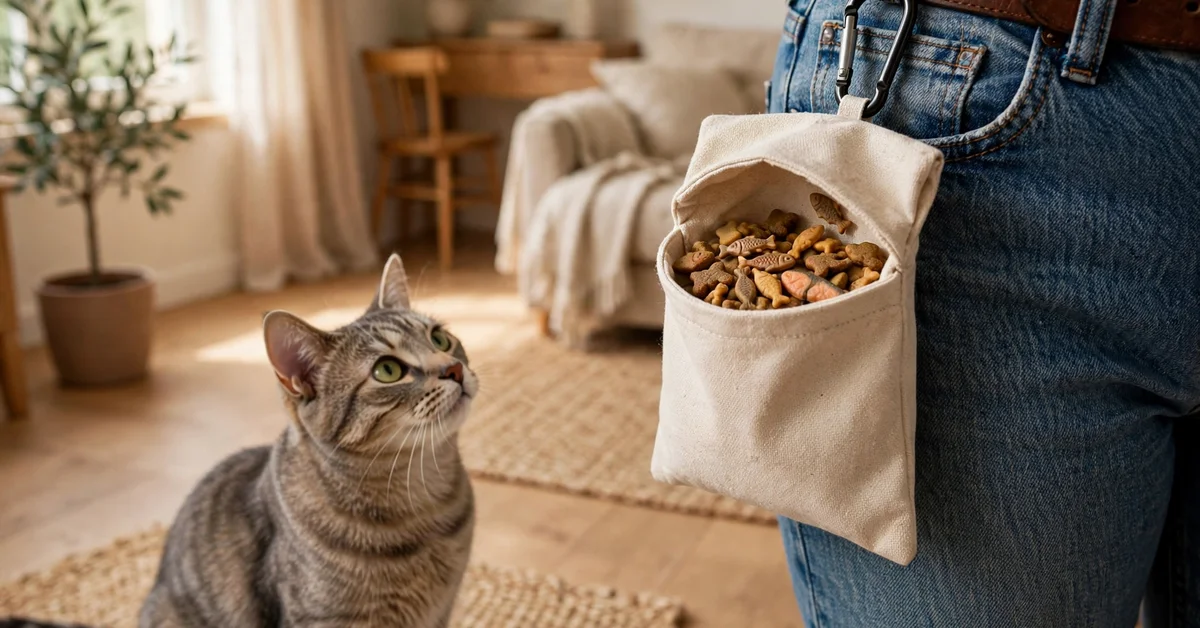
Cats are trainable. That sentence still surprises people, which tells you something about how long the dog industry has owned the treat-pouch category. Every pouch on this list is marketed to dog owners, and every one of them works just as well clipped to the hip of someone clicker-training a cat to walk into a carrier without a fight. Cats learn fast, sometimes faster than dogs, but the reward has to land within about two seconds of the behavior or the lesson never registers. That timing requirement is the entire reason a treat bag exists: it keeps the reward on your body and reachable with one hand, so you are not digging through a jacket pocket while your cat decides the carrier is a trap after all.
The good news for cat owners is that the standard treat pouch is overbuilt for your needs, which means you can buy at the affordable end without compromise. A dog trainer running a session with a labrador burns through a cup or more of treats in twenty minutes. A cat training session is ten to fifteen minutes, uses pea-sized or smaller rewards, and rarely needs more than a small handful of treats. So the giant 4-cup fanny packs that dog trainers love are wasted on a cat. The small, cheap, unglamorous pouches that dog owners overlook are exactly right for you. A pouch sized for cat treats keeps the treats near the opening instead of letting them sink to the bottom where your hand has to fish around for them.
Here is what this roundup is and is not. It is six real pouches you can buy on Amazon US today, chosen for low prices and for designs that suit cat-sized sessions. It is not a lab test. What you get instead is the spec sheet for each one, checked against real owner reviews, with the complaints left in. Treat pouches have boring failure modes: belt clips that pop off, magnets that weaken, drawstrings that slow you down, fabric that absorbs the smell of fish treats and never lets it go. You will read about all of that below, attached to the specific pouch it applies to, because a review that hides the drawbacks is an ad.
One more honest note before the list. Half of these pouches come with a built-in poop bag dispenser, and none of your cats need one. The dispenser is dog-walk infrastructure baked into the design; it adds no cost worth worrying about, but do not pay extra for it and do not count it as a feature.
Below: the full list, then what each pouch is actually good at and where each one lets you down.
| # | Product | Why it made the list | Check Price |
|---|---|---|---|
| 1 | Kurgo Go Stuff It Dog Treat Bag | The established brand name with a lifetime-warranty company behind it; compact enough for cat-sized sessions | Check Price |
| 2 | Gobeigo Dog Treat Pouch | Magnetic closure, washable silicone insert, and an included clicker — the best value bundle for new cat trainers | Check Price |
| 3 | RC Pets Quick Grab Treat Bag | Spring-hinge mouth stays open while you work and a divider separates two treat values — the serious-session pick | Check Price |
| 4 | Outward Hound Treat Tote | The cheapest brand-name option here; a simple drawstring tote with nothing to break | Check Price |
| 5 | Ubbi Dog Treat Pouch | Magnetic closure plus real organization and a recycled-material build; the organized-and-eco pick | Check Price |
| 6 | Paw Print Hanging Zero-Wallet Treat Bag | A pocket-sized mini pouch for a few tiny treats; the cheapest way to try the whole concept | Check Price |
1. Kurgo Go Stuff It Dog Treat Bag
Kurgo is one of the few companies in this category that behaves like a real company. It makes travel gear for dogs, backs its products with a lifetime warranty, and has sold this treat bag for the better part of a decade. The Go Stuff It is a compact drawstring pouch with a belt clip on the back, an included carabiner, a pocket for poop bags or keys, and reflective trim. The listing puts it at about 5.5 by 3.5 by 6 inches and just over 2 ounces, which is the right footprint for a cat owner: big enough to hold a session’s worth of tiny treats, small enough that the treats stay near the opening instead of sinking out of reach.
The drawstring-and-cord-lock closure is the classic treat-pouch design, and it is honest work. Cinch it and the treats stay sealed; loosen it and you can reach in with one hand. The pocket for bags and keys means this can be your only thing on your hip during a harness walk. And because Kurgo is an established brand, the listing is stable — the product you read reviews about is the product you buy, which is not always true of the no-name pouches that rotate through Amazon under new storefront names every few months.
The complaint record on this one is specific and worth reading before you buy. The back belt clip pops off. This is the most repeated complaint across review sources, and it is not a minor one: owners describe the pouch detaching from their belt unnoticed and having to retrace their steps to find it. Multiple owners fixed the problem themselves by sewing the clip in place or abandoning it for the carabiner alone. The included carabiner has its own record: small, light, and at least one owner reported it breaking within a week. If you buy this pouch, buy a sturdier small carabiner at the same time and treat the included one as a backup.
Two more caveats from owners. The cord lock on the drawstring has failed for some buyers — one reviewer went through two bags with the lock breaking differently each time, and on current stock the interior cord routing can catch and make cinching fiddly. The mouth also runs narrower than the photos suggest; owners with large hands report having to work to get a hand in. For a cat owner carrying small treats, the mouth issue matters less, but the clip issue matters just as much. Plan around it from day one.
Specs:
- About 5.5 x 3.5 x 6 in; 2.26 oz; model K01672
- Drawstring closure with cord lock
- Back belt clip plus included carabiner
- Pocket for poop bags, keys, or cards; reflective trim
- Lightweight breathable fabric; hand wash
- Multiple colors including Coastal Blue
What it does well:
- Established brand with a real warranty behind it — rare at this price
- Compact size suits cat-sized treat loads without dead space
- Pocket and reflective trim make it a complete harness-walk setup
- Drawstring seals treats reliably when cinched
Where it falls short:
- Belt clip is the known weak point — it pops off and owners lose the pouch
- Included carabiner is undersized; plan to replace it
- Cord lock on the drawstring has broken for some owners
- Mouth runs narrow for large hands
Verdict: The brand-name safe buy, with one rule: do not trust the belt clip. Use a better carabiner or clip it through a belt loop and this is the most dependable pouch on the list.
2. Gobeigo Dog Treat Pouch
The Gobeigo is the bundle play: a magnetic-closure pouch with a removable silicone insert, a training clicker in the box, and three ways to wear it, at a price that undercuts every brand-name pouch on this list. For a cat owner just starting clicker training, that bundle matters. The clicker is the part most beginners forget to buy, and buying it separately plus a pouch costs more than this whole package. The 4-cup capacity in the listing title is dog-marketing talk; for cat treats it means you will fill it a quarter full, which is actually ideal because the treats stay piled near the magnetic mouth where your hand can grab them fast.
The silicone insert is the genuinely good idea here. Cat training rewards are often soft, smelly, and slightly greasy — bits of cooked chicken, lickable treats, soft treats with fish oil. That residue soaks into fabric pouches and turns rancid. A food-grade silicone liner pulls out, rinses or goes in the dishwasher, and the pouch itself stays clean. If you train with anything wet or oily, a wipeable liner is the difference between a pouch that lasts a season and one that lasts a month before you cannot stand the smell.
The magnetic closure is the right mechanism for cat clicker work. Magnets are silent, which matters for noise-sensitive cats, and fast — you peel the mouth open with one hand and it snaps shut on its own. Owners report the magnets take a couple dozen openings to break in; early on the mouth feels stiff. That is a break-in note, not a defect, and it resolves with use. The clicker in the box is functional rather than premium. It works for close-range indoor training, but owners training around traffic noise or in group classes may still want a louder clicker of their own.
The honest knocks: build quality splits reviewers. Most owners call it excellent value and use it daily, but at least one described it as flimsy and doubted it would last. Treat this as a consumable at this price, not an heirloom. The waist strap can dig if overtightened, and one variant’s belt runs short for larger waists. Accessory storage is tight: phone and keys fit, barely.
Specs:
- 4-cup capacity per listing title; sealable silicone bag insert (dishwasher safe)
- Magnetic closure for one-handed open and self-close
- Training clicker included
- Three wear options: belt clip, waist belt, crossbody strap
- Front zipper pocket and side pocket for poop bags or keys
What it does well:
- Best value bundle for beginners: pouch + clicker + three wear styles
- Silicone insert is the right answer for wet, oily, or fishy cat treats
- Silent magnetic closure suits noise-sensitive cats
- Quarter-filled with cat treats, the capacity keeps rewards near the opening
Where it falls short:
- Build quality reviews are mixed — some owners call it flimsy; treat it as a consumable
- Magnetic mouth is stiff for the first couple dozen uses
- Waist strap comfort is poor at the extremes; can dig when overtightened
- Included clicker is basic; serious trainers may replace it
Verdict: Buy this if you are starting clicker training from zero and want the clicker, the pouch, and a wipeable liner in one cheap box. The silicone insert alone justifies it for anyone using soft or fishy treats.
3. RC Pets Quick Grab Treat Bag
The Quick Grab is the most serious piece of equipment on this list, and the priciest of the six — it sits noticeably above the budget picks. What you are paying for is the closure: a metal purse-hinge mouth that stays open while you work and snaps shut when you are done. For rapid-fire clicker training, where you are delivering a treat every few seconds, a mouth that holds itself open is the fastest design there is. No fumbling with a drawstring, no peeling magnets apart. Your hand goes in, comes out, done.
The second feature worth the money is the interior divider with a hook-and-loop closure. If you train with two reward values — kibble for easy reps, something high-value like freeze-dried meat for the hard ones — the divider keeps them separated in one pouch. That is a genuinely useful training feature, and it is rare at this price. Around that core, RC Pets built a proper walk kit: ripstop polyester shell with a water-resistant backing, a waterproof lining, a zippered front pocket for phone and keys, a belt clip plus a removable waist belt that adjusts from 32 to 60 inches, a built-in poop bag dispenser, webbing loops, and a metal carabiner.
The honest framing: this is a dog-sized pouch. At 8 inches wide and over 7 inches tall, it is roomier than any cat trainer strictly needs. It earns its place on a cat list because the hinge mouth and the divider are the two features that matter most for serious clicker work, and nothing cheaper here offers both. If you train one cat casually, this is more pouch than you need.
The caveats are about the hinge itself and the price. Purse-hinge closures are a known wear item across every brand that uses them: the spring fatigues over months of heavy use. There is no confirmed defect report on this specific unit, but hinge fatigue is the long-term question to watch, not a surprise to discover later. And the price is the price: this is the “spend a bit more” pick in an affordable roundup, justified only because the hinge and divider are genuinely better than what the cheaper pouches offer.
Specs:
- About 8 in wide x 7.25 in high x 1.2 in deep; one size
- Metal purse-hinge mouth: stays open while working, snaps shut when done
- Interior divider with hook-and-loop closure for two treat types
- Ripstop polyester shell; water-resistant backing; waterproof lining,
- Zippered front pocket; poop bag dispenser; webbing loops; metal carabiner
- Back belt clip + removable waist belt (32–60 in); reflective logo
What it does well:
- Fastest closure type for rapid-fire clicker training — mouth holds itself open
- Divider separates high-value and low-value treats in one pouch
- Proper materials: ripstop shell, water-resistant backing, waterproof lining
- Complete kit: belt, clip, carabiner, dispenser, zippered pocket
Where it falls short:
- Most expensive of the six — the premium pick in an affordable list
- Dog-sized; roomier than a casual cat trainer needs
- Purse-hinge mechanisms fatigue over time — the long-term wear question
- One size only, no compact option
Verdict: The pick for people who train daily and want the fastest possible reward delivery. Casual trainers will find it oversized; serious ones will find the hinge mouth worth every extra dollar.
4. Outward Hound Treat Tote
The Treat Tote is the simplest thing on this list and, depending on your temperament, that is either the selling point or the dealbreaker. It is a drawstring tote made of water-resistant nylon with reflective piping, a belt clip, and a small velcro belt loop. One compartment. No pockets, no divider, no waist belt, no clicker, no liner. You put treats in it, you cinch the drawstring, you clip it to your belt or waistband, and you walk out the door. At roughly 8 by 6 inches it holds far more than a cat session needs, which means a handful of tiny cat treats sits in the bottom and you reach in past empty space — the one ergonomic cost of buying a dog-sized sack for cat-sized rewards.
What it has going for it is the absence of failure points. There is no magnet to weaken, no hinge spring to fatigue, no zipper to jam. Drawstring pouches are the oldest design in the category precisely because there is almost nothing to go wrong. The nylon wipes clean, dries fast, and the reflective piping is a real plus for evening harness walks.
The limitations are all about what is missing. No pockets means your phone, keys, and clicker go in your own pockets. No waist belt means the fit depends entirely on what you are wearing; the clip and velcro loop work fine on jeans and poorly on leggings. The drawstring is the slowest closure for rapid rewards — fine for rewarding a cat for walking nicely on a harness, less fine for rapid-fire shaping where every second counts. And one design quirk worth knowing: the cinch strap routes on the inside of the bag rather than the rim, which owners have asked about and which makes the closure feel slightly different from most drawstring pouches.
Buy this with clear eyes. It is not the best pouch on this list. It is the cheapest way to get a brand-name pouch with nothing to break, and for casual use — a few treats on a walk, rewarding carrier entries — nothing to break is a legitimate feature. Serious trainers should look at the hinge or magnetic options above.
Specs:
- About 8.25 in long x 6 in wide; model 23006; one size
- Drawstring closure
- Water-resistant nylon; reflective piping
- Belt clip + small velcro belt-loop attachment
- Single open compartment; doubles for small accessories
- Lightweight; collapses flat
What it does well:
- Cheapest brand-name pouch here — simple and hard to break
- No magnets, hinges, or zippers to wear out
- Nylon wipes clean and dries fast; reflective piping for night walks
- Cinch strap on the inside keeps the opening uncluttered
Where it falls short:
- No pockets, no divider, no waist belt — a single sack, nothing more
- Dog-sized; a handful of cat treats sinks to the bottom
- Drawstring is the slowest closure for rapid-fire training
- Attachment depends on your waistband; no dedicated belt included
Verdict: The honest budget pick: a simple sack that holds treats and refuses to break. Buy it for casual walks and light training; buy something faster if you are doing serious clicker work.
5. Ubbi Dog Treat Pouch
Ubbi is best known for diaper pails and litter accessories, and the treat pouch is cut from the same cloth: organized, a little design-forward, and priced above the budget tier. The pitch here is the combination of a magnetic no-spill closure with actual organization — a built-in poop bag dispenser that feeds through a back mesh panel, multiple zippered compartments for phone, wallet, and keys, and three ways to wear it: crossbody strap, waist belt, or belt clip. If your complaint about cheap pouches is that they are just sacks, this is the answer to that complaint.
The material story is the differentiator. The shell is 100% recycled RPET made from water bottles, and the whole pouch is machine washable. For cat owners, the washability matters more than the recycling: fish-based treats leave residue that a machine-washable pouch handles without a second thought. The magnetic closure gives you the one-handed speed clicker training demands, and because the pouch is compact rather than cavernous, a cat-sized load of treats stays accessible.
The honest math: this costs noticeably more than the budget picks on this list. The value case is organization plus materials, not savings. If you just need a sack that holds treats, the Outward Hound does that for less. What the Ubbi buys you is the consolidated walk kit — treats, phone, keys, bags in one organized pouch — and the recycled build.
Caveats are the standard magnetic-pouch ones, stated as physics rather than defects. Magnets are fast and silent but they never fully seal; tip the pouch upside down and treats escape. Heat, drops, and time weaken them, so the closure you love in month one will be lazier in month twelve. The review base is also thinner than the big sellers in this category, which means less long-term durability data.
Specs:
- Magnetic no-spill closure for one-handed access
- Three wear options: crossbody strap, waist belt, belt clip
- Built-in poop bag dispenser through back mesh panel
- Multiple zippered compartments for phone, wallet, keys
- 100% recycled RPET shell; machine washable
- Charcoal Gray and other Ubbi collection colors
What it does well:
- Real organization: treats, phone, keys, and bags in their own compartments
- Recycled-material build with full machine washability
- Magnetic closure is fast and silent for clicker work
- Three wear styles cover belt, waist, and crossbody preferences
Where it falls short:
- Costs noticeably more than the budget picks — the premium-priced entry here
- Magnets never fully seal; treats escape if the pouch tips
- Thinner review base means less long-term durability evidence
- Dry time and odor resistance are unverified
Verdict: Buy it if you want one organized, washable, recycled pouch instead of a sack plus your pockets. Skip it if all you need is a cheap treat holder — the budget picks do that job.
6. Paw Print Hanging Zero-Wallet Treat Bag
This is the odd one out, and it is here on purpose. The Paw Print pouch is not really a treat pouch — it is a tiny hanging zero-wallet, the kind of pocket organizer sold for coins and earbuds, that the listing also positions as a portable snack pouch for pet training. It has a zipper closure, a snap tab, a hanging loop, and a structured shape that stands upright on its own. It holds a small handful of treats. That is all it holds. And for a cat owner, a small handful of tiny treats is frequently all a session needs.
The case for it is simple: it is usually the cheapest option on this list, it weighs almost nothing, and it hangs from a belt loop, leash, or bag strap instead of requiring a belt or waist strap. Clip it to the leash during a harness walk and the treats ride right where your hand already is. Toss it in a jacket pocket for a vet visit and you have rewards on hand without wearing a fanny pack through the waiting room.
The case against it is equally simple, and the article will not soft-pedal it. A zipper is the slowest possible closure for rewards. Unzipping, fishing out a treat, and zipping back up takes seconds you do not have in clicker training, where the reward must land within about two seconds of the behavior. This is a portability pick, not a training-session pick. The hanging loop is the only attachment — no belt clip, no strap — so it dangles and swings rather than sitting stable on your hip. Capacity is a few treats; a longer session means refilling from a bigger bag, which defeats the purpose.
And the brand line on the listing reads “Generic.” There is no company behind this, no warranty, no one to email when the zipper fails. Quality will vary by seller batch. That is the trade for the price. Buy it as an experiment: the cheapest possible way to find out whether carrying treats on your body changes your training.
Specs:
- Tiny hanging pouch (zero-wallet form factor); holds a handful of small treats
- Zipper closure with snap tab
- Integrated hanging loop for belt loops, leashes, bags, or hooks
- Structured shape stands upright on its own
- PVC build wipes clean; doubles as a key or coin pouch
- Brand listed as Generic — no warranty
What it does well:
- Cheapest entry point on the list — a low-risk experiment
- Pocket-sized and nearly weightless; ideal for travel and vet visits
- Hanging loop clips to a leash, keeping treats at hand on harness walks
- Structured shape means no digging for treats buried in fabric folds
Where it falls short:
- A zipper is far too slow for real clicker-training timing
- Tiny capacity — a few treats, then you are refilling
- Hanging loop only; it dangles instead of sitting stable
- Generic brand with no warranty and batch-to-batch quality variance
Verdict: The try-it-cheap pick for travel and vet visits, not a training tool. If carrying treats on your body clicks for you, upgrade to a magnetic or hinge pouch next.
How to Pick a Treat Bag When the Customer Is a Cat
Start by throwing out the dog math. Dog treat-bag reviews obsess over cup capacity because a training session with a big dog genuinely runs through a cup or two of treats. A cat session is shorter, the rewards are smaller, and the cat quits before the pouch does. Twenty to thirty pea-sized treats is a full session for most cats. That means capacity is the least important spec on the page. What matters instead is whether a handful of tiny treats stays reachable: a pouch that is too deep or too wide lets small treats scatter across the bottom, and you end up fishing. Smaller pouches are not a compromise for cat owners. They are the correct tool.
Next, match the pouch to the actual job. Indoor clicker training — sit, high-five, going into the carrier on cue — wants speed above all, because the reward window is two seconds. Harness walks want a pouch that rides stable on your hip while you manage a leash with the other hand. Vet visits and travel want something small and discreet that does not look like a utility belt in the waiting room. Most cat owners need the second and third more than the first, which is why the simple pouches on this list beat the feature-loaded ones for everyday use.
Finally, think about what you are putting in it. Dry kibble and commercial treats are forgiving: they do not smell much, they do not stain, any pouch handles them. Soft treats, cooked chicken, cheese, and fish-based rewards are a different substance. The fat and moisture soak into fabric, go rancid, and the pouch starts smelling like a bait shop. If you train with anything wet or oily, the liner is the whole decision: a silicone insert or a pull-out washable liner (the Gobeigo approach) or a fully machine-washable pouch (the Ubbi approach) will save you from replacing a stinking pouch every two months. With dry treats only, buy whatever is cheapest and comfortable.
Closures, Ranked for Cat Training
There are four closure types in this category and they are not interchangeable. Ranked by reward speed, from fastest to slowest: spring-hinge mouths, magnetic closures, drawstrings, zippers. The hinge mouth (RC Pets) stays open while you work and closes with a touch — nothing beats it for rapid-fire reps. Magnets (Gobeigo, Ubbi) are nearly as fast and completely silent, which is a real advantage with noise-sensitive cats; the trade is that magnets weaken over months and never fully seal against spills. Drawstrings (Kurgo, Outward Hound) seal the best and last indefinitely, but they are slower one-handed and kibble dust collects in the folds. Zippers (the Paw Print mini) seal perfectly and are far too slow for real training timing.
Speed is not the only axis. Silence matters with cats in a way it does not with most dogs. Velcro is the worst offender — the ripping sound startles some cats mid-session — and none of the six pouches here use velcro as the main closure. Magnets and hinges are silent. Drawstrings are nearly silent. If your cat is sound-sensitive, strike anything with a velcro flap off your shortlist no matter how good the reviews are.
The durability axis runs in the opposite direction from speed. The fastest closures wear out: hinge springs fatigue, magnets weaken. The slowest closures last: a drawstring is a piece of cord, and there is nothing to break. This is the fundamental trade of the category, and it is why the honest answer to “which closure is best” is “it depends on how fast you reward.” Rapid shaping with a clicker wants a hinge or magnet and accepts replacing the pouch sooner. Casual rewarding on walks is perfectly served by a drawstring that will outlive the cat’s interest in training.
Treat Bags and Cat Travel: How You Will Actually Use One
This site is about traveling with pets, so here is the travel-specific case. The highest-value use of a treat bag for a cat owner is carrier training before a trip: rewarding the cat for walking into the carrier, sitting in it, and tolerating the door closing, repeated over days. A hip-worn pouch turns that from a production — treats on the counter, cat at your feet, you bending and reaching — into a smooth loop. The second use is the trip itself: a small pouch in your carry-on with familiar treats smooths security lines, layovers, and the hotel room, where rewarding calm behavior in a strange place goes a long way.
For harness walks, which more traveling cat owners are doing, the pouch earns its keep differently. Your hands are full: leash in one hand, phone in the other, cat doing something unpredictable at the end of the lead. A pouch on your hip means rewards happen without a pocket search, and the two-second window stays intact even mid-walk.
One thing not to do: do not store treats in the pouch between sessions, especially in a warm car or a packed travel bag. Trapped moisture plus heat is how pouches start smelling, and a sealed pouch of fish treats in a hot car is a smell you will not forget. Empty the pouch after every session, leave it open to air out, and wash it on whatever schedule the material allows. The pouch is a holster, not a pantry.
Frequently asked questions
How many treats does a cat treat bag need to hold?
A focused cat training session runs ten to fifteen minutes and uses twenty to thirty pea-sized treats at most. Any pouch on this list holds that with room to spare. The mistake is buying a huge pouch “just in case” — a handful of tiny treats in a deep pouch scatters across the bottom and you waste the two-second reward window fishing for them. Size the pouch to the session, not the bag of treats in your pantry.
Can I use a dog treat pouch for my cat?
Yes. There is no such thing as a cat-specific mechanism here; a pouch is a pouch. The only adjustment is sizing: dog pouches are designed around cup-scale capacity and hand-scale mouths, so prefer the smaller options and the ones where a partial fill keeps treats near the opening. Every pick on this list was chosen with that in mind. Ignore any listing that tells you a pouch is “for dogs” as if that were a technical specification. It is marketing.
What is the best closure for clicker training a cat?
A spring-hinge mouth first, a magnetic closure second. Both are fast and silent, and speed plus silence is exactly what cat clicker work rewards. Drawstrings are acceptable for slower training but cost you fractions of a second per rep, and zippers are too slow for real clicker timing — fine for carrying treats on a walk, not for shaping behavior. Whatever you choose, avoid velcro main closures; the ripping sound startles noise-sensitive cats.
How do I keep a treat bag from smelling like fish?
Do not give it the chance. Empty the pouch after every session instead of leaving treats in it, and wipe or rinse the interior before the residue sets. If you train with fish treats, soft treats, or anything oily, buy a pouch with a silicone insert or a fully washable build — the Gobeigo and Ubbi here — because fabric alone will absorb the smell permanently within weeks. Store the pouch empty and open so it airs out. Once a fabric pouch smells rancid after washing, it is done; replace it rather than fighting it.
Should I pay extra for a pouch with a poop bag dispenser?
No. The dispenser is dog-walk infrastructure that comes baked into most pouch designs, and on this list it costs you nothing extra — but it should never be the reason you pick one pouch over another. You already carry waste bags when you travel with a cat; where they live on your body does not matter. Judge the pouch on closure speed, size, and washability. Treat the dispenser as a freebie, because that is what it is.
Is a treat bag actually useful for harness training a cat?
Yes, and it is one of the best uses for one. Harness training is all about rewarding calm behavior in small increments — a step forward, standing still while a dog passes, coming back when called — and your hands are busy with the leash. A hip-worn pouch keeps the reward inside the two-second window without a pocket search. Start indoors with the harness and pouch together so the cat associates both with good things before you ever go outside.
The short version of this whole list: cats need small pouches, fast quiet closures, and washable interiors. They do not need capacity, organization systems, or brand prestige. The Kurgo is the dependable brand pick if you work around its clip. The Gobeigo is the best value for anyone starting clicker training. The RC Pets is the serious trainer’s tool at a serious-trainer price. The Outward Hound is the cheapest honest pouch. The Ubbi is the organized, washable upgrade. The little Paw Print pouch is the experiment.
And the part no product page will tell you: the pouch is the least important part of the training. What makes a cat learn is the timing of the reward, the size of the treat, and ending the session before the cat checks out. A cheap pouch used with good timing beats an expensive pouch used late. Buy the cheapest pouch on this list that fits your hand and your routine, spend the savings on good treats, and keep your sessions short.
