

Here’s the scenario this carrier exists for: vet appointment at 10, a cat who vanishes the moment the hard plastic carrier comes out of the closet, and you standing in the PetSmart aisle wondering whether the $27 soft-sided one with the top opening is genius or a trap. The top-load pitch is real — lowering a cat in from above beats shoving one through a front door every time.
The honest note most reviews skip: Whisker City is PetSmart’s house brand. It’s not competing with premium carriers — it’s competing with the other budget soft-sided carrier on the shelf. And soft-sided carriers are a category with known failure modes: zippers, framing that loses its shape, and optimistic weight ratings. This review covers the main Whisker City soft-sided carrier plus the brand’s hard-sided top-load option, with the category complaints you should check for in the store before you buy.
Pet Travel Items is reader-supported. When you buy through links on this page, we may earn a commission at no extra cost to you. Our picks are driven by documented owner feedback, never by commission rates.
The Carrier: Whisker City Soft-Sided Cat Carrier
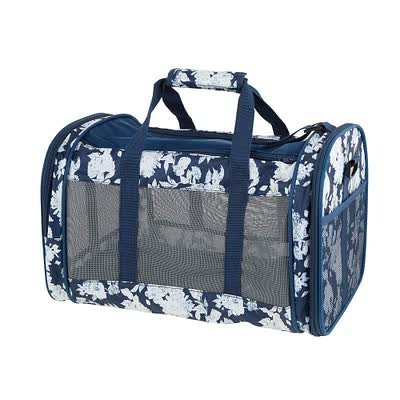
This is the flagship Whisker City carrier — the soft-sided model (19″L x 11″W x 11″H) rated for cats up to 22 lbs, sold in colors including black, gray, blue, tan, and pink, exclusively at PetSmart. The pitch is convenience: easy-load entry from the top or the side, locking zippers for what PetSmart calls “stress-free travel,” and mesh panels for airflow and visibility. The Blue Cat Print variant has over 400 PetSmart reviews; the Black Mesh variant over 200 — a solid base of real owner experience.
Where it sits on price: roughly $26–$30 at PetSmart depending on color and promotions (the Blue Cat Print lists around $25.99, the standard soft-sided around $29.99). That’s the budget end of soft-sided carriers — which is the whole point of a house brand.
Specs: 19″L x 11″W x 11″H · rated for cats up to 22 lbs · top or side entry with locking zippers · mesh panels for airflow/visibility · colors: black, gray, blue, tan, pink · PetSmart exclusive.
Pros: top loading is genuinely the easiest way to get a reluctant cat in; light and easy to carry; mesh panels give good airflow; locking zippers add a layer of security over plain zippers; the price is hard to argue with; in-store pickup and easy PetSmart returns.
Cons: 19 inches is tight for a true 22-lb cat — a big Maine Coon is longer than this carrier, so treat the weight rating as optimistic and size your actual cat against the dimensions; soft-sided framing is the category’s known weak point — carriers in this class can lose their shape and flatten with regular use, so inspect the frame in the store and don’t force a cat into a carrier that’s collapsing; zippers are the escape point on every soft carrier — always engage the locking zippers and double-check them before you leave the house, because a carrier opening in an unfamiliar place is every owner’s nightmare; no rigid structure, so it won’t protect against being stacked under luggage; PetSmart exclusive — no Amazon listing and no price comparison.
Verdict: A perfectly good vet-visit and car-travel carrier for average-sized cats, and the top loading is a genuine advantage. Buy it for the price and the loading; don’t expect it to fit a giant cat or survive years of hard travel. Check the price at PetSmart.
Also in the Line: Whisker City Two-Door Top Load Portable Kennel
If you want the top-loading convenience in a hard-sided shell, Whisker City makes one: the Two-Door Top Load Portable Kennel (around $30.99), a plastic carrier roughly 22″L x 14.8″W x 12″H rated for cats up to 20 lbs, with top and side entry, flow-through ventilation, and easy-clean plastic construction. This is the better pick for destructive cats, for owners who want a carrier that holds its shape indefinitely, and for anyone whose vet prefers examining the cat with the top half removed — a real workflow advantage at checkups.
The trade-offs: hard-sided carriers are heavier and bulkier to store, the 12-inch height is low for tall cats, and plastic latches are the part to inspect in the store (flex them; they should close with a confident click, not a mushy one). For most owners, the decision is simple: soft-sided for easy carrying and storage, hard-sided for durability and vet-friendly exams. Check the price at PetSmart.
Who It’s For — and Who Should Skip It
Buy it if: your cat fights front-loading carriers (top loading changes the game); you want a light carrier for vet visits and car travel; your cat is average-sized (under ~15 lbs — comfortably within the real capacity); you want to see and touch the carrier before buying, which PetSmart lets you do.
Skip it if: your cat is genuinely large — measure against 19″ x 11″ x 11″ and don’t trust the 22-lb rating blindly; your cat chews or claws through fabric (get the hard-sided kennel instead); you need airline cabin travel — soft-sided can work for in-cabin, but confirm your airline’s exact under-seat dimensions first, and note this carrier is not marketed as airline-approved; you need a carrier that will be checked as cargo (hard-sided only, and not this one).
Alternatives Worth Knowing
PetAmi Expandable Backpack Carrier — the Amazon-available step up. If you want to buy online with an affiliate option, or you’d rather wear the carrier than carry it, PetAmi’s expandable backpack (12.5″ x 10.2″ x 16.3″, up to 18 lbs) adds an expandable side for extra room at rest stops, mesh windows, sherpa-lined bedding, and padded backpack straps. It’s the “I walk or bike with my cat” answer to Whisker City’s “I drive to the vet” design. Check the price on Amazon.
Travel Cat Odyssey — the in-store premium comparison. Sold at PetSmart alongside Whisker City, the Travel Cat Odyssey is the soft carrier for owners who want multi-access points and an explicitly airline-approved design. It costs more than Whisker City — that’s the trade: house-brand price versus a carrier engineered for frequent flyers. Compare them side by side in the aisle.
How to Choose a Cat Carrier (and Where Whisker City Fits)
Top loading beats front loading for difficult cats. This is the least controversial advice in cat travel. Lowering a cat into a top opening — or removing the top half entirely at the vet — avoids the shove-and-scramble of front doors. If your cat is carrier-averse, prioritize top access over every other feature. Whisker City’s whole line gets this right.
Measure the cat, not the rating. Weight ratings on budget carriers are optimistic. A 19-inch carrier is a full-body fit for an average 10-lb cat and a squeeze for a 15-pounder; a true 22-lb cat belongs in a larger carrier regardless of what the tag says. Measure nose-to-tail-base and floor-to-ear-tip, then compare to interior dimensions.
Test the zippers like your cat’s safety depends on it. On any soft-sided carrier, the zippers are the escape hatch. In the store: zip and unzip every opening, engage the locks, and tug. Locking zippers (which Whisker City includes) are meaningfully better than plain ones — but only if you actually lock them. Make the double-check part of your leaving-the-house routine.
Check the frame before you commit. The documented failure mode of budget soft carriers is framing that flattens with use. In the store, load the carrier the way your cat will — does it hold its shape, or do the sides bow in? A carrier that collapses inward on the cat is worse than no carrier; it panics them.
Keep a carrier out, not hidden. The best carrier trick costs nothing: leave it open in the living room with treats inside for a week before the vet visit. A carrier that’s furniture is a carrier the cat walks into voluntarily. A carrier that appears once a year is a trap, and the cat knows it.
Match the carrier to the trip. Vet visits and car rides: soft-sided is fine and easier to carry. Air travel: confirm airline under-seat dimensions and look for explicitly airline-approved designs. Destructive cats or multi-cat households: hard-sided. Whisker City covers the first and third of those; don’t force it into the second.
Bottom line: the Whisker City Soft-Sided Cat Carrier is the right call for an average-sized cat’s vet visits and car travel — top loading at a house-brand price is a genuine win. Big cats should size up, chewers should go hard-sided (Whisker City’s own Two-Door Top Load Portable Kennel is the in-brand answer), and frequent flyers should compare the Travel Cat Odyssey in the same aisle or the PetAmi backpack on Amazon.
Frequently Asked Questions
Is Whisker City a good cat carrier brand?
Whisker City is PetSmart’s house brand, and its carriers are solid budget options — not premium ones. Owners buy them for the price, the top-loading designs, and the convenience of PetSmart availability. Match the carrier to your cat’s size and temperament, inspect zippers and framing in the store, and they do the job.
What size cat fits the Whisker City soft-sided carrier?
It’s rated for cats up to 22 lbs, but the 19″L x 11″W x 11″H dimensions tell the real story: it’s a comfortable fit for average cats up to about 12–15 lbs. Large or long cats should be measured against the dimensions rather than trusted to the weight rating — when in doubt, size up.
Is the Whisker City carrier airline approved?
The soft-sided carrier is not marketed as airline approved. Some owners do fly with soft-sided carriers in-cabin, but you must confirm your specific airline’s under-seat dimensions and pet policy before booking — “it fit last time” is not a policy. For air travel, look for carriers explicitly marketed as airline approved.
Top-loading vs. front-loading — which is better?
Top loading, for most cats. Lowering a cat in from above (or lifting the top off at the vet for exams) avoids the confrontation of pushing a cat through a front door. Front-only carriers are fine for cats that walk in willingly; for everyone else, top access is worth prioritizing.
Where is Whisker City sold?
Whisker City is exclusive to PetSmart — you won’t find it on Amazon or Chewy. The upside is in-store pickup, same-day availability in most areas, and PetSmart’s return policy if the carrier doesn’t work out.
How do I get my cat used to a new carrier?
Leave it open in the living room with treats and a familiar blanket inside for at least a week before you need it. Feed meals near it, then in it. The goal is a carrier the cat naps in voluntarily — a cat that only sees the carrier on vet day will fight it every time.
