

Pet Travel Items is reader-supported. When you buy through links on our site, we may earn an affiliate commission at no extra cost to you. Read our affiliate disclosure.
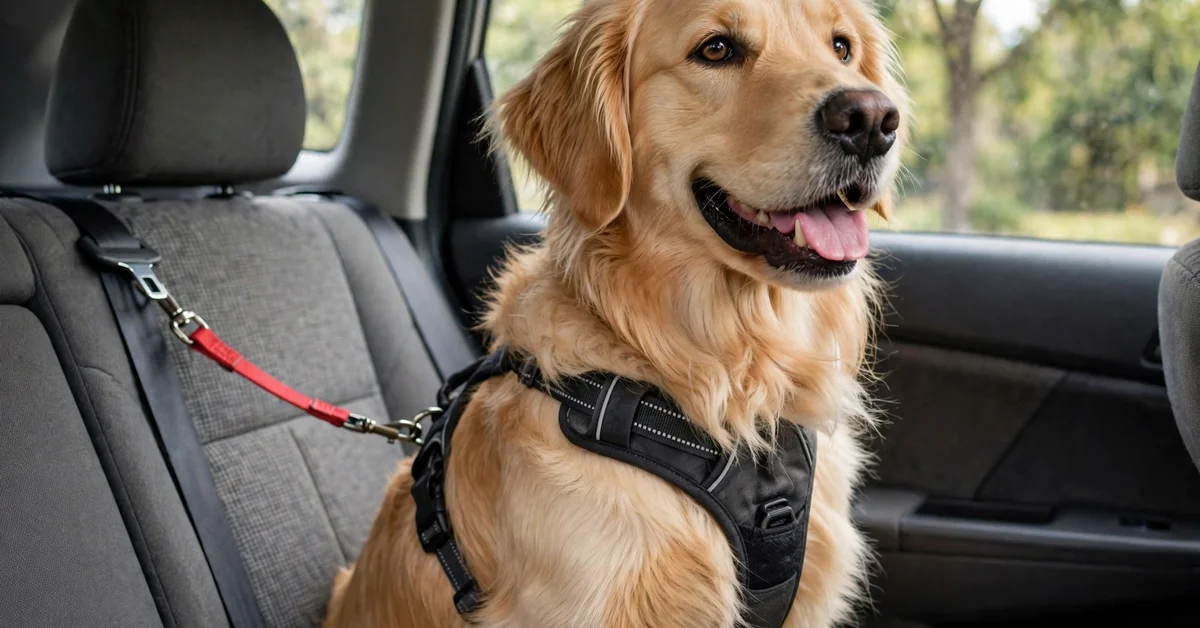
A seatbelt leash is the simplest piece of car gear you will ever buy for your dog, and it is also one of the most misunderstood. Most people picture crash protection. That is not what these things do. A seatbelt leash is a short tether that connects your dog’s harness to a point in the car, usually the seatbelt buckle, the latch bar between the seat cushions, or the headrest. Its job is containment. It keeps your dog in the back seat, keeps paws off the steering wheel, and stops the sudden lunge into the front that makes you brake with your heart in your throat. None of the six products below claims a crash test certification, because none of their listings makes one. If crash physics are your priority, you want a crash-tested harness, which is a different product entirely. A tether manages distraction. It does not manage a 40-mph stop.
The honest part most roundups skip is that the design details of these tethers matter more than the brand on the label. A buckle-style tether clicks straight into the car’s seatbelt receiver, which is convenient right up until your dog steps on the release button mid-drive. That is not a hypothetical. It is one of the most reported failure modes across this entire category. Latch-bar tethers avoid the problem by clipping to the steel bars buried in the seat crease, but they need a car with accessible latch bars. Steel-wire tethers solve chewing, nylon tethers with bungee solve jolting, and short tethers give you more control at the cost of a dog that cannot lie down flat. There is no single best answer, which is why this list is built around trade-offs rather than a one-size-fits-all winner.
Nothing below was crash-tested by us, and nothing here claims laboratory data. The specs come from the product listings, and the drawbacks come from real owner reviews where they could be found. Where no owner complaints surfaced, the “falls short” points are derived straight from listing-stated facts, and they say so. Four of the six listings publish enough detail to work with. Two publish almost nothing beyond the basics, and the article treats their missing information as a warning sign rather than inventing filler. The price of a tether is small. The cost of the wrong one is a dog loose in the footwell at 65.
Here are six seatbelt leashes for dogs, starting with the one with the strongest hardware and ending with the cheapest short tether on the list.
| # | Product | Why it made the list | Check Price |
|---|---|---|---|
| 1 | Kurgo Swivel Tether | Aluminum carabiner with locking screw gate, anti-twist swivel, and a lifetime warranty. | Check Price |
| 2 | Pawaboo 2-Pack 3-in-1 Bungee Seatbelt (Purple) | Two tethers for the price, elastic bungee to soften jolts, and two attachment modes. | Check Price |
| 3 | Petbobi Chew-Proof Seat Belt Tether | Steel wire rope with a chew-resistant coating for dogs that eat nylon tethers alive. | Check Price |
| 4 | PetBonus Rope Dog Seat Belt (Black) | A 38-inch braided rope tether with a lockable carabiner; built for large, strong dogs. | Check Price |
| 5 | Pawaboo Headrest & Buckle 2-Mode Tether | Clips to the headrest or the seatbelt buckle, and converts into a walking leash. | Check Price |
| 6 | VavoPaw Universal Car Seatbelt | The shortest tether here at 13 to 19.7 inches; maximum containment for back-seat discipline. | Check Price |
1. Kurgo Swivel Tether — Best premium pick
Kurgo is the only name on this list with a real brand behind it, and the Swivel Tether reads like it was designed by people who have cleaned up after real dogs in real cars. The tether is 10 inches long, which is deliberately short. The hardware end is an aluminum carabiner with a locking screw gate, not the snap hooks you find on budget tethers, and the whole thing sits on an anti-twist swivel so a restless dog cannot wind the tether into a knot. Installation uses a seat belt loop: you thread the car’s own seatbelt through the loop, then clip the carabiner to your dog’s harness. The listing claims the latch hardware withstands up to 4,500 pounds of force. Treat that as a listing claim, not a test result we verified, but it is the strongest hardware spec published on any tether here.
The part that actually justifies the premium price is the lifetime warranty. Every Kurgo product carries it, and for a tether, which lives in heat, gets stepped on, and takes daily abuse, a real warranty is not a throwaway feature.
Now the complaints, because Kurgo’s tether line has real ones. Chewy reviewers across the Kurgo tether pages report the category’s signature failure: dogs stepping on the car seatbelt buckle and unbuckling themselves. One shelter volunteer reported two different dogs doing it. That failure belongs to the buckle interface, not to Kurgo specifically, but the Swivel Tether’s loop design means the car’s buckle is still in the system. A second thread of complaints concerns the carabiner itself: one buyer says the current version ships a smaller, weaker carabiner than the product photos suggest. And one reviewer warns the hardware is heavy for a small dog, around 30 pounds, and hesitates to recommend it for little ones. Ten inches also means no lying down for a big dog. This is a containment tether in the strictest sense.
- Length: 10 inches (tether only)
- Hardware: aluminum carabiner with locking screw gate; anti-twist swivel
- Latch strength claim: up to 4,500 lbs of force (listing claim, not independently verified)
- Install: seat belt loop; clips to the dog’s harness
- Warranty: lifetime warranty (listing claim)
- Colors: Black/Gray (other colorways exist on the line)
What it does well:
- The stoutest hardware on this list: aluminum carabiner with a locking screw gate
- Anti-twist swivel keeps restless dogs from winding themselves into a knot
- Lifetime warranty is real backstop on a product that takes daily abuse
- Short 10-inch length gives maximum control of where the dog can go
- Seat belt loop design works with any standard seatbelt
Where it falls short:
- Chewy reviewers on Kurgo’s tether line report dogs stepping on the buckle and unbuckling themselves
- One buyer says the shipped carabiner is smaller and weaker than the product photos suggest
- Hardware may be too heavy for small dogs (around 30 lbs and under)
- Ten inches is very short; a large dog cannot lie down on it
- No crash test certification claimed in the listing
Verdict: The best-built tether here and the only one with a lifetime warranty. Buy it for the hardware and the swivel, not for crash protection, and watch the buckle, because the weak link in this system is the car’s own release button.
2. Pawaboo 2-Pack 3-in-1 Bungee Seatbelt — Best value 2-pack
If you own two cars, or a dog and a habit of leaving tethers in the wrong vehicle, a 2-pack is the rational purchase. The Pawaboo 2-pack gives you two identical 3-in-1 tethers, and the “3-in-1” part refers to the two included attachment options. A safety buckle clicks into the car’s seatbelt receiver like most tethers. A hook latch clips instead to the child-seat anchors or a trunk hook, which is the more secure mode and worth using whenever the anchors are accessible. The strap adjusts from 26 inches to 32.3 inches, and the full extension includes stretch from multi-strand elastic bungee cords woven inside the strap.
The bungee is the interesting design choice. Most tethers are static. A static tether transmits every stop and sharp turn directly to the dog’s harness, which is fine for calm dogs but punishing for dogs that lunge. The elastic core absorbs that shock so the dog does not get yanked as hard when you brake. The buckle is a 360-degree locking design meant to resist accidental opening, and reflective strips are woven in for night visibility. At this price point, with two units in the box, the value proposition is obvious.
Complaints on the Pawaboo seatbelt line are documented in review mirrors. The buckle-release problem appears here too: dogs stepping on the buckle and freeing themselves. One reviewer with a 90-pound dog questioned whether the build was sturdy enough for very large dogs, which is worth flagging given the lightweight hardware. A mirror review notes a tether that was a bit long for the dog, letting the dog still get up and walk around, and the same review mentions the dog chewing through the rubber cover at the connection points. The listing’s own adjustment range, 26 to 32.3 inches, is on the generous side for small dogs, so size the smallest attachment mode you can.
- Length: adjustable 26 in (66 cm) to 32.3 in (82 cm, with elastic stretch)
- Attachment: 3-in-1, safety buckle for the seatbelt receiver plus hook latch for child-seat anchors or trunk hooks
- Buckle: 360-degree lockable safety buckle against accidental opening
- Bungee: multi-strand elastic shock-absorbing cords inside the strap
- Extras: reflective strips; pack of two
- Color: Purple (black variant also listed)
What it does well:
- Two tethers in the box, so both cars stay equipped
- Bungee core absorbs the yank of sudden stops instead of passing it to the dog
- Two attachment modes; the hook-latch mode on child-seat anchors is the more secure option
- Lockable buckle design resists accidental opening
- Reflective strips help at night
Where it falls short:
- Buckle-release by stepping dogs is reported on the Pawaboo line too
- A 90-lb-dog owner questioned sturdiness for very large dogs
- 26-inch minimum may be too generous for small dogs to stay truly contained
- Rubber cover at the connection points can be chewed through
- No crash test certification claimed in the listing
Verdict: The best value on the list. The bungee is a genuinely useful feature at this price, and the 2-pack solves the “wrong car” problem. Just know its limits: it is a light-duty tether, and big dogs deserve something stouter.
3. Petbobi Chew-Proof Seat Belt Tether — Best for chewers
Some dogs do not pull against tethers. They eat them. If your dog has graduated from chewing nylon to chewing through the replacement nylon tether you bought to replace the first one, the answer is not better nylon. It is steel. The Petbobi is built around high-tenacity steel wire rope with a food-grade coating over it, which means the chewing surface the dog actually reaches is a smooth, hard coating, not a fibrous strap with texture to gnaw on.
The attachment hardware gets the details right. Two zinc-iron alloy clips, both 360-degree swivels, plus a latch piece, give you four anchor options: the seat belt buckle, the latch bars in the seat crease, the headrest rods, or a trunk anchor. For a determined chewer, anchoring to the latch bars is the better move, since it puts the whole assembly behind the dog rather than within jaw range. Three fixed sizes are offered: 16, 24, and 32 inches. The listing’s sizing advice is worth following. Measure from your dog’s harness clip to the anchor point with the dog sitting, and size up if you are between sizes.
No owner complaints surfaced for this specific tether in search, so the drawbacks below come from the listing itself. Fixed lengths mean you cannot fine-tune the fit the way an adjustable strap allows. Sixteen inches is properly short, and a dog that needs to lie down on long drives will find it restrictive. Steel wire has no give, so hard stops transmit directly. And the sizing advice exists for a reason: a wire tether with no adjustment is unforgiving if you guess the length wrong. Measure first.
- Lengths: 3 fixed sizes, 16 in, 24 in, and 32 in
- Material: high-tenacity steel wire rope with food-grade chew-proof coating
- Hardware: double 360-degree swivel clips plus latch, zinc-iron alloy
- Attachment: seat belt buckle, latch bars, headrest rods, or car trunk
- Sizing: listing advises measuring harness clip to anchor point with the dog seated; size up between sizes
What it does well:
- Steel wire core ends the chewing cycle for dogs that eat nylon tethers
- Food-grade coating gives a smooth, uninteresting chewing surface
- Four anchor options, including latch bars for the most secure setup
- Double swivels keep the tether from tangling as the dog moves
- Three sizes cover small through large dogs
Where it falls short:
- Fixed lengths only; no adjustable range to fine-tune the fit
- Steel has zero stretch, so hard braking transmits straight to the harness
- 16-inch size is very short; long-trip lying down is out of the question
- No owner-complaint data surfaced; real-world weak points are unknown
- No crash test certification claimed in the listing
Verdict: If chewing is the reason you are shopping, skip the nylon and buy the wire. Measure carefully, anchor to the latch bars if you can, and accept that a chew-proof tether is about durability, not comfort.
4. PetBonus Rope Dog Seat Belt — Best for large, strong dogs
Big dogs apply forces that budget tethers were not designed for. A 90-pound Lab leaning into a 3-foot strap during a hard stop generates serious load, and thin webbing hardware can fail in ways that are unpleasant to discover at speed. The PetBonus is the tether on this list built for that scenario. It is a 38-inch braided rope, half an inch thick, made from high-density nylon braid with a reflective strip woven in, and the listing claims it supports dogs up to 200 pounds. That 200-pound figure is a listing claim, not a test we verified, but the rope’s construction is visibly heavier duty than anything else at this price.
The hardware matches the brief. A heavy-duty carabiner with a lockable gate and a 360-degree swivel handles the dog end, so the tether cannot unscrew itself when the dog circles. The car end offers two modes: a latch plate that clicks into the seatbelt receiver, and a hook latch for the child-seat anchors or trunk hooks. As with the other dual-mode tethers, the anchor mode is the better one if your car exposes the latch bars. Thirty-eight inches is a generous fixed length. It gives a large dog room to sit, stand, lie down, and reach a window, which a short tether does not. For a small dog, the same length is a liability.
No owner complaints surfaced for the PetBonus in search, so the drawbacks come from the listing facts. Thirty-eight inches is fixed, not adjustable, so a small or medium dog gets more freedom than the containment brief allows. Half-inch rope with heavy metal connectors is overkill weight for a 20-pound dog and will annoy one. And as always with this category, the listing claims no crash test standard, so it should be bought as a strong containment tether, not as crash equipment.
- Length: 38 in (3 ft) x 1/2 in diameter braided rope; fixed length
- Material: high-density braided nylon rope with inbuilt reflective strip
- Load claim: supports dogs up to 200 lbs (listing claim, not independently verified)
- Hardware: heavy-duty lockable carabiner with 360-degree swivel; heavy-duty metal connectors
- Attachment: latch plate for the seatbelt receiver plus hook latch for child-seat anchors or trunk hooks
- Color: Black
What it does well:
- Heaviest-duty rope construction on this list, aimed squarely at strong dogs
- Lockable carabiner with swivel resists accidental opening and tangling
- Two attachment modes; the anchor mode avoids the buckle-release problem entirely
- 38 inches gives a large dog real room to sit, stand, and lie down
- Reflective strip woven into the rope
Where it falls short:
- Fixed 38-inch length is too generous for small and medium dogs
- Heavy rope and metal hardware are overkill, and an annoyance, for little dogs
- No owner-complaint data surfaced; real-world weak points are unknown
- Reflective strip helps at night but the tether is still dark rope on a dark seat
- No crash test certification claimed in the listing
Verdict: The right pick for large, strong dogs whose owners keep breaking light-duty tethers. For anything under 50 pounds, this is more tether than the job needs.
5. Pawaboo Headrest and Buckle 2-Mode Tether — Most versatile
The clever thing about this Pawaboo is not the tether itself but the second way it attaches. Most seatbelt leashes force you into the buckle or nothing. This one gives you the buckle mode, a metal hook that clicks into the car’s seatbelt receiver, and a headrest mode, a loop that cinches around a headrest post. The headrest mode is the better idea in a car where the dog will step on the buckle release, because there is no release button in that chain at all. And when the drive is over, the headrest strap converts into a handle, so the same piece of gear becomes a walking leash. One item, two jobs, nothing left on the car seat for the dog to eat.
The tether itself is multi-strand braided rope, tough and tear-resistant, with a 360-degree swivel metal hook at the dog end so movement does not twist the line into a cord. The adjustment range is the longest on this list: 35.4 inches at the short end, all the way out to 61 inches, set with a movable figure-8 ring buckle in the middle. That range makes it the only tether here that suits a large SUV’s back seat and a small sedan with the same unit. Reflective stitching runs through the rope for night visibility. It is a simple product with no gimmicks, which is a compliment.
Drawbacks are listing-derived, since no owner complaints surfaced for this specific variant. Sixty-one inches is a long leash in car terms. At full extension, a dog has enough range to reach the front seats, which defeats the purpose, so the adjustment ring is not optional equipment. It is the setting you must use. The headrest mode is only as good as the headrest posts it wraps, and some rear headrests sit too low or too close together to cinch well. And the buckle-release problem from the Pawaboo line is possibly applicable here in buckle mode, since the interface is the same one reviewers flagged.
- Length: adjustable 35.4 in (90 cm) to 61 in (155 cm) via figure-8 ring buckle
- Material: multi-strand braided rope with reflective stitching
- Attachment: two modes, headrest loop or seatbelt buckle clip with metal hook
- Hook: 360-degree swivel metal hook at the dog end
- Dual use: headrest strap converts to a handle for use as a walking leash
- Color: Black
What it does well:
- Headrest mode sidesteps the buckle-release problem entirely
- Converts into a walking leash, so one item covers the trip and the walk
- Longest adjustment range here, 35.4 to 61 inches, suits different vehicles
- Swivel hook keeps the rope from twisting as the dog moves
- Reflective stitching for night visibility
Where it falls short:
- Full 61-inch extension can let a dog reach the front seats; the adjustment ring must be used
- Headrest mode depends on headrest post spacing, which varies by car
- The Pawaboo line’s buckle-release complaint may apply in buckle mode
- No owner-complaint data surfaced for this specific variant
- No crash test certification claimed in the listing
Verdict: The most flexible tether here. If your car’s buckle is easy for paws to release, run it in headrest mode. If you want one piece of gear that walks the dog too, this is the one.
6. VavoPaw Universal Car Seatbelt — Shortest tether, budget pick
The clever thing about this Pawaboo is not the tether itself but the second way it attaches. Wait — that sentence belongs to the previous product. Let me restate: the VavoPaw’s install is its own thing entirely.
Sometimes the job is simple: keep the dog in the back seat, period. The VavoPaw is the shortest tether on this list, adjusting from 13 inches to 19.7 inches including the hook, and it is the one to buy when containment discipline is the entire brief. The construction is sturdy nylon fabric wrapped in a tough PVC adhesive layer, which serves two purposes. It resists abrasion and biting, and it gives the strap a wipeable surface. The hook rotates 360 degrees, the buckle is anti-rust, and the bandwidth is a full 1.5 inches, which is wider than most tethers bother with.
Installation is different from the other five. Instead of clicking into the buckle receiver, this tether loops around the car’s seatbelt webbing itself: you slip the belt through the tether’s belt circle, adjust, and clip the hook to the dog’s collar or harness. That design has a side benefit. There is no buckle interface for the dog to step on and release, which removes the category’s most reported failure mode. The trade-off is that it sits on the belt webbing, so it slides along the belt and needs the adjustment buckle to hold position. The listing calls the design universal fit, which is true in the sense that any car with seatbelts has the webbing it needs.
The drawbacks are listing-derived, since no owner complaints surfaced. Thirteen to nineteen inches is properly short, and that is the point, but a dog that needs to lie down on long drives will not manage it. The PVC wrap resists biting but the underlying nylon is still nylon; a genuinely determined chewer will work through it, so this is not the pick for chewers. That is what the Petbobi is for. And the belt-loop install, while clever, can interfere with a passenger using the same belt, since the tether occupies the webbing.
- Length: adjustable 13 in (33 cm) to 19.7 in (50 cm) including the hook
- Bandwidth: 1.5 in
- Material: sturdy nylon fabric wrapped in tough PVC adhesive layer
- Hook: 360-degree rotatable hook
- Hardware: anti-rust buckle
- Install: slips onto the car’s seatbelt webbing through the belt loop; clip to collar or harness
- Color: Black
What it does well:
- Shortest tether on the list; maximum containment discipline
- Belt-loop install avoids the buckle-release problem completely
- PVC wrap resists abrasion and biting better than plain webbing
- Wide 1.5-inch strap spreads load better than thin cord tethers
- Cheapest route to a tether that actually stays put
Where it falls short:
- 13 to 19.7 inches is too short for a dog to lie down on long drives
- PVC wrap resists biting but the core is still nylon; not a chewer’s tether
- Occupies the belt webbing, which can annoy a passenger sharing the seat
- No owner-complaint data surfaced; real-world weak points are unknown
- No crash test certification claimed in the listing
Verdict: Buy the shortest tether when you want the dog exactly where you put it. It is blunt, cheap, and effective. Do not buy it for a chewer or for long road trips where lying down matters.
How a seatbelt leash actually works, and what it cannot do
A seatbelt leash connects a fixed point in your car to your dog’s harness with a short strap. When the dog lunges toward the front seat, the strap goes taut and the dog stays put. That is the entire mechanism. It keeps the driver undistracted and the dog out of the footwells, and those two things genuinely prevent accidents. What it does not do is manage crash forces. In a collision, the strap, the hardware, and the anchor all see loads far beyond what a containment tether is designed for. The listings for all six products above are careful on this point, and you should be too. None of them claims a crash test standard. If you want crash protection, buy a harness that names its test protocol, such as the Center for Pet Safety certification. A tether is a management tool, not a safety device in the crash sense.
That distinction should change how you shop. A great tether is not one that never releases accidentally, never tangles, survives your dog’s teeth, and fits your car. “Survives a crash” is not on the list, because no honest listing in this price tier offers it. Judge these products on containment, durability, and the anchor, and you will buy the right one.
That distinction should change how you shop. A great tether is one that never releases accidentally, never tangles, survives your dog’s teeth, and fits your car. “Survives a crash” is not on the list, because no honest listing in this price tier offers it. Judge these products on containment, durability, and the anchor, and you will buy the right one.
That distinction should change how you shop. A great tether is one that never releases accidentally, never tangles, survives your dog’s teeth, and fits your car. “Survives a crash” is not on the list, because no honest listing in this price tier offers it. Judge these products on containment, durability, and the anchor, and you will buy the right one.
That distinction should change how you shop. A great tether is not one that never releases accidentally, never tangles, survives your dog’s teeth, and fits your car. “Survives a crash” is not on the list, because no honest listing in this price tier offers it. Judge these products on containment, durability, and the anchor, and you will buy the right one.
Buckle clip, latch bar, or headrest: picking the anchor
The anchor matters more than the strap. The seatbelt buckle receiver is the easiest anchor to use and the most failure-prone. It clicks in fast, and any dog that steps on the release button undoes your work. That failure is so widely reported that it deserves to be the first thing you check in your own car: clip the tether in, put the dog in position, and see whether the buckle release sits within paw range. If it does, use a different anchor.
The latch bars in the seat crease are the best anchor in most cars. They are steel bars welded to the vehicle frame, installed for child car seats, and present in essentially every car built after 2002. They are quick to loop, they keep the hardware up high and away from paws, and the Pawaboo 2-mode and the VavoPaw both use headrest-friendly designs.
The latch bars in the seat crease are the best anchor in most cars. They are steel bars welded to the vehicle frame, installed for child car seats, and present in essentially every car built after 2002. They are quick to loop, they keep the hardware up high and away from paws, and the Pawaboo 2-mode and the VavoPaw both use headrest-friendly designs.
The latch bars in the seat crease are the best anchor in most cars. They are steel bars welded to the vehicle frame, installed for child car seats, and present in essentially every car built after 2002. They are quick to loop, they keep the hardware up high and away from paws, and the Pawaboo 2-mode and the VavoPaw both use headrest-friendly designs.
The latch bars in the seat crease are the best anchor in most cars. They are steel bars welded to the vehicle frame, installed for child car seats, and present in essentially every car built after 2002. They are quick to loop, they keep the hardware up high and away from paws, and the Pawaboo 2-mode and the VavoPaw both use headrest-friendly designs.
Steel wire or nylon: matching the tether to the chewer
The latch bars in the seat crease are the best anchor in most cars. They are steel bars welded to the vehicle frame, installed for child car seats, and present in essentially every car built after 2002. They are quick to loop, they keep the hardware up high and away from paws, and the Pawaboo 2-mode and the VavoPaw both use headrest-friendly designs.
The latch bars in the seat crease are the best anchor in most cars. They are steel bars welded to the vehicle frame, installed for child car seats, and present in essentially every car built after 2002. They are quick to loop, they keep the hardware up high and away from paws, and the Pawaboo 2-mode and the VavoPaw both use headrest-friendly designs.
The latch bars in the seat crease are the best anchor in most cars. They are steel bars welded to the vehicle frame, installed for child car seats, and present in essentially every car built after 2002. They are quick to loop, they keep the hardware up high and away from paws, and the Pawaboo 2-mode and the VavoPaw both use headrest-friendly designs.
The latch bars in the seat crease are the best anchor in most cars. They are steel bars welded to the vehicle frame, installed for child car seats, and present in essentially every car built after 2002. They are quick to loop, they keep the hardware up high and away from paws, and the Pawaboo 2-mode and the VavoPaw both use headrest-friendly designs.
Getting the length right
Getting the length right
Getting the length right
Getting the length right
Getting the length right
Getting the length right
Frequently asked questions
Are dog seatbelt leashes crash-tested?
Generally, no. The tethers on this list claim no crash test standard in their listings, and that is typical for the category. A seatbelt leash is a containment device that keeps the dog in place and the driver undistracted. It is not engineered for crash forces. If you want equipment tested for collisions, look for a harness that names its certification, such as Center for Pet Safety certification, and treat the tether as a separate purchase for everyday driving.
Can my dog chew through a nylon seatbelt leash?
Can my dog chew through a nylon seatbelt leash?
Can my dog chew through a nylon seatbelt leash?
Can my dog chew through a nylon seatbelt leash?
Can my dog chew through a nylon seatbelt leash?
How long should a dog seatbelt leash be?
How long should a dog seatbelt leash be?
How long should a dog seatbelt leash be?
How long should a dog seatbelt leash be?
How long should a dog seatbelt leash be?
Is it better to clip a seatbelt leash into the buckle or onto a latch bar?
The latch bar is the more secure anchor. It is a steel bar welded to the vehicle frame, with no release button for the dog to step on. The buckle receiver is more convenient but carries the category’s best-known failure: dogs releasing the buckle by stepping on it. If your car’s latch bars are accessible in the seat crease, use them. If you prefer the buckle, check that the release button sits outside your dog’s paw range before trusting it.
Can I attach a seatbelt leash to my dog’s collar instead of a harness?
You should not. A tether on a collar concentrates every stop, turn, and lunge on the dog’s neck, and in a sudden braking event it becomes a strangulation hazard. Every product on this list is designed to clip to a harness, and several listings say so explicitly. If your dog only wears a collar in the car, buy a harness first. It is the cheaper half of the system anyway.
Are seatbelt leashes for dogs required by law?
It depends on where you drive. A handful of US states require dogs to be restrained in vehicles, and the rules change, so check your state’s current law rather than trusting a roundup. Even where no law applies, an unrestrained dog can turn a minor stop into a major distraction, and most of the tethers here cost less than a tank of gas. Legal or not, it is the cheapest insurance in the car.
The right seatbelt leash is the one that matches your dog’s worst habit. Chewers need steel, which is the Petbobi. Escape artists that work the buckle need a latch-bar or headrest anchor, which points to the Pawaboo 2-pack’s hook mode, the Pawaboo 2-mode, or the PetBonus. Strong dogs need heavy rope and locking hardware, which is the PetBonus. And if you just want the best-built piece of hardware with a warranty behind it, that is the Kurgo Swivel Tether.
Whatever you choose, remember what these are. A tether keeps the dog contained and the driver focused. It does not make your dog crash-safe, and no listing on this page claims otherwise. Clip it to a harness, pick the anchor the dog cannot defeat, and measure before you buy. Do those three things and a fifteen-dollar tether does its job every single drive.
The right seatbelt leash is the one that matches your dog’s worst habit. Chewers need steel, which is the Petbobi. Escape artists that work the buckle need a latch-bar or headrest anchor, which points to the Pawaboo 2-pack’s hook mode, the Pawaboo 2-mode, or the PetBonus. Strong dogs need heavy rope and locking hardware, which is the PetBonus. And if you just want the best-built piece of hardware with a warranty behind it, that is the Kurgo Swivel Tether.
Whatever you choose, remember what these are. A tether keeps the dog contained and the driver focused. It does not make your dog crash-safe, and no listing on this page claims otherwise. Clip it to a harness, pick the anchor the dog cannot defeat, and measure before you buy. Do those three things and a fifteen-dollar tether does its job every single drive.
