

The honest note up front: a “Gentle Leader leash” isn’t a special category of leash — it’s the question of what you clip to a headcollar, and the answer matters more than with any other walking tool. A headcollar steers the head, which means the leash is the steering column. Clip on the wrong leash — a retractable, a bungee, a flimsy dollar-store lead — and you get the worst of both worlds: a dog that can still lunge, and a neck taking the force.
The good news: there is no special leash you have to find. Below are the compatible leashes you can actually buy, including the dual-clip designs that replicate the headcollar’s backup-clip function (one clip for the headcollar’s control ring, one for the flat collar as backup). This guide covers three: the dual-clip training leash, the simple fixed leash PetSafe itself recommends, and the cheap safety add-on every headcollar user should know about.
Pet Travel Items is reader-supported. When you buy through links on this page, we may earn a commission at no extra cost to you. Our picks are driven by documented owner feedback, never by commission rates.
Leashes for Headcollars at a Glance
| # | Product | Key spec | Best For | |
|---|---|---|---|---|
| 1 | Halti Training Leash | Double-ended · 2 clips · ~2 m | Best dual-clip leash | Check Price |
| 2 | PetSafe Nylon Leash (6 ft) | 3/4″ nylon · matches GL webbing | Simple fixed leash | Check Price |
| 3 | PetBonus Backup Safety Clip | Double-ended collar connector | Headcollar backup | Check Price |
Prices shift constantly — check before you buy. Sizes are manufacturer figures.
1. Halti Training Leash — Best Dual-Clip Training Leash
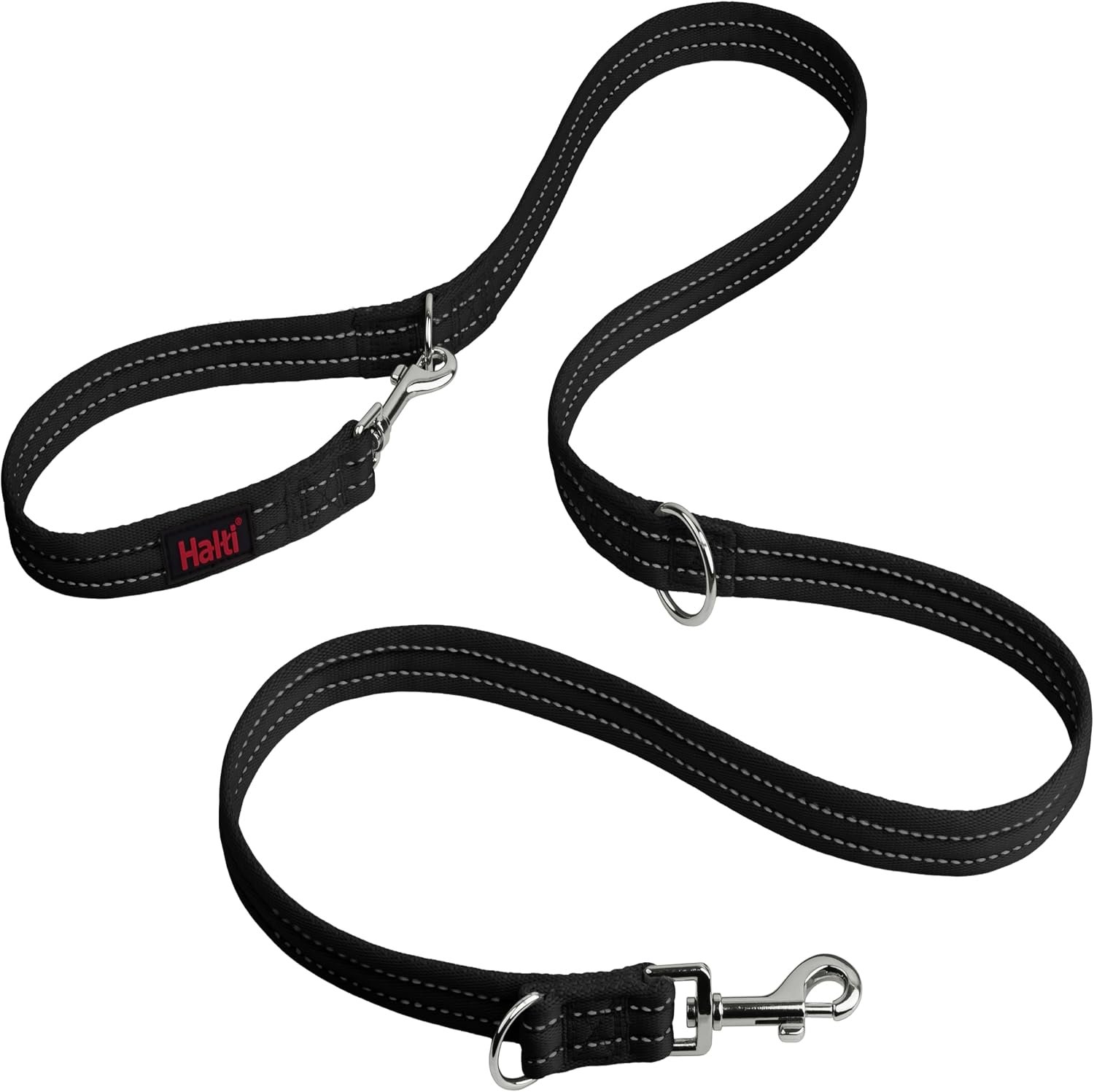
Halti’s Training Leash is the most widely available dual-clip leash actually designed for headcollar work, and it’s the one Halti itself recommends pairing with its headcollar. Two trigger clips let you connect to two points at once — headcollar plus flat collar, or front and back of a harness — and Halti advertises 7 configurations: double-clipped, long-line, over-the-shoulder, waist-worn, tethered, and more. It’s lightweight premium webbing with a 1-year manufacturer warranty, and the Small runs about 2 meters (roughly 6.5 feet).
The real complaints: it’s long. At 2 m with multiple adjustment loops, owners report it’s awkwardly lengthy for close road walking — one detailed reviewer noted that even at its shortest it’s too long for what they’d call road length, forcing them to wrap excess leash around their hand. And there’s no dedicated handle: a verified Chewy reviewer gave the double-ended lead one star specifically because, clipped front-and-back, there’s no firm grip point for controlling a strong dog. It also tangles more readily than a single-clip leash. None of this makes it bad — it’s the right tool for the headcollar backup job — but know what you’re getting.
Specs: double-ended · 2 trigger clips · ~2 m (78.7″) on Small · lightweight webbing · 7 advertised configurations · 1-year warranty.
Pros: true dual-clip backup for headcollars; versatile configurations; light and strong; pairs with any headcollar brand.
Cons: long and handle-less — awkward for close control; excess leash needs wrapping; tangles more than single-clip leads.
Verdict: The best verified dual-clip leash for headcollar users — just expect to manage the length. Check the price on Amazon.
2. PetSafe Nylon Leash (6 ft, 3/4″) — Best Simple Fixed Leash
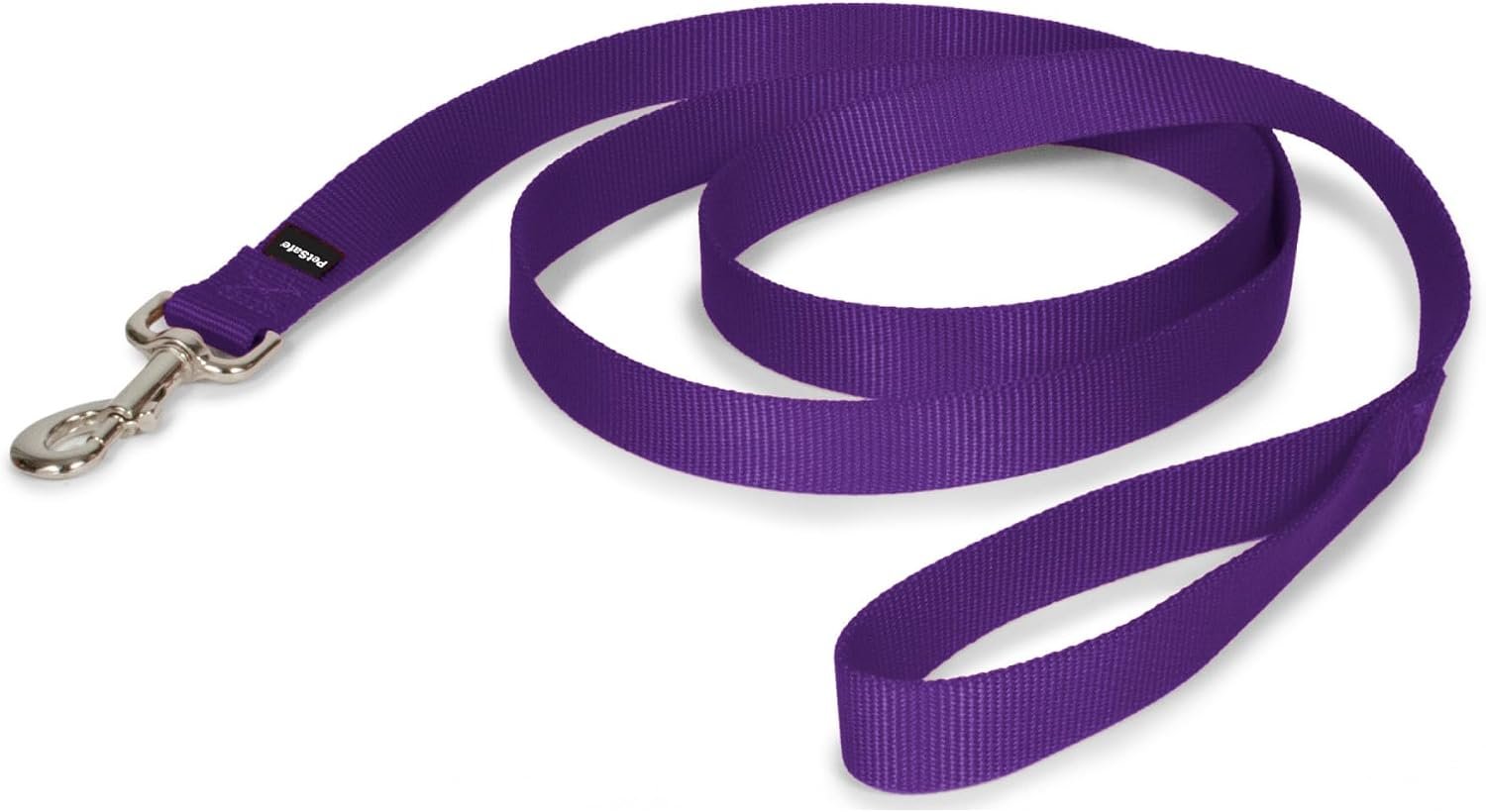
Sometimes the right answer is boring: a plain, fixed-length nylon leash. PetSafe’s own product description says this leash is “perfectly matched to the nylon webbing of Gentle Leader Headcollars,” and it comes in the two lengths headcollar trainers actually recommend — 4 or 6 feet — in 3/8″, 3/4″, and 1″ widths. The 3/4″ x 6 ft is the sweet spot for medium and large dogs: soft durable nylon, heavy-duty stitching, and a nickel-plated zinc alloy bolt snap. It ranks in Amazon’s top 10 Standard Dog Leashes.
The honest limitations: it’s a single-clip leash, so it gives you zero backup if the dog slips the headcollar — pair it with pick #3 if that worries you. The handle is a basic nylon loop, not padded, which matters on long walks with a puller. And width matters: the 3/8″ version is too slight for a strong large dog; match the width to the dog. It’s also just a leash — no dual-clip versatility, no reflectivity. But for the core job (a fixed, non-retractable connection to a headcollar), it’s exactly right and inexpensive.
Specs: 4 or 6 ft lengths · 3/8″, 3/4″, 1″ widths · nylon with nickel-plated zinc alloy snap · comfort hand loop.
Pros: fixed length (the headcollar-safe choice); PetSafe-matched to Gentle Leader webbing; cheap; proven basic.
Cons: single clip — no backup connection; unpadded handle; choose width carefully for strong dogs.
Verdict: The simple, correct leash for headcollar walking — add the backup clip below for full security. Check the price on Amazon.
3. PetBonus Backup Safety Clip — Best Headcollar Safety Add-On
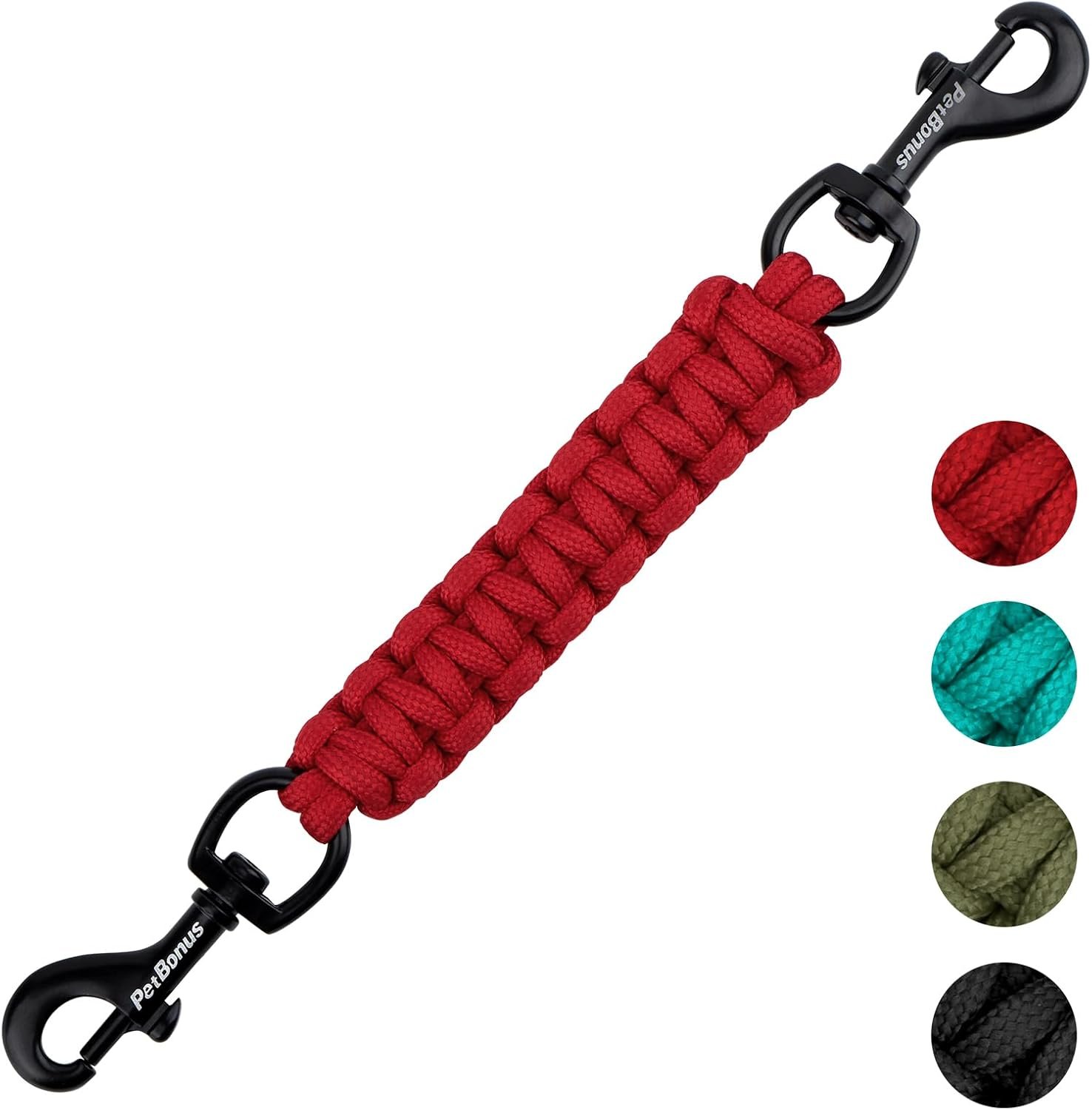
This is the $10-ish insurance policy: a short double-ended strap with 360° rotating clips on both ends that connects the headcollar to the dog’s flat collar. If the dog paws off the nose loop or backs out of the headcollar, the leash (clipped to the headcollar ring) stays connected to the dog via the collar. It fits headcollars, harnesses, and flat collars alike, comes in 17 colors, and the clips need deliberate vertical pressure to release — designed so a dog can’t pop them accidentally.
Keep expectations realistic: it’s a 7–8″ backup tether, not a leash — it does nothing on its own. It’s also a third-party accessory, so quality control is “check it on arrival” territory: inspect the stitching and clip action before trusting it. But for the price of a coffee, it closes the exact failure mode that makes experienced headcollar users nervous, and it works with whatever leash you already own.
Specs: double-ended backup strap · 360° rotating clips · ~7–8″ adjustable · fits headcollars, harnesses, collars · 17 colors.
Pros: closes the back-out failure mode; works with any leash; cheap; deliberate-release clips.
Cons: not a leash by itself; third-party quality — inspect on arrival; one more thing to clip on.
Verdict: Cheap insurance for any headcollar setup — buy it with whichever leash you choose. Check the price on Amazon.
How to Choose a Leash for a Headcollar
Fixed length is non-negotiable. Retractable leashes and headcollars are a dangerous combination — a dog hitting the end of 16 feet of cord stops on their neck. Trainers and manufacturers agree: use a fixed 4–6 foot leash, full stop.
Prioritize the backup connection. A headcollar a dog can slip is a leash attached to nothing. The ideal setup connects you to two points: headcollar ring plus flat collar (dual-clip leash), or headcollar plus a backup strap to the collar. In an unfamiliar travel environment — rest stops, trailheads, vet parking lots — this is the feature that prevents a loose dog.
Match leash length to the scenario. Six feet is the everyday standard: enough freedom for sniffing, short enough for control. Four feet is better for crowded areas and strong pullers. Two-meter multi-use leashes are versatile but fiddly — if you mostly walk roads and sidewalks, simpler is better.
Match width and hardware to the dog. A 3/8″ leash with a small bolt snap is fine for a 20-lb dog and irresponsible for an 80-lb puller. Check the clasp: it should be a proper bolt snap or trigger clip, not a flimsy spring clip, and the stitching at the handle and clip should be box-stitched and substantial.
Skip the bungee. Bungee/elastic leashes are popular for jogging, but with a headcollar the stretch defeats the steering — the dog gets a running start before the leash engages, and the snap-back lands on the neck. Use bungees with harnesses, never headcollars.
Inspect the backup gear. Clips, stitching, and swivels are wear items. Before a trip, check the backup strap’s clips and the leash’s snap for smooth action and solid stitching. A ten-second check beats a roadside chase.
Bottom line: the Halti Training Leash is the best dual-clip leash you can actually buy for headcollar work. Pair the simple PetSafe Nylon Leash with the PetBonus backup clip for the cheapest fully safe setup.
Frequently Asked Questions
Can I use any leash with a Gentle Leader headcollar?
Any fixed-length leash, yes — the headcollar has a standard metal control ring under the chin. What’s not optional: it must be fixed length (4–6 ft), never retractable. A dual-clip leash or a backup strap to the flat collar is strongly recommended so a slipped headcollar doesn’t mean a loose dog.
What is a dual-clip leash and why does it matter for headcollars?
A leash with a clip on each end instead of a handle on one end. One clip goes to the headcollar’s control ring, the other to the flat collar (or harness), giving two points of connection. If the dog backs out of the headcollar, you’re still attached via the collar. It’s the standard safe setup for headcollar walking.
How long should the leash be for headcollar training?
Six feet for everyday walking, four feet for crowded areas or strong pullers. Longer lines (15–30 ft) have training uses but defeat the headcollar’s close steering and increase neck-injury risk if the dog bolts — keep long-line work to harnesses.
Can I clip the leash to both the headcollar and a harness?
Yes — this is a popular travel setup: one clip to the headcollar ring, one to a harness front or back clip. You get head steering plus body security, and the harness acts as the backup if the headcollar slips. A double-ended leash like the Halti is made for exactly this.
Do I really need a backup clip?
If your dog has ever pawed at the headcollar or you’re walking anywhere a loose dog would be dangerous — highways, unfamiliar towns, crowded trailheads — yes. It’s a few dollars, weighs nothing, and covers the one failure mode headcollars actually have.
